Custom Semiconductor Heat Sink Solutions: Advanced Manufacturing for High-Performance Electronics
In the era of rapidly increasing power densities, overheating remains the primary bottleneck for electronic performance. For engineers and procurement managers, selecting the right semiconductor heat sink is no longer just about buying a piece of metal; it is about precise thermal resistance management. This article explores advanced cooling strategies, manufacturing technologies, and design considerations for modern semiconductor applications.
Takeaway
semiconductor heat sinks must evolve to handle the high heat flux of modern chips like IGBTs, SiC, and GaN devices.
Advanced manufacturing processes like skiving and cold forging offer superior performance compared to traditional extrusion.
Material innovation, including copper alloys and vapor chambers, is critical for reducing thermal resistance.
Ecothemgroup utilizes CFD simulation to optimize designs for specific airflow and space constraints.
The Evolving Challenge: Thermal Management in Semiconductors
A semiconductor heat sink is the first line of defense against thermal runaway. As the industry transitions from standard Silicon to Silicon Carbide (SiC) and Gallium Nitride (GaN), devices are becoming smaller but generating significantly more heat per square centimeter.
Effective thermal management is crucial not just for preventing failure, but for enabling these devices to operate at their peak switching frequencies. A well-designed heat sink reduces the junction-to-case thermal resistance ($R_{th-jc}$), directly impacting the lifespan and reliability of data centers, automotive inverters, and power supplies.
Advanced Manufacturing Technologies for Semiconductor Heat Sinks
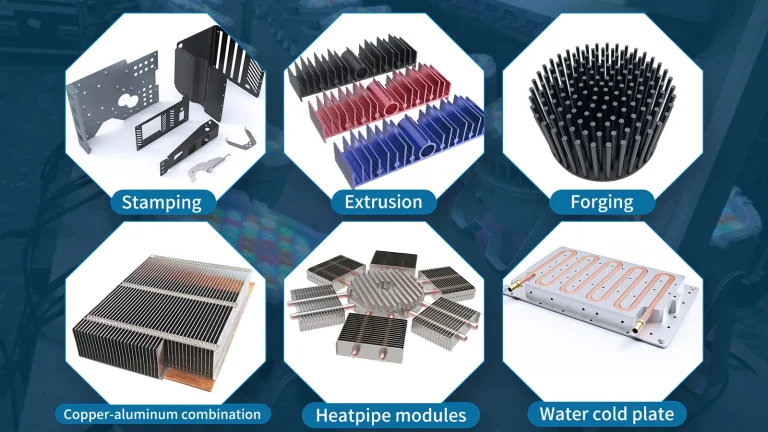
Standard aluminum extrusion is often insufficient for high-power applications. As a specialized factory, Ecothemgroup employs advanced manufacturing techniques to maximize surface area and cooling efficiency:
1. Skived Fin Technology
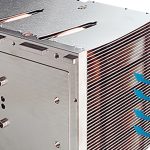
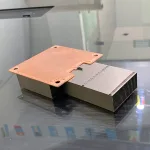
For applications requiring high fin density in a limited space, skived fin heat sinks are the superior choice. This process involves slicing fins directly from a solid block of copper or aluminum.
SEO Benefit: Unlike bonded fins, skived fins have zero interface thermal resistance, making them the ideal semiconductor heat sink for high-heat-flux components.
Application: Server CPUs and GPU cooling plates.
2. Cold Forging
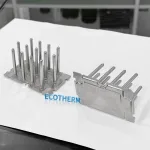
Cold forging creates pin-fin heat sinks by compressing metal under high pressure. This aligns the grain structure of the material, improving thermal conductivity by up to 15% compared to die-casting.
Key Advantage: Excellent for omnidirectional airflow environments, such as LED lighting or naturally convected power modules.
3. Bonded Fin Design
When the required aspect ratio (fin height vs. gap) exceeds the limits of extrusion, bonded fin heat sinks are the solution. We use thermal epoxy or brazing to attach fins to a base plate, allowing for massive surface area improvements.
Material Selection: Aluminum vs. Copper
Choosing the right material is a balance of weight, cost, and thermal performance.
| Material | Thermal Conductivity | Key Characteristic | Ideal Use Case |
| Aluminum 6063 | ~200 W/m·K | Lightweight, Cost-effective | Standard semiconductor heat sink applications, consumer electronics. |
| Copper C1100 | ~385 W/m·K | Superior Conductivity | High-power IGBTs, base plates for spreading heat rapidly. |
While aluminum is the industry standard, high-performance semiconductor devices often require Hybrid Designs. For instance, a copper base plate (to spread heat fast) combined with aluminum fins (to dissipate heat to the air) offers the best price-performance ratio.
Innovations in Cooling: Liquid and Vapor Technologies
For power densities exceeding 50W/cm², air cooling hits a physical limit.
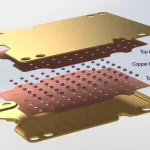
Vapor Chambers: These act as “super-conductive” planar heat pipes, spreading heat evenly across the base of the semiconductor heat sink to eliminate hot spots.
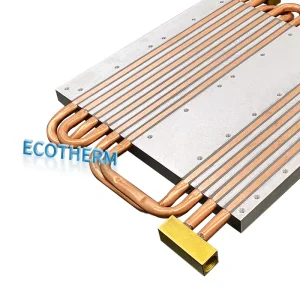
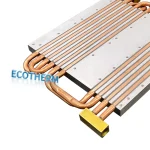
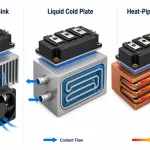
Liquid Cold Plates: Featuring internal microchannels, these are essential for electric vehicle (EV) power electronics and high-performance computing (HPC), where liquid coolant actively removes heat from the source.
Optimizing Performance with CFD Modeling
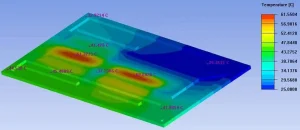
At Ecothemgroup, we don’t just manufacture; we optimize. Using Computational Fluid Dynamics (CFD) simulation, we can predict airflow patterns and thermal hotspots before a prototype is ever cut.
This allows us to fine-tune the geometry of the semiconductor heat sink—adjusting fin spacing, thickness, and shape—to ensure compatibility with the specific semiconductor device and the system’s airflow characteristics.
Industry Trends and Applications
The demand for custom semiconductor heat sinks is surging in key sectors:
Automotive: Cooling SiC inverters in Electric Vehicles to increase range and charging speed.
Renewable Energy: Managing heat in solar inverters and wind turbine controllers.
Telecommunications: 5G base stations require compact, lightweight, yet highly efficient thermal solutions.
People Also Ask (FAQ)
What is the best material for a semiconductor heat sink?
While Copper offers the best thermal conductivity (~385 W/m·K), Aluminum is lighter and cheaper. The “best” material depends on the thermal density of the semiconductor; high-power devices often use copper bases with aluminum fins.
How do you calculate the required thermal resistance?
You calculate thermal resistance ($R_{th}$) by taking the maximum junction temperature, subtracting the max ambient temperature, and dividing by the power dissipated ($P_d$). A custom semiconductor heat sink is designed to meet this specific $R_{th}$ value.
Why choose a custom heat sink over an off-the-shelf part?
Standard parts often fail to fit specific spatial constraints or handle concentrated heat loads. A custom solution from Ecothemgroup ensures the fin geometry and base thickness are optimized for your specific semiconductor device and airflow conditions.