Analysis of the Heat Dissipation Principles of High-Power LED Automotive Lights ————Heat-conducting materials and heat sinks
The working principle of thermal interface materials is the same, but according to the actual needs of different products, there are mainly three types of products available on the market:
Thermal Grease
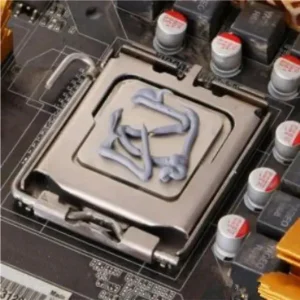
A certain type of thermal grease
Thermal grease is the most widely used thermal interface material, also known as thermal paste or thermal compound. It belongs to high thermal conductivity, electrically insulating silicone-based materials. Thermal grease offers high thermal conductivity, excellent heat transfer performance, good electrical insulation, a wide operating temperature range, stable performance, low viscosity, and easy application.
In practical use, it is mainly applied between two closely fitted parts, squeezing out as much air gap as possible between the components to achieve optimal heat conduction. However, it is well known that silicone-containing products are prone to volatilization over time. After a certain service life, thermal grease may solidify and form gaps, significantly reducing its thermal performance.
Thermal Silicone Gel
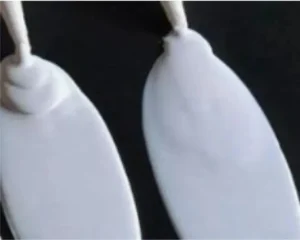
A certain type of thermal conductive adhesive
The advent of thermal silicone gel has addressed the evaporation issue associated with thermal grease, while retaining the other advantages of thermal grease. It offers excellent thermal performance, with a cured thermal conductivity of 1.1–1.5 W/mK, providing strong assurance for heat dissipation in electronic products. It also features superior electrical properties, aging resistance, and resistance to thermal cycling, thereby extending product lifespan. Thermal silicone gel has a certain level of adhesion, especially good bonding with electronic components, aluminum, PVC, and PBT plastics, ensuring good sealing and adhesion. Because thermal silicone gel cures, it does not suffer from volatilization or cracking like thermal grease, making it suitable for products with higher lifespan requirements.
Thermal Pads
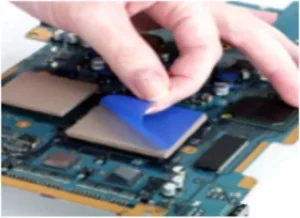
A certain type of thermal conductive gasket
Thermal pads have certain flexibility, good insulation, and compressibility, and are specifically designed to transfer heat through gaps. They can fill gaps to facilitate heat transfer between the heat-generating parts and the heat dissipation components. Thermal pads are mostly used in driver circuit board designs within lighting fixtures and in some medium-power FR4 circuit boards, especially where circuit protection is required. They are less commonly used in high and low beam LED modules because high-power modules aim to minimize gaps in thermal design, making thermal pads unsuitable.
Heatsinks
Die casting
Aluminum extrusion
Forging
Process
Material
Thermal Conductivity
Model Complexity
Surface Treatment
Mold Cost
Surface Treatment Cost
Appearance
Die Casting
ADC6/10/12
146/100/92
Complex
Anodizing/Painting
High
High
Poor
Aluminum Extrusion
Al 6063
200
Simple
Anodizing/Painting
Low
Medium
Good
Forging
Al 1070
230
Medium
Anodizing/Painting
Medium
Medium
Good
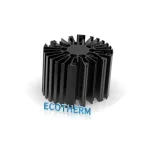
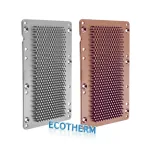
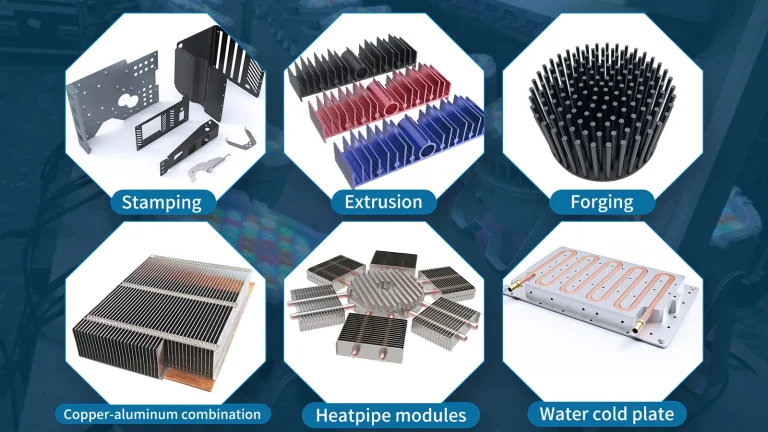
The heatsink is arguably the most important component in the entire module design. In this design phase, it is necessary to determine the heatsink manufacturing method, shape, and evaluate whether a fan is needed. The table below introduces the differences among common heatsink manufacturing processes.
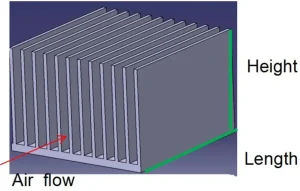
In addition, the fin height and length of the heatsink, as well as the airflow velocity around it, all have certain effects on the temperature of the LED module. Below is a brief analysis of how each key dimension of the classic heatsink shown in the illustration impacts its heat dissipation performance:
A typical heat sink design
Junction temperature is a function of height
As shown in the above figure, the heat dissipation area increases further with the rise in fin height, while the temperature at the heat source continues to decrease. However, it is important to note that the temperature reduction is not linear; when the fin height exceeds 80mm, the temperature drop becomes negligible. At this point, blindly increasing the fin height is meaningless.
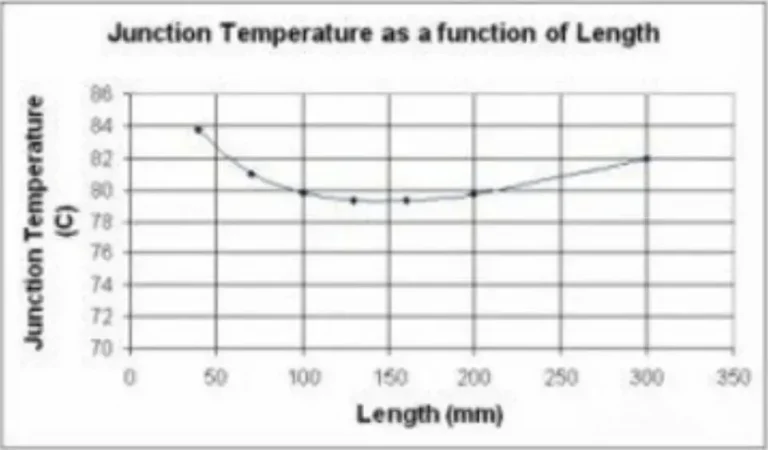
Junction Temperature as a function of Length
Increasing the length in the longitudinal direction also enlarges the heatsink’s surface area, achieving a certain cooling effect. However, beyond a certain length, the temperature actually rises. This is because, under natural convection conditions, the airflow is driven by the temperature difference and generally remains slow, resulting in laminar flow. From fluid mechanics, we know that laminar flow has a well-defined boundary layer. As the heatsink length increases, the boundary layer thickens and, once it fills the gaps between the fins, air circulation is blocked, leading to a decline in heat dissipation performance. Therefore, when designing heatsinks with large lengths, the fins are typically interrupted at certain intervals to disrupt the boundary layer buildup, allowing better airflow and ensuring the heat dissipation performance can be fully realized.
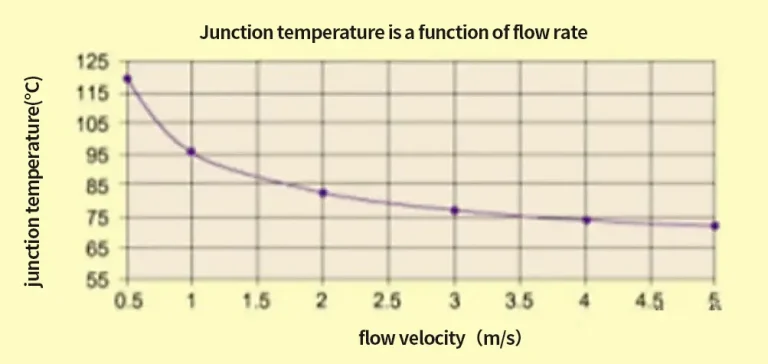
The junction temperature is a function of the flow velocity
The last diagram shows the relationship between temperature and airflow velocity. It can be seen that when the airflow velocity increases from 0.5 m/s to 3 m/s, the temperature drops significantly by nearly 50%. However, as the airflow velocity increases further, the temperature reduction becomes less noticeable. From this pattern, it can be concluded that in automotive lighting thermal design, the presence or absence of a fan causes a significant temperature difference; however, fans with different airflow specifications do not produce qualitatively different temperature differences.
At Ecothermgroup, we do more than manufacture heat sinks; we provide end-to-end thermal engineering solutions. Backed by over two decades of manufacturing expertise, we partner with your engineering teams to solve complex thermal challenges. Whether you require a critical design review or a rapid shift from prototype to mass production, we ensure your high-power systems achieve optimal thermal performance with maximum cost-efficiency.