Leading LED Thermal Design Manufacturer: Custom Solutions for Extreme Environments
As LED arrays become more powerful and compact, standard off-the-shelf heat sinks are no longer viable. This is especially true in harsh environments like automotive headlamps or industrial high-bays. As a leading LED thermal design manufacturer, we engineer data-backed thermal solutions that ensure your LED junction temperatures ($T_j$) remain strictly below the 85°C degradation threshold, maximizing the L70 lifespan.
Why Partner with a Specialized LED Thermal Design Manufacturer?
Designing for high-power LEDs is not just about adding more metal; it requires precise thermal engineering.
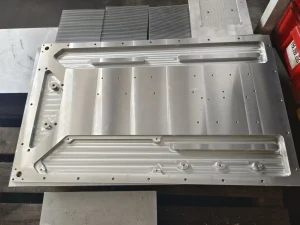
When working with a specialized LED thermal design manufacturer, you gain access to thermal simulation (CFD) and Design for Manufacturing (DFM) expertise. A major failure point in LED cooling is the interfacial thermal resistance between the PCB and the heat sink. By utilizing high-precision CNC machining, we guarantee a surface flatness of ±0.05mm. Data point: Reducing the air gap and optimizing the thermal interface material (TIM) can lower the overall thermal resistance by up to 0.15 °C/W, which alone can drop the LED core temperature by 5°C to 8°C.
What Makes Us Reliable Automotive LED Heat Sink Suppliers?
The automotive industry presents the toughest thermal challenges. Unlike commercial indoor lighting (ambient ~25°C), automotive LED headlights operate in engine bays where ambient temperatures ($T_a$) can soar to 105°C.
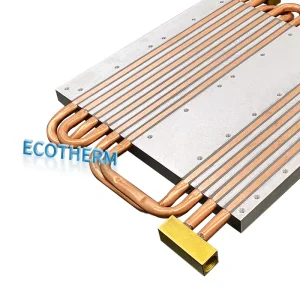
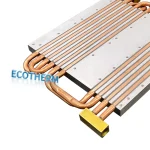
As trusted automotive LED heat sink suppliers, we design thermal modules that operate efficiently within these extreme thermal margins. Because the $\Delta T$ (temperature difference between ambient and junction) is so small (often only 15°C to 20°C), natural convection fails. We engineer integrated micro-cooling systems combining high-density pure copper bases (thermal conductivity ~390 W/m·K) with micro-blowers, ensuring 30W-50W automotive LED chips do not undergo thermal throttling during prolonged use.
Automotive LED Cooling vs. Commercial Lighting: A Data Comparison
Engineers must understand the vast differences in operating environments. Below is a data-driven comparison illustrating why automotive LED cooling requires specialized manufacturing.
| Specification | Automotive LED Headlamp | Commercial High-Bay LED |
| Max Ambient Temp ($T_a$) | 85°C – 105°C | 35°C – 45°C |
| Cooling Mechanism | Active (Micro-fan + Copper Base) | Passive (Aluminum Extrusion/Forging) |
| Vibration Standard | High (Requires 50G shock testing) | Low (Stationary) |
| Space Constraint | Extreme (Sealed housing, < 50mm depth) | Minimal (Open air) |
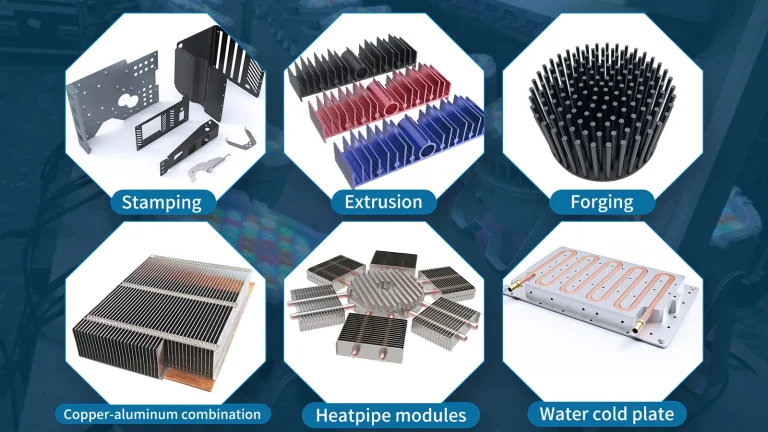
| Optimal Mfg Process | Cold Forging / CNC Machining | Aluminum Extrusion |
Custom Thermal Solutions: Cold Forging vs. Die Casting for LEDs
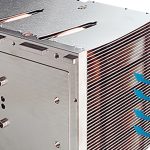
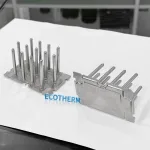
To meet the stringent weight and thermal requirements of modern lighting, manufacturing processes matter immensely. For custom thermal solutions, we highly recommend Cold Forging over traditional Die Casting. Die casting molten aluminum (like ADC12) introduces microscopic air bubbles, reducing the thermal conductivity to roughly 96 W/m·K. In contrast, Cold Forging utilizes pure AL1070 aluminum under extreme pressure. Data point: Cold forged aluminum maintains a thermal conductivity of 220 W/m·K (a 129% improvement over die casting). Furthermore, cold forging allows for an incredibly dense pin-fin structure, increasing the convective surface area by up to 30% without adding excessive weight to the automotive chassis or ceiling mount.
Frequently Asked Questions (FAQ)
Active cooling is required because the ambient temperature inside an engine bay is too high for passive cooling to work.
Heat transfer relies on a temperature difference ($\Delta T$). If a car’s engine bay is 95°C and the LED’s safe limit is 110°C, the $\Delta T$ is only 15°C. A passive aluminum block cannot dissipate heat fast enough with such a narrow margin. Automotive suppliers must use micro-fans or heat pipes to force the heat out of the confined headlamp assembly rapidly.
They provide engineered solutions that prevent rapid lumen depreciation and color shifting. Overheating degrades the phosphors in an LED, causing a permanent drop in brightness (lumen depreciation) and altering the color temperature (e.g., turning white light blue). A specialized manufacturer uses thermal simulations to design a heat sink with the exact thermal resistance needed to keep the junction temperature below 85°C, ensuring the LED lasts its promised 50,000+ hours.
Yes, cold forging produces a dense, unified structure highly resistant to mechanical stress. Unlike stacked fins or soldered assemblies that can crack under prolonged high-frequency vehicle vibrations, a cold-forged heat sink is pressed from a single, solid piece of AL1070 aluminum. There are no joints or seams. This structural integrity easily passes strict automotive 50G shock and vibration tests.
Black anodizing enhances radiative heat transfer in passive cooling applications.
For commercial lighting relying on passive cooling (no fans), thermal radiation is a key factor. Bare aluminum has an emissivity of about 0.05. Applying a black anodized finish increases the emissivity to ~0.85, allowing the heat sink to radiate stored heat up to 15% more effectively into the surrounding environment.
Cold forging tooling typically ranges from $1,000 to $3,000 depending on complexity.
While the initial NRE (Non-Recurring Engineering) cost for a cold forging die is higher than a simple extrusion profile, it is cheaper than a die-casting mold. Given the 129% improvement in thermal conductivity and the ability to produce highly complex, omnidirectional pin-fin structures, the ROI for high-power LED applications is rapidly achieved.
Yes, we conduct full CFD (Computational Fluid Dynamics) thermal simulations during the design phase.
Before cutting any metal, we simulate the airflow, ambient temperatures, and LED TDP using specialized software. This allows us to predict the exact thermal resistance and junction temperature of the proposed design. This data-driven approach prevents costly prototyping errors and ensures the final product will perform reliably in the field.