Table of Contents
Air Cooling vs. Liquid Cold Plates: When to Make the Switch?
Executive Summary:
The choice between liquid and air cooling depends on your Power Density (W/cm²) and Space Constraints.
Choose Air Cooling if your device has a low thermal load (< 300W), ample space for airflow, and cost is the primary driver.
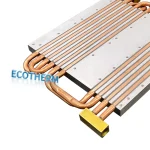
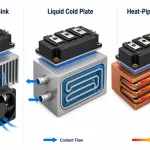
Choose Liquid Cold Plates if you are managing high-heat flux components (e.g., AI GPUs, IGBTs, Lasers), require silent operation, or need to maintain a compact footprint. Liquid transfers heat 24 times faster than air.
Why Liquid Outperforms Air
Thermal Conductivity & Heat Capacity
The superiority of liquid cooling isn’t magic; it’s physics.
Thermal Conductivity: Water has a thermal conductivity of approx. 0.6 W/m·K, while air is only 0.026 W/m·K. This means liquid can absorb and move heat away from the source much more efficiently.
Specific Heat Capacity: Water can hold 4 times more heat energy per unit mass than air before increasing in temperature.
The Result: A liquid cold plate system can handle massive Thermal Design Power (TDP) loads (1kW – 10kW+) that would require impossibly large fans and heatsinks in an air-cooled setup.
Comparison Matrix: Air vs. Liquid
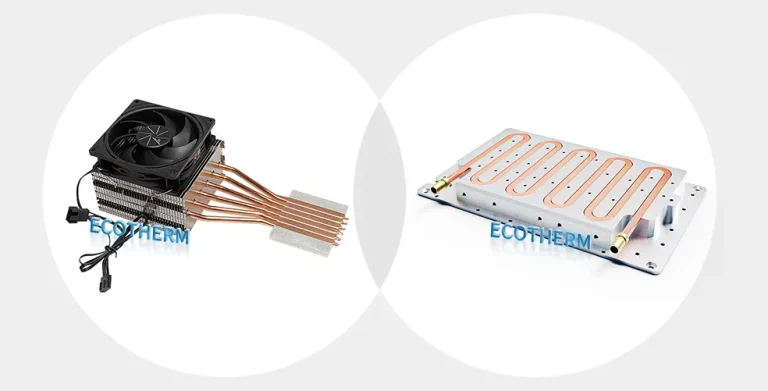
| Engineering Metric | Forced Air Heat Sinks | Liquid Cold Plates |
| Max Heat Flux Limit | Diminishes rapidly after 15-20 W/cm² | Easily manages > 500 W/cm² |
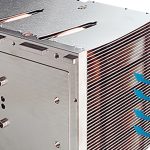
| Spatial Footprint (Volume) | Massive. Requires tall fin stacks & airflow clearance | Ultra-Compact. Typically 10mm–25mm thick |
| Acoustic Profile | High. Requires high-static-pressure fans | Near-Silent. Remote pump and low-speed fans |
| Reliability & Leak Risk | High (but fans are mechanical failure points) | Zero-Leakage when using industrial monolithic manufacturing processes |
Addressing the "Leak" Myth
The most common hesitation engineers have is the risk of coolant destroying sensitive electronics.
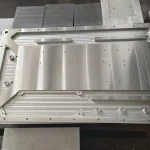
While consumer-grade liquid cooling relies on flexible hoses and plastic fittings prone to human error, industrial cold plates are engineered differently. By utilizing advanced manufacturing techniques like Vacuum Brazing or Friction Stir Welding (FSW), modern cold plates are monolithic metal structures. Once subjected to strict helium leak testing and burst pressure validation, the risk of internal leakage is virtually zero.
At Ecotherm, every plate undergoes a helium mass spectrometer test to detect even microscopic leaks
before shipment.
Contact our Thermal Engineers for a Free Consultation: support@ecothermgroup.com