Copper vs. Aluminum Skived Fin Heat Sink: Which is Best for High Power?
Selecting the right material for a skived fin heat sink is essential for high-power applications. Copper and aluminum are the two most popular choices, each offering distinct benefits and challenges. This article compares these materials to help you choose the best option for optimal thermal performance with Ecothermgroup solutions.
Takeaway
- Skived fin heat sinks are effective for thermal management, offering increased surface area for heat dissipation in high-power applications.
- Copper has better thermal conductivity than aluminum, making it ideal for applications needing maximum heat transfer performance.
- Aluminum is lighter, more affordable, and easier to manufacture, making it a practical choice for less demanding thermal environments or weight-sensitive designs.
- In high-power applications, copper skived fin heat sinks often outperform aluminum due to their ability to handle higher thermal loads efficiently.
- Aluminum heat sinks are suitable when cost, weight, and manufacturing flexibility are key considerations, despite their slightly lower thermal performance.
- The choice between copper and aluminum depends on the specific requirements of the application, such as power density, thermal performance needs, budget, and weight limitations.
- Hybrid designs combining copper and aluminum can provide a balance of high thermal performance with reduced weight or cost, depending on the application.
Introduction to Skived Fin Heat Sinks
What Are Skived Fin Heat Sinks?
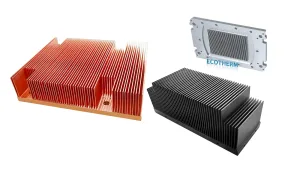
Skived fin heat sinks are thermal management solutions designed to effectively dissipate heat in high-power applications. This technology carves fins directly from a base material, such as copper or aluminum, using a precision skiving process. The result is a seamless structure with no joints, enhancing thermal conductivity by reducing resistance.
Compared to other methods like extrusion or bonding, skived fin heat sinks provide superior heat transfer efficiency due to their seamless design. This makes them ideal for cooling applications such as GPUs, CPUs, power modules, and high-intensity LEDs. Without adhesives or soldered joints, skived fin heat sinks deliver consistent thermal performance over time, even under demanding conditions.
Why Skived Fin Technology for High-Power Applications?
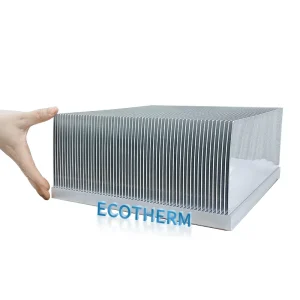
Skived fin technology is well-suited for high-power applications because it handles significant heat loads while maintaining compact dimensions. The fins created through this process are thinner and more closely spaced, increasing the surface area available for heat dissipation. This design is particularly useful in environments where space is limited but cooling demands are high.
When choosing a skived fin heat sink, the choice of material—copper or aluminum—significantly affects performance. Copper offers excellent thermal conductivity of approximately 390-400 W/m·K, making it ideal for applications with high heat flux. However, it is heavier and more expensive than aluminum. Aluminum offers adequate thermal performance at a lower weight and cost, with thermal conductivity ranging between 136-205 W/m·K. These properties make aluminum skived fin heat sinks a common choice for weight-sensitive or budget-conscious projects.
| Material | Thermal Conductivity (W/m·K) | Advantages | Disadvantages |
|---|---|---|---|
| Copper | 390-400 | Superior heat transfer, high efficiency | Heavy, expensive |
| Aluminum | 136-205 | Lightweight, cost-effective | Lower thermal conductivity |
Manufacturers like Ecothermgroup offer customized skived fin heat sinks to meet specific thermal and dimensional requirements. By optimizing parameters such as fin density, height, and thickness, designers can tailor aluminum heat sinks to narrow the performance gap with copper while maintaining advantages in weight and cost. This customization helps engineers balance performance and practicality, ensuring efficient thermal management for various applications.
- High-power applications benefit from skived fin heat sinks due to their seamless design and increased surface area.
- Copper provides maximum thermal conductivity but has trade-offs in weight and cost.
- Aluminum delivers a good balance of performance, weight, and affordability for less demanding applications.
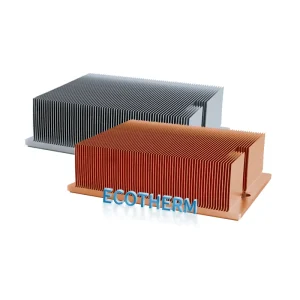
Material Comparison: Copper vs. Aluminum
Key Properties of Copper and Aluminum
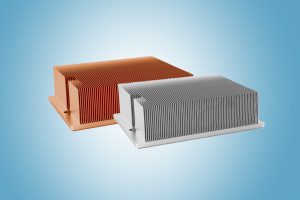
Copper and aluminum are the two most commonly used materials in skived fin heat sinks, and each offers distinct properties suited to specific thermal management needs. Copper has a thermal conductivity of approximately 398 W/mK, nearly double that of aluminum’s 205 W/mK. This makes copper highly effective for high-power applications requiring efficient heat transfer, such as servers, CPUs, and industrial inverters. Aluminum is much lighter, with a density of 2.7 g/cm³ compared to copper’s 8.9 g/cm³. Its lower weight and cost-effectiveness make aluminum a popular choice for larger systems or applications focused on affordability and ease of installation.
| Property | Copper | Aluminum |
|---|---|---|
| Thermal Conductivity (W/mK) | ~398 | ~205 |
| Density (g/cm³) | ~8.9 | ~2.7 |
| Cost | Higher | Lower |
| Weight | Heavier | Lighter |
Material Trade-Offs for Heat Dissipation
When choosing a material for skived fin heat sinks, the trade-offs between copper and aluminum need careful consideration. Copper’s superior thermal conductivity allows for more compact designs, making it ideal for space-constrained or performance-critical applications. However, its higher cost and weight can be limiting, especially in large systems. Aluminum, while less efficient in thermal conductivity, offers the advantage of being lightweight and budget-friendly, making it suitable for applications like LED lighting, renewable energy systems, and less heat-intensive electronics.
Skiving technology enhances the efficiency of both materials by creating thin, closely spaced fins that increase surface area for heat dissipation. Skiving copper is more challenging due to its hardness and density, leading to higher production costs and tool wear. Aluminum’s malleability simplifies the manufacturing process, reducing overall costs while maintaining effective cooling performance.
- Copper heat sinks work well for high-power, compact, or extreme thermal environments.
- Aluminum heat sinks are ideal for lightweight, cost-sensitive, or large-scale systems.
- Hybrid designs combining copper bases with aluminum fins offer a balance of performance and cost.
Ecothermgroup provides options in both copper and aluminum skived fin heat sinks, ensuring customers can select the best material for their specific needs. By evaluating the properties and trade-offs of each material, you can achieve effective thermal management without compromising efficiency or budget.
Performance in High-Power Applications
Heat Transfer Efficiency of Copper vs. Aluminum
When comparing copper and aluminum skived fin heat sinks in high-power applications, heat transfer efficiency is a key factor. Copper’s thermal conductivity, around 390–400 W/m·K, significantly surpasses aluminum’s range of 136–205 W/m·K. This makes copper an excellent choice for systems requiring maximum heat dissipation, such as high-density GPUs, CPUs, and server modules. Aluminum heat sinks, on the other hand, utilize skived fin technology to improve cooling performance, compensating for lower conductivity by optimizing airflow and surface area exposure.
While copper provides superior thermal properties, its higher cost and weight can be limiting. Aluminum, with a density of 2.7 g/cm³ compared to copper’s 8.9 g/cm³, is often chosen for applications where weight reduction is critical, such as electric vehicles and portable electronics. Ecothermgroup’s aluminum skived fin heat sinks are designed to deliver effective cooling, even in demanding conditions.
| Material | Thermal Conductivity (W/m·K) | Density (g/cm³) |
|---|---|---|
| Copper | 390–400 | 8.9 |
| Aluminum | 136–205 | 2.7 |
Impact on Cooling for 300W Systems
For high-power systems, such as those requiring 300W cooling capacity, material choice directly affects thermal performance. Copper-based skived fin heat sinks excel at managing large heat loads due to their high thermal conductivity. Aluminum, however, is a practical alternative for systems constrained by cost and weight. Skiving techniques enhance aluminum’s cooling efficiency, making it effective in applications like telecom modules and automotive systems.
Hybrid designs, which combine a copper base for heat absorption with aluminum fins for lightweight dissipation, are gaining popularity. These solutions balance performance and cost, delivering reliable cooling for high-power systems. Ecothermgroup specializes in such tailored solutions, addressing diverse industry requirements.
- Copper offers exceptional thermal conductivity, suited for applications with tight thermal margins.
- Aluminum provides lightweight and cost benefits, ideal for larger-scale systems.
- Skived fin technology improves cooling efficiency for both copper and aluminum designs.
Cost and Manufacturing Considerations
Cost Differences Between Copper and Aluminum
When considering the cost of a skived fin heat sink, the choice between copper and aluminum has a significant impact on expenses. Copper, with its superior thermal conductivity (≈385 W/m·K), is about three times more expensive than aluminum (≈205 W/m·K) in terms of raw material costs. This makes aluminum a more economical choice for many applications, especially where moderate cooling performance is sufficient. Additionally, aluminum’s lighter weight reduces shipping and handling costs, further increasing its affordability.
Manufacturing costs also play a key role in overall expenses. Copper is harder to process due to its density and hardness, which leads to increased tool wear and slower production speeds during skiving. Consequently, copper skived fin heat sinks can be up to nine times more expensive to manufacture than aluminum ones. Companies like Ecothermgroup offer both materials, helping clients balance performance needs with budget constraints.
| Factor | Copper | Aluminum |
|---|---|---|
| Raw Material Cost | High (≈3x aluminum) | Low |
| Thermal Conductivity | ≈385 W/m·K | ≈205 W/m·K |
| Manufacturing Cost | High | Low |
| Weight | Heavier | Lighter |
Manufacturing Complexity and Customization Options
The manufacturing process of skived fin heat sinks is another critical factor. Aluminum is easier to work with, enabling faster production and streamlined mass manufacturing methods like extrusion and die-casting. These techniques allow manufacturers to produce aluminum heat sinks in large quantities at reduced costs. In contrast, copper skived fin heat sinks require more precise and labor-intensive methods, as copper’s hardness and higher density complicate the skiving process.
Despite these challenges, copper skiving allows for high-density fins, delivering excellent thermal performance for demanding applications like server CPUs and GPUs. Aluminum, while less thermally efficient, benefits from advanced skiving technologies that improve its cooling capabilities. Both materials can be customized to meet specific design needs, but aluminum’s versatility makes it better suited for projects with complex geometries or tight deadlines.
- Aluminum is ideal for mass production due to its ease of processing and cost efficiency.
- Copper provides superior cooling performance but is more expensive and harder to manufacture.
- Customization options are available for both materials, with aluminum offering greater design flexibility.
Choosing the Right Material for Your Application
Factors to Consider: Power, Budget, and Design
When selecting the ideal material for a skived fin heat sink, understanding the unique properties of copper and aluminum is essential. Copper, with its impressive thermal conductivity of approximately 400 W/m•K, is often the go-to choice for high-power applications where efficient heat transfer is paramount. Aluminum, with a thermal conductivity of around 205 W/m•K, is lighter, more affordable, and easier to manufacture, making it a practical choice for applications with less demanding heat dissipation needs.
The choice of material largely depends on specific application requirements. For example, high-power systems like data centers or servers benefit from copper heat sinks due to their ability to dissipate heat effectively in compact spaces. In contrast, aluminum is commonly used in applications such as LED lighting and electric vehicles (EVs), where weight and cost are critical factors. The overall design of the heat sink, including the size and layout of the fins, also influences material selection, as it impacts heat dissipation efficiency.
| Factor | Copper | Aluminum |
|---|---|---|
| Thermal Conductivity | ~400 W/m•K | ~205 W/m•K |
| Weight | Heavier | Lighter |
| Cost | Higher | Lower |
| Manufacturability | More challenging | Easier |
Recommendations for Specific Use Cases
For applications requiring maximum thermal performance, such as high-power CPUs or GPUs, copper skived fin heat sinks are an excellent choice. Their superior heat dissipation capabilities ensure optimal performance and prevent overheating in demanding scenarios. Similarly, industries like telecommunications and aerospace, where space constraints are crucial, often rely on copper for its compact and efficient design potential.
In contrast, aluminum heat sinks are better suited for projects with budget constraints or weight limitations. Their lightweight nature and lower cost make them ideal for consumer electronics, automotive systems, and renewable energy devices. Aluminum heat sinks can also be scaled in size to offset their lower conductivity, offering a cost-effective solution without compromising performance in moderate-power applications.
- Choose copper for compact, high-power applications requiring top-tier thermal performance.
- Opt for aluminum in cost-sensitive or weight-restricted projects with moderate thermal demands.
- Consider hybrid designs with copper bases and aluminum fins for balanced performance and cost-efficiency.
By evaluating the power requirements, budget limitations, and design constraints of your application, you can select the most suitable material. Ecothermgroup offers a range of customizable skived fin heat sinks in both copper and aluminum, ensuring the right solution for every thermal management challenge.
People Also Ask
A skived fin heat sink is a heat sink where thin fins are carved from a single block of material. This design enhances thermal conductivity and heat dissipation, making it ideal for high-power applications by maximizing surface area for heat transfer.
Copper offers higher thermal conductivity for better heat dissipation, while aluminum is lighter and more cost-effective. Copper is commonly used in high-power applications, whereas aluminum is better suited for less demanding thermal needs.
Copper is typically preferred for high-power applications due to its excellent thermal conductivity, enabling faster heat transfer. Aluminum may be chosen when weight or budget constraints are more important.
Yes, copper skived fin heat sinks are usually more expensive to produce because of copper’s higher cost and the complexity of processing it. Aluminum is lighter and easier to work with, making it more affordable.
Consider thermal performance, weight, budget, and application needs. Copper is ideal for systems requiring efficient heat dissipation, while aluminum is better for lightweight or cost-sensitive designs.
Aluminum skived fin heat sinks can handle high-power applications but may not perform as efficiently as copper due to lower thermal conductivity. They are often used when weight and cost are prioritized.
The skived fin design provides a large surface area for heat dissipation and eliminates the need for thermal adhesives or joints, improving overall thermal performance. This makes it effective for high-power systems.
Customization optimizes fin density, dimensions, and material selection based on cooling requirements, enhancing heat dissipation and efficiency. Manufacturers often create tailored designs to meet specific needs.