Custom Heat Sink for LED Light Housing: Die Casting, Forging, or Extrusion?

Effective heat management is essential for LED light housing to maintain performance and extend lifespan. Selecting the ideal custom heat sink design can be complex, especially when comparing die casting, forging, and extrusion methods. This article examines these options to help you find the best solution for your LED lighting requirements.
Takeaway
- Heat sinks play a vital role in LED light housing by dissipating heat and improving the lifespan of LED systems.
- Die casting works well for complex designs and mass production, offering precision but may require additional processing for better thermal performance.
- Forging delivers excellent mechanical strength and thermal conductivity, making it ideal for high-performance LED applications, though it is less suited for intricate designs.
- Extrusion is a cost-effective option for simpler designs, enabling lightweight and efficient heat sink production with minimal waste.
- Selecting the right manufacturing process depends on factors such as design complexity, cost, production volume, and thermal performance needs.
- Material compatibility is important, with aluminum being a popular choice for LED heat sinks due to its strong thermal properties and machinability.
- Balancing performance, cost, and scalability is key when deciding on a manufacturing method for LED heat sinks.
Introduction to Heat Sinks for LED Lights
Efficient heat management is a crucial part of LED light design, and heat sinks are essential for optimal performance and longevity. Heat sinks for LED lights are designed to dissipate the heat produced by LEDs during operation. Without proper thermal management, LEDs can overheat, leading to reduced efficiency, color shifts, or even premature failure. As a leader in thermal management solutions, Ecothermgroup highlights the importance of choosing the right heat sink for LED applications to ensure performance and durability.
Why Heat Management is Critical for LEDs
LED lights are known for their energy efficiency and long lifespan. However, these benefits can be affected if excess heat is not properly managed. Unlike traditional lighting, LEDs are highly sensitive to temperature changes. Excessive heat can damage the semiconductor material, reducing light output and efficiency. Overheating can also shorten the lifespan of LEDs, undermining their cost-saving advantages.
Heat sinks transfer heat away from the LED diode and release it into the surrounding air, maintaining a stable operating temperature. This ensures consistent light output, efficiency, and reliable performance. The choice of heat sink design and material depends on factors such as the LED’s power output, intended application, and housing design. For example, high-power LEDs used in industrial lighting may need more advanced heat sink solutions than those used in residential settings.
Overview of Heat Sink Materials and Manufacturing
Heat sinks for LED lights can be made using various processes, including die casting, extrusion, and forging. Each method has its own advantages. Aluminum is the most commonly used material due to its high thermal conductivity, lightweight properties, and cost-effectiveness. Below is a comparison of the three main manufacturing techniques.
| Manufacturing Method | Key Features |
|---|---|
| Die Casting | Allows complex designs, integrates mounting features, cost-effective for high-volume production, but lower thermal efficiency due to material porosity. |
| Extrusion | Offers excellent thermal conductivity, cost-effective for low to medium volumes, best for simple linear designs. |
| Forging | Provides superior thermal performance with higher material density, ideal for applications requiring maximum heat dissipation, but higher production costs. |
Die casting is valued for its ability to create intricate designs with features like fins and mounting points, making it ideal for custom LED light housings. For example, Ecothermgroup uses die-casting techniques to produce high-precision aluminum heat sinks that combine durability and heat dissipation efficiency. Extrusion is preferred for simpler designs and lower production volumes due to its cost and material efficiency. Cold forging, while more expensive, delivers unmatched performance in high-demand applications where heat dissipation is critical.
- Die casting is best for complex, high-volume designs.
- Extrusion suits simpler, lower-cost solutions.
- Forging is ideal for superior thermal performance.
The choice of heat sink manufacturing method depends on the specific requirements of the LED housing design, production scale, and performance goals. As a trusted industry partner, Ecothermgroup helps clients find the best solutions for efficient and reliable heat management in LED lighting systems.
Die Casting for LED Heat Sinks
Advantages of Die Casting in LED Applications
Die casting is an efficient manufacturing process for creating heat sinks for LED light housing. This method is particularly effective for producing components with intricate designs and smooth finishes, essential for efficient heat dissipation and aesthetic appeal. Using materials like ADC12 aluminum alloy, die-cast heat sinks balance strength, durability, and cost-effectiveness. The process also supports high-volume production with consistent quality, making it ideal for large-scale LED lighting projects.
Compared to other methods like extrusion, die casting suits complex geometries and features that enhance heat dissipation. While its thermal conductivity (96-110 W/m·K) is lower than that of cold-forged heat sinks, it is sufficient for low to medium-power LED applications. This process also minimizes material waste, reducing production costs and environmental impact.
Design Flexibility and Cost-effectiveness
Die casting offers high design flexibility. Manufacturers like Ecothermgroup use this process to create custom heat sink designs tailored to specific LED lighting needs. It accommodates features such as fins, mounting holes, or integrated housings, which are challenging to achieve through extrusion or forging.
In terms of cost, die casting is competitive for mass production. While tooling costs are initially higher than extrusion, the per-unit cost decreases significantly with larger production volumes. This makes die casting a cost-effective choice for industries scaling production while keeping affordability in focus. Additionally, die-cast LED heat sinks are lightweight, which is important for applications requiring reduced weight, like portable or suspended lighting systems.
Case Studies: Custom Die-Cast LED Heat Sinks
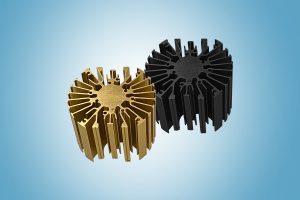
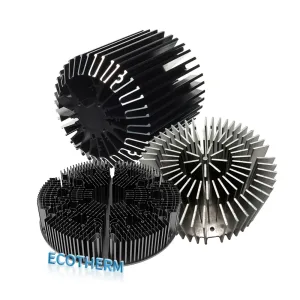
Several case studies highlight the benefits of die casting for LED heat sinks. For example, custom LED downlight heat sinks produced through die casting demonstrate optimized designs and structural integrity, ensuring better performance and durability. These heat sinks are crafted to improve airflow and thermal management, essential for extending the lifespan of LED lights.
High-precision die-cast aluminum heat sinks designed for LED lighting also show exceptional heat dissipation efficiency. Ecothermgroup has been leading innovations in this area, delivering tailored solutions for complex LED lighting requirements. By focusing on performance and aesthetics, they ensure their products meet the diverse needs of modern lighting systems.
| Manufacturing Method | Advantages |
|---|---|
| Die Casting | High design flexibility, cost-effective for large volumes, suitable for complex geometries |
| Forging | Superior thermal conductivity, high material density, ideal for high-power LEDs |
| Extrusion | Lower tooling costs, suitable for simpler designs and small production runs |
- Die casting is ideal for intricate heat sink designs with smooth finishes.
- It offers scalability for large production volumes.
- Lower thermal conductivity makes it suitable for low to medium-power LEDs.
- Custom designs can integrate features like fins and mounting systems.
Forging as a Manufacturing Method for Heat Sinks
Strength and Thermal Efficiency in Forged Heat Sinks
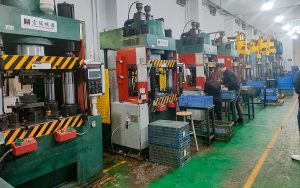
Forging is an effective method for manufacturing heat sinks for LED light applications, offering superior strength and thermal performance compared to alternatives like die casting and extrusion. In the forging process, aluminum is compressed under high pressure, resulting in a dense molecular structure. This density eliminates porosity, a common issue in die casting, and significantly improves heat dissipation efficiency. High-purity aluminum alloys often used in forging further enhance thermal conductivity, making forged heat sinks ideal for high-performance LED systems where heat management is critical.
One of the main benefits of forging is its ability to produce intricate pin-fin designs with higher aspect ratios. These designs improve airflow and maximize surface area, enabling better heat dissipation in compact LED housings. Unlike extrusion, which is limited to simpler shapes, forging supports the creation of complex geometries that meet demanding performance and space-saving requirements. Ecothermgroup, a leader in custom heat sink solutions, emphasizes how forging ensures precise tolerances and defect-free results, essential for optimizing the longevity and efficiency of LED lighting systems.
Applications and Limitations of Forging
Forged heat sinks are commonly used in applications requiring strong thermal management, such as high-power LED lights in industrial, automotive, and architectural settings. Their durable construction and excellent heat dissipation properties make them particularly suitable for environments where LEDs operate under high thermal loads. Additionally, forged heat sinks are highly customizable, allowing manufacturers to tailor designs to specific LED housings and performance needs.
However, there are some limitations to consider. Tooling costs for forging are higher than those for die casting and extrusion, making it less cost-effective for low-volume production. Additionally, the manufacturing process is slower, which can extend lead times. Despite these challenges, many manufacturers, including Ecothermgroup, recommend forging for applications where performance and reliability outweigh initial cost considerations.
| Feature | Forging | Die Casting | Extrusion |
|---|---|---|---|
| Thermal Conductivity | High | Moderate | Moderate |
| Strength | High | Moderate | Low |
| Shape Complexity | High | High | Low |
| Cost (Tooling) | High | Low | Low |
| Production Speed | Slow | Fast | Fast |
- Forging is ideal for high-performance LED heat sinks requiring maximum thermal efficiency and strength.
- While it has higher costs, it offers defect-free and highly precise results.
- It is less suitable for low-volume or budget-sensitive applications.
Extrusion Techniques for LED Heat Sinks
How the Extrusion Process Works
Extrusion is a manufacturing method where aluminum is pushed through a die to form long, uniform shapes with consistent cross-sections. This technique is ideal for creating effective heat sink designs for LED light housings. Commonly used aluminum alloys like 6061 and 6063 offer excellent thermal conductivity and are easy to work with. After extrusion, the aluminum profiles are cut to the required length and further processed for specific design needs, such as grooves or mounting holes.
Ecothermgroup uses this process to produce high-quality heat sinks for LED applications, ensuring their products meet thermal performance and durability standards. The precise control of dimensions during extrusion ensures consistent heat dissipation, which is essential for prolonging the lifespan of LEDs.
Benefits of Extruded Aluminum Heat Sinks
Extruded heat sinks are a preferred choice for LED light housings due to their cost-effectiveness and versatility. The extrusion process has lower tooling costs compared to die casting, making it suitable for small to medium production runs. Additionally, this method allows for straightforward yet efficient designs that meet various thermal management needs.
An added benefit is the use of high-conductivity aluminum alloys, enabling extruded heat sinks to deliver better thermal performance than die-cast options. Post-extrusion customization is also simpler, allowing manufacturers to incorporate features like fins or mounting slots without significant added costs.
- Cost-effective for small to medium production runs
- High thermal conductivity with 6061 or 6063 aluminum alloys
- Easy post-production customization
- Lightweight and durable designs
Comparison with Die Casting and Forging
| Manufacturing Method | Key Features | Best Use Case |
|---|---|---|
| Extrusion | High thermal conductivity, cost-effective, simple designs | Standard LED light heat sinks |
| Die Casting | Complex geometries, integrated features, lower thermal conductivity | High-volume production with intricate designs |
| Forging | Superior thermal performance, high durability, higher cost | High-power LED systems |
Compared to die casting and forging, extrusion provides a balance of cost, performance, and flexibility. While die casting is ideal for detailed designs and large-scale production, it often has lower thermal conductivity due to the alloys used. Forging offers excellent thermal performance and durability but is more expensive, making it suitable for specialized, high-power LED systems. Extrusion is the optimal choice for most standard LED heat sink applications, delivering reliable thermal management at an affordable price.
Choosing the Right Manufacturing Process for LED Heat Sinks
Factors to Consider: Cost, Efficiency, and Design
When selecting a manufacturing process for LED heat sinks, the decision depends on balancing cost, thermal efficiency, and design complexity. Die casting, extrusion, and forging each offer unique advantages and limitations for producing heat sink LED light housings.
Die casting is ideal for mass production of LED heat sinks with intricate geometries. This process ensures high precision and structural integrity, meeting the needs of compact LED systems. However, die casting may introduce porosity in the material, slightly reducing thermal conductivity compared to other methods. Brands like Ecothermgroup use die-casting techniques to enhance heat dissipation and durability, especially in aluminum LED heat sinks.
Extrusion is a cost-effective solution for simpler designs. It is well-suited for producing uniform profiles with aluminum alloys like 6061 or 6063, which offer good thermal performance and corrosion resistance. Extruded heat sinks are popular for their affordability and ability to handle moderate LED heat loads.
Forging, particularly cold forging, is preferred for high-performance LED applications. This method aligns metal grain structures, eliminating material porosity and improving thermal conductivity. Cold-forged aluminum heat sinks can reduce junction temperatures by up to 10°C compared to die-cast alternatives, making them a reliable choice for high-power LED systems.
| Manufacturing Process | Key Features |
|---|---|
| Die Casting | Precision, structural integrity, suitable for intricate designs |
| Extrusion | Cost-effective, good for uniform profiles, moderate thermal efficiency |
| Forging | Superior thermal conductivity, eliminates porosity, ideal for high-power LEDs |
Real-World Examples of Manufacturing Decisions
Manufacturers often choose a process based on specific project requirements. For instance, Ecothermgroup’s custom die-cast aluminum heat sinks for LED lighting show how intricate designs can be achieved without sacrificing durability. These designs are optimized for compact downlight housings and ensure effective heat dissipation for longer LED lifespans.
In contrast, extrusion is widely used for larger, less complex heat sinks in cost-sensitive applications. This process works well for outdoor LED installations where simplicity and corrosion resistance are essential. Meanwhile, cold forging is often applied in industrial and high-power LED systems, where maximizing thermal conductivity and reliability is critical.
- Die casting is best for compact, intricate designs.
- Extrusion suits cost-sensitive projects with simpler shapes.
- Forging is optimal for high-performance and industrial applications.
The manufacturing process should align with the LED system’s thermal requirements, budget, and design specifications. By understanding the strengths of each method and utilizing expertise from brands like Ecothermgroup, manufacturers can create efficient and cost-effective solutions for LED heat sink production.
People Also Ask
The primary purpose of a heat sink in an LED light housing is to dissipate excess heat generated by the LED, ensuring optimal performance, efficiency, and longevity of the LED components.
Die casting enables precise manufacturing of LED heat sinks, offering strong structural integrity, cost savings, and the ability to create complex shapes that enhance heat dissipation.
Aluminum is lightweight, has excellent thermal conductivity, and is affordable, making it a great choice for LED heat sinks to effectively dissipate heat and support high-output LEDs.
Forging produces strong and durable heat sinks by compressing the material into shape, but it is less suitable for intricate designs compared to the precision and versatility of die casting.
Extrusion is a process where aluminum is pushed through a die to create consistent profiles. It is widely used for LED heat sinks because it produces lightweight designs with excellent thermal conductivity.
Important factors include thermal performance, design complexity, durability, production volume, and cost. Die casting works well for detailed shapes, forging for strength, and extrusion for simple, effective designs.
Die-cast aluminum heat sinks are cost-effective as they support large-scale production, minimize material waste, and produce precise designs in a single process, lowering manufacturing costs.
Proper heat dissipation prevents LEDs from overheating, which can reduce brightness, efficiency, and lifespan, making heat sinks vital for maintaining performance.