Solar Inverter Heat Sink: Custom Liquid Cold Plates for High-Power PV Systems
High-power photovoltaic (PV) systems often face challenges in managing excess heat, which can affect efficiency and durability. An inverter heat sink is essential for dispersing this heat and maintaining reliable performance. This article examines custom liquid cold plates as an innovative solution to improve thermal management in modern solar inverters.
Takeaway
- Solar inverter heat sinks are essential for managing thermal performance and maintaining efficiency in high-power photovoltaic (PV) systems.
- Traditional heat sink solutions, such as air-cooled systems, struggle to handle the growing power densities of modern solar inverters.
- Switching to liquid cooling provides better heat dissipation, compact designs, and improved performance for high-power solar inverters.
- Custom liquid cold plates offer a tailored solution, optimizing thermal management and ensuring compatibility with specific inverter designs.
- Benefits of custom liquid cold plates include increased energy efficiency, extended equipment lifespan, and lower maintenance needs.
- Advances in heat sink technology, including new materials and integration with smart cooling systems, are driving the evolution of solar inverter thermal management.
- Liquid cooling solutions support the scalability of PV systems and enable the development of more efficient, compact solar inverters.
Introduction to Solar Inverter Heat Sinks
Why Thermal Management Matters
The performance and reliability of solar inverters rely heavily on effective thermal management systems. High-power photovoltaic (PV) systems generate significant heat during operation, which can reduce the efficiency of power electronics, including insulated gate bipolar transistors (IGBTs) and diodes. Without proper cooling, thermal stress increases, potentially causing system failures and shortening the lifespan. This makes heat sinks, particularly advanced liquid cold plates, essential components in modern inverter designs.
Liquid cooling provides significant advantages over traditional air-cooled heat sinks. By using custom liquid cold plates tailored to specific PV system requirements, manufacturers like Ecothermgroup enable precise heat dissipation and reduce thermal resistance. This approach boosts energy conversion efficiency and supports the long-term stability of high-power solar inverters.
Role of Heat Sinks in High-Power PV Systems
Heat sinks are crucial for maintaining optimal temperatures in solar inverters that operate under high electrical loads. Inverter heat sinks, especially liquid cold plates, are designed to efficiently transfer heat away from critical components, ensuring reliable performance in demanding conditions. As PV systems scale up in power output, air-cooled heat sinks often fall short, driving the need for liquid cooling solutions.
Custom liquid cold plates for solar inverters use materials like aluminum and copper, valued for their high thermal conductivity and durability in outdoor environments. Advanced methods such as computational fluid dynamics (CFD) simulations optimize thermal performance and ensure compatibility with various coolants for extreme temperatures. By incorporating these innovative heat sinks, manufacturers like Ecothermgroup meet the growing demand for scalable cooling solutions in high-power PV systems.
| Cooling Method | Key Features |
|---|---|
| Air-Cooled Heat Sink | Lower cost, limited efficiency for high-power applications |
| Liquid Cold Plate | Higher thermal conductivity, ideal for high-power systems |
- Reduces thermal stress on power electronics
- Improves system reliability and lifespan
- Enhances energy conversion efficiency
Traditional Heat Sink Solutions for Solar Inverters
Challenges with Conventional Heat Sinks
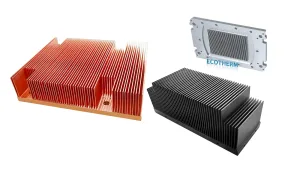
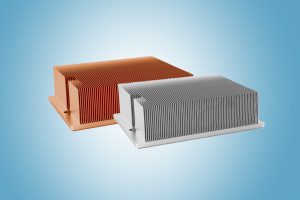
Traditional heat sink designs, typically made from aluminum or copper, rely on passive or forced air convection to manage the thermal output of solar inverters. These materials are cost-effective and relatively easy to produce, but their performance often falls short in high-power applications. Modern photovoltaic (PV) systems with increasing energy densities require more effective cooling solutions, as conventional heat sinks often struggle to handle significant heat loads efficiently.
A major challenge is the inability of traditional heat sinks to maintain optimal operating temperatures under high-power conditions. Excessive heat can cause thermal stress, reducing the inverter’s efficiency and shortening the lifespan of critical components. This problem is especially severe in regions with high ambient temperatures or where PV systems run continuously under heavy loads.
Another issue is the limited scalability of conventional heat sink systems. As solar inverters become more compact and power-dense, traditional designs may require larger surface areas or additional cooling mechanisms, which can increase the system’s overall size and cost while complicating installation processes.
| Problem | Impact |
|---|---|
| Insufficient heat dissipation | Reduced inverter efficiency and component lifespan |
| Limited scalability | Increased size, cost, and installation complexity |
Limitations in High-Power Applications
The limitations of traditional inverter heat sink solutions become more apparent as solar inverters move toward higher power outputs. Passive cooling methods often fail to meet the thermal demands of systems operating at peak efficiency, leading to overheating and performance issues. Forced air convection, while more effective, can add power consumption and noise, reducing the inverter’s overall energy efficiency.
In high-power PV systems, traditional heat sinks also face material limitations. Aluminum, while lightweight and affordable, has lower thermal conductivity compared to copper, which may not be sufficient for extreme thermal loads. Copper, although more conductive, adds considerable weight and cost, making it less practical for large-scale installations.
- Material limitations reduce performance in high-power scenarios.
- Passive cooling cannot meet thermal management needs.
- Forced air convection increases noise and energy consumption.
Ecothermgroup addresses these challenges with innovative solutions like custom liquid cold plates. These advanced cooling systems provide superior thermal dissipation, ensuring solar inverters operate reliably under high-power conditions. By overcoming the inefficiencies of conventional heat sinks, liquid cold plates are a critical step forward in enhancing the performance and lifespan of modern PV systems.
Transition to Liquid Cooling in Solar Inverters
Benefits of Liquid Cold Plates
The use of liquid cold plates in solar inverters offers significant advantages for high-power photovoltaic (PV) systems. These systems often encounter thermal challenges due to the increasing power density of modern inverters. Liquid cooling provides superior heat transfer capabilities, efficiently dissipating heat from critical components such as insulated-gate bipolar transistors (IGBTs) and capacitors. This reduces thermal stress, lowers the risk of hotspots, and extends the lifespan of inverter components, improving system reliability.
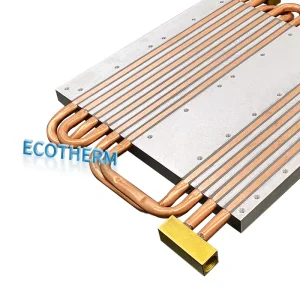
Unlike air-cooled systems, liquid cold plates can handle heat flux densities exceeding 300 W/cm², making them essential for advanced PV applications. Custom designs, such as those offered by Ecothermgroup, enhance cooling performance with features like microchannels, embedded heat exchangers, and copper piping. These innovations ensure uniform temperature distribution and effective cooling, even in systems with concentrated heat loads.
Comparing Liquid Cooling to Air Cooling
Liquid cooling and air cooling differ significantly in thermal performance and scalability. Air-cooled systems rely on fans and fins to dissipate heat but often struggle with the high thermal densities of modern solar inverters. Liquid cooling systems provide a more efficient solution, especially for large-scale installations.
One major advantage of liquid cooling is its ability to handle higher power densities without requiring excessive space. Air-cooled systems often need larger heat sinks and additional airflow mechanisms, increasing size and weight. Liquid cooling systems, with compact cold plate designs, are better suited for applications with space limitations and high power demands.
| Feature | Liquid Cooling | Air Cooling |
|---|---|---|
| Thermal Performance | High (300 W/cm²+) | Moderate |
| Space Efficiency | Compact | Bulky |
| Scalability | Flexible | Limited |
| Maintenance Needs | Low | Moderate |
Liquid cooling systems enhance the efficiency and reliability of solar inverters, especially under demanding conditions. By preventing overheating and lowering long-term maintenance costs, they play a key role in optimizing high-power PV systems. Ecothermgroup’s expertise in custom liquid cold plate designs ensures solutions tailored to the unique requirements of solar inverters, driving innovation in thermal management.
- Improved heat dissipation
- Greater reliability for inverter components
- Enhanced scalability for high-power applications
- Compact designs suited for space-constrained installations
Custom Liquid Cold Plates for Solar Inverter Heat Sinks
Design and Integration
Custom liquid cold plates are essential for managing the thermal needs of solar inverter heat sinks, especially in high-power photovoltaic (PV) systems. These cold plates are designed to enhance heat dissipation by incorporating advanced channel geometries that improve fluid flow. This ensures consistent temperature distribution across key components such as insulated-gate bipolar transistors (IGBTs) and power modules. By customizing designs to match specific inverter requirements, manufacturers can overcome challenges like limited space and high power densities, where traditional air-cooled systems often underperform.
Materials like copper and aluminum are commonly used for liquid cold plates due to their strong thermal conductivity. Copper offers excellent heat transfer capabilities, making it ideal for high-efficiency applications, while aluminum provides a lighter and more cost-effective option for broader applications. Ecothermgroup uses these materials to create reliable solutions, ensuring compatibility with modern inverter systems. The custom design process also simplifies integration with existing setups, reducing installation challenges and boosting performance.
| Material | Key Benefit |
|---|---|
| Copper | High thermal conductivity for superior heat transfer |
| Aluminum | Lightweight and cost-effective |
Enhancing Efficiency and Reliability
Liquid cold plates significantly improve both the efficiency and reliability of solar inverter heat sinks. By effectively dissipating heat, these systems prevent overheating, which can decrease performance or cause component failures. This is especially important in high-power applications, where consistent temperatures are crucial for uninterrupted operation. Custom cold plates evenly distribute thermal loads, reducing stress on components and extending the inverter system’s lifespan.
Liquid cooling systems also boost energy efficiency by lowering thermal resistance and optimizing heat transfer rates. Regular maintenance, like monitoring coolant levels and checking for leaks, is vital for maintaining reliability. Ecothermgroup prioritizes these aspects in its designs, delivering robust solutions tailored to the demands of high-power PV systems. As liquid cooling technologies gain prominence, custom cold plates are becoming critical for achieving advanced inverter performance.
- Improved heat dissipation prevents overheating
- Optimized thermal management enhances inverter lifespan
- Lower thermal resistance improves energy efficiency
- Regular maintenance ensures system reliability
Future Trends in Heat Sink Technology for Solar Inverters
Emerging Innovations in Liquid Cooling
Advancements in heat sink technology for solar inverters are increasingly focused on liquid cooling systems, particularly custom liquid cold plates. These systems effectively manage the high thermal loads produced by modern photovoltaic (PV) systems. Materials such as aluminum and copper are frequently used, often incorporating microchannel structures that boost thermal conductivity and ensure consistent heat distribution.
Another innovation is the use of phase-change materials and two-phase cooling methods. By leveraging the latent heat during liquid-to-vapor transitions, these systems enhance heat dissipation capacity and reduce thermal resistance. This is especially important as inverters operate at higher power densities and in extreme environmental conditions. Ecothermgroup’s custom solutions utilize these advancements to meet the need for efficient thermal management in high-power PV applications.
An additional development is the adoption of friction-stir-welded and diffusion-bonded liquid cold plates. These techniques improve the structural integrity and thermal efficiency of liquid cooling systems, reduce pressure drops, and enhance compatibility with complex inverter designs. As the solar industry continues to expand, these innovations will be key to ensuring system reliability and longevity.
| Innovation | Benefit |
|---|---|
| Microchannel Designs | Improved heat dissipation and uniform temperature management |
| Phase-Change Materials | Higher thermal capacity and reduced resistance |
| Friction-Stir Welding | Enhanced durability and thermal efficiency |
| Two-Phase Cooling | More effective operation under high-power conditions |
Scalability for Next-Generation PV Systems
With the growing demand for high-power PV systems, scalability has become essential in heat sink technology. Liquid cold plates are particularly suited for handling increasing thermal loads efficiently. These systems adapt to various inverter sizes and configurations, making them ideal for next-generation solar installations.
Customization also drives scalability. Manufacturers like Ecothermgroup offer tailored solutions that integrate with specific PV system requirements, ensuring optimal thermal performance. By addressing design challenges, such as space constraints and high ambient temperatures, these solutions improve the functionality and lifespan of solar inverters.
Further advancements in modular liquid cooling systems simplify integration and maintenance. Modular designs allow for quick upgrades and adjustments, offering cost-effective options for large-scale deployments. As renewable energy adoption accelerates, these scalable cooling technologies will be vital to the solar industry’s growth.
- Customization ensures compatibility with diverse inverter designs
- Modular systems simplify upgrades and maintenance
- Scalable solutions support growing power densities
People Also Ask
A heat sink in a solar inverter manages and dissipates heat generated during operation. Proper thermal management ensures the inverter operates efficiently, prevents overheating, and extends its lifespan.
Traditional heat sinks, such as air-cooled systems, struggle to handle the increased thermal loads in high-power solar inverters. Liquid cooling solutions, like custom liquid cold plates, offer better heat dissipation, efficiency, and reliability for modern PV systems.
Liquid cold plates are advanced components that use liquid coolant to dissipate heat more effectively than air-cooled systems. They maintain optimal operating temperatures, improve efficiency, and enhance system reliability.
Key factors include the inverter’s power output, thermal load, type of liquid coolant, and cold plate material. Custom designs are tailored to meet specific cooling needs for high-power PV systems.
Liquid cooling provides superior heat dissipation compared to air cooling, enabling high-power solar inverters to operate efficiently under heavy thermal loads. It also lowers the risk of overheating and extends the inverter’s lifespan.
Lorem ipsum dolor sit amet, consectetur adipisicing elit. Optio, neque qui velit. Magni dolorum quidem ipsam eligendi, totam, facilis laudantium cum accusamus ullam voluptatibus commodi numquam, error, est. Ea, consequatur.
Air-cooled heat sinks rely on airflow to dissipate heat, while liquid-cooled heat sinks use liquid coolant to transfer heat away from components. Liquid cooling is more effective for high-power applications like modern solar inverters.
Effective thermal management prevents overheating, ensures stable operation, and reduces energy losses caused by excessive heat. This improves efficiency and reliability in solar inverter systems.