The Forced Convection Frontier: A Deep Industry Analysis of Active vs. Passive Heat Sink Technology
Introduction: The Imperative of Thermal Management in Modern Electronics
In the relentless pursuit of speed, miniaturization, and power density, modern electronic and electrical systems face a critical, perennial challenge: thermal management. Every component, from high-performance CPUs and GPUs to power semiconductors (IGBTs, MOSFETs) and LED arrays, converts a portion of electrical energy into waste heat. This heat, if not effectively dissipated, directly compromises device reliability, reduces operational lifespan, and can lead to thermal runaway or catastrophic failure.
At the core of nearly every thermal solution lies the heat sink, a thermal component designed to transfer heat generated by a solid electronic device to a fluid medium, typically air or a liquid coolant. Yet, not all heat sinks are created equal. The fundamental decision in thermal engineering—the choice between an Active Heat Sink and a Passive Heat Sink—dictates the entire cooling strategy, influencing performance, noise, reliability, and cost.
This comprehensive guide, grounded in established thermal engineering principles (E-E-A-T), dissects the core differences, performance metrics, design considerations, and future innovations across both active and passive cooling paradigms.
Part I: The Passive Paradigm—Elegance in Simplicity
A passive heat sink is a solid, conductive structure that relies solely on natural heat transfer mechanisms: conduction, natural convection, and radiation. It contains no moving mechanical parts, fans, or external power sources to facilitate the flow of the cooling medium.
1. Operating Principle: Natural Convection and $R_{th}$
The principle of passive cooling is fundamentally rooted in thermodynamics. Heat is conducted from the source (e.g., a microprocessor die) through the heat sink base and into its fins. The fins are designed to maximize the contact surface area with the ambient fluid (air).
- Conduction: Heat moves from the hot source, through the bulk material of the heat sink.
- Natural Convection (Free Convection): The air immediately surrounding the hot fins heats up, becomes less dense, and rises. Cooler, denser air flows in from below to replace it, creating a slow, self-sustaining flow loop around the heat sink.
- Radiation: Heat is also emitted from the heat sink surfaces as infrared energy, a mechanism that can be enhanced by specific surface finishes.
The key measure of a heat sink’s performance is Thermal Resistance ($R_{th}$), defined as the temperature difference across which heat flows per unit of heat flux, measured in degrees Celsius per Watt ($^\circ\text{C}/\text{W}$).
$$ R_{th} = \frac{\Delta T}{Q} = \frac{T_{source} – T_{ambient}}{P_{dissipated}} $$
In a passive system, $R_{th}$ is inherently higher than an active system of comparable size because the air flow velocity is minimal.
2. Design and Structural Types
Passive heat sink design focuses on optimizing the fin-to-air interface area while minimizing resistance within the solid material.
| Passive Heat Sink Type | Description | Optimization Focus |
|---|---|---|
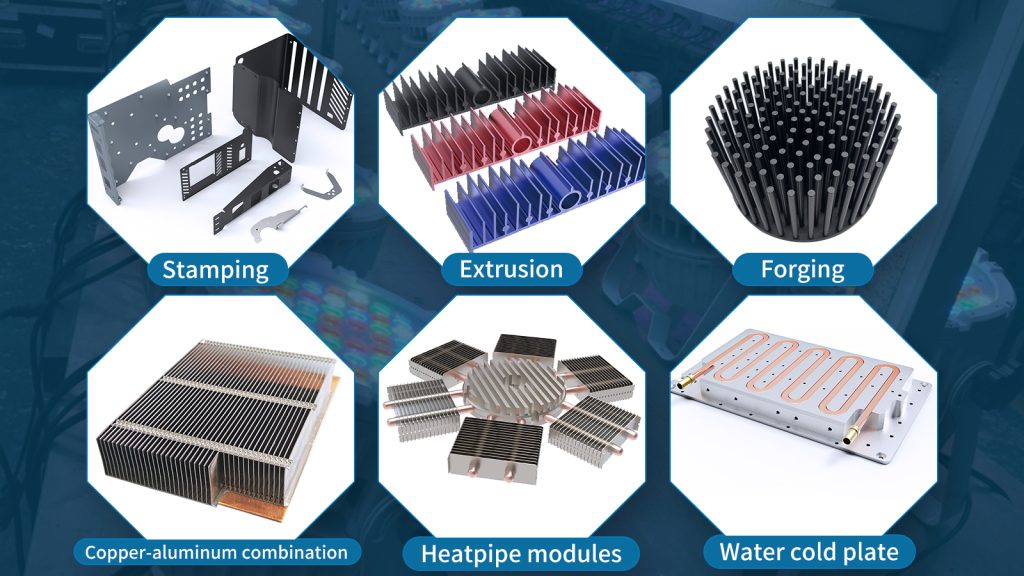
| Extruded Fin | The most common type; aluminum material is pushed through a die. Fins are parallel plates. | Cost-effective, good surface area-to-volume ratio. |
| Stamped Fin | Thin fins stamped from sheets of metal and attached to a base. | Low profile, used for lower power applications. |
| Bonded Fin | Fins are individually cut and then bonded (usually with epoxy or brazing) to a base. Allows for taller fins and higher fin density. | Higher performance than extruded; accommodates larger heat loads. |
| Skived Fin | A specialized process where a sharp blade “peels” and folds thin fins from a single block of material. | Allows for extremely thin and densely packed fins from a single block (monolithic). |
3. Advantages and Disadvantages
| Feature | Advantage (Passive) | Disadvantage (Passive) |
|---|---|---|
| Reliability | Virtually infinite Mean Time Between Failures (MTBF) as there are no moving parts. | Performance highly dependent on ambient conditions and orientation. |
| Acoustics | Completely silent operation (0 dBA). | Low cooling power capacity; struggles with high-TDP components. |
| Complexity | Simple design, minimal cost, and zero power consumption. | Requires a larger form factor and significant free space for natural airflow. |
| Control | No thermal control needed. | $R_{th}$ values are generally higher, requiring larger sizes to achieve target temperatures. |
Part II: The Active Advantage—Forced Convection for High Power
An active heat sink system utilizes an external, mechanical power source to force the cooling fluid (air or liquid) over the heat transfer surface. This forced movement dramatically increases the convection heat transfer coefficient, leading to a much lower thermal resistance and vastly superior cooling performance.
1. Operating Principle: Forced Convection and Low $R_{th}$
The core difference is the introduction of forced convection.
- Forced Convection: A mechanical device (fan, pump, blower) actively moves the cooling fluid at a high velocity across the heat sink’s surfaces. This higher velocity breaks up the insulating boundary layer of air/fluid that forms on the surface, dramatically increasing the rate of heat transfer.
- Result: Active systems provide precise temperature control and can effectively manage higher levels of heat dissipation (higher power density) in demanding applications.
2. Design and System Types
Active cooling extends beyond simple fan-heat sink assemblies to include highly sophisticated liquid and thermoelectric systems.
| Active System Type | Description | Typical Application |
|---|---|---|
| Fan-Sink Assembly | A standard finned heat sink paired with a DC fan (axial or blower). | Consumer PCs, high-end routers, gaming consoles. |
| Heat Pipe Technology | Utilizes a sealed tube with a working fluid (often water/methanol) to transfer heat via phase change (evaporation/condensation). Often used as a component within a larger heat sink. | Laptops, mobile devices, servers (to move heat from the chip to an external fin array). |
| Liquid Cooling (Water/Dielectric Fluid) | A pump moves a liquid coolant through a cold plate (water block) on the heat source and then to a remote radiator. | Data centers, supercomputers, extreme performance computing (CPUs/GPUs). |
| Thermoelectric Coolers (TECs) | A solid-state device that creates a temperature difference via the Peltier effect. Requires significant power and is used in conjunction with a conventional heat sink. | Niche applications requiring cooling below ambient temperature (e.g., lasers, sensors). |
3. Advantages and Disadvantages
| Feature | Advantage (Active) | Disadvantage (Active) |
|---|---|---|
| Performance | Achieves significantly lower $R_{th}$ values, allowing for cooling of components with power loads exceeding 250W. | System components (fans, pumps) have finite lifespans (MTBF) and require maintenance. |
| Size | Can cool high-power components with a smaller overall form factor compared to a passive solution for the same heat load. | Generates noise (audible operation) and requires external electrical power. |
| Control | Provides precise, dynamic thermal control via fan/pump speed based on thermal load (Pulse Width Modulation – PWM). | Higher initial cost and increased complexity (more points of failure). |
| Airflow | Airflow direction and velocity can be precisely controlled, allowing for optimal case design. | Can draw dust and contaminants into the system, requiring filters and cleaning. |
Part III: The Quantitative Core—Performance Metrics and Materials Science
The most rigorous way to compare active and passive cooling is through an analysis of performance metrics and the physical properties of the materials used.
1. Thermal Resistance ($R_{th}$) Comparison
The performance differential is best understood through the magnitude of $R_{th}$. While passive heat sinks generally reside in a higher $R_{th}$ range, advanced active systems push performance to its limit.
| Cooling Method | Typical Application Range | Approximate $R_{th}$ Range ($^\circ\text{C}/\text{W}$) | Key Limiting Factor |
|---|---|---|---|
| Passive (Simple Fin) | Low-power electronics, routers, lighting (5W – 25W) | $1.0$ to $5.0$ | Natural convection limit |
| Passive (Vapor Chamber/Heat Pipe) | High-end embedded systems (20W – 50W) | $0.19$ to $0.23$ (specific for $30,\text{W}$ load) | Heat pipe capacity and total surface area |
| Active (Forced Air) | Consumer CPUs, GPUs, Power Supplies (50W – 250W) | $0.1$ to $1.0$ | Fan noise, volume of air flow (CFM), and pressure drop |
| Active (Liquid Cooling) | High-performance servers, overclocked PCs (100W – 400W+) | $<0.1$ (for high-end systems) | Coolant temperature, pump capacity, radiator size |
The data clearly indicates that for high-wattage components, where a low $R_{th}$ is mandatory to maintain a safe junction temperature ($T_{j}$), an active solution is the only viable option.
2. The Critical Role of Heat Sink Materials
Regardless of whether a system is active or passive, the material composition is fundamental to conduction efficiency. The selection is a complex trade-off between thermal conductivity, cost, weight, and manufacturability.
| Material | Thermal Conductivity ($\text{W}/(\text{m}\cdot\text{K})$) | Pros | Cons |
|---|---|---|---|
| Copper (Cu) | $\sim 400$ | Excellent thermal conductivity (highest among common metals). | High cost, heavy, difficult to machine, and heavier than aluminum. |
| Aluminum (Al) | $\sim 200 – 240$ | Good thermal conductivity, lightweight, highly cost-effective, easy to manufacture (extrusion). | Lower conductivity than copper; less effective for small, high-density heat loads. |
| Graphite (Pyrolytic) | $\sim 500$ (in-plane) | Extremely high in-plane conductivity, ultra-lightweight. | High cost, low through-plane conductivity, often used as a heat spreader, not a bulk heat sink. |
Due to its optimal balance of thermal performance, weight, and manufacturing flexibility, aluminum remains the best heat sink material for the majority of applications. High-performance active solutions often utilize a copper base plate (for superior conduction from the chip) mated to aluminum fins (for lighter weight and cheaper mass production).
Part IV: The Hybrid Frontier and Future Innovations
As power densities continue to climb, a simple choice between fully active and fully passive is often insufficient. This gap is being bridged by hybrid heat sinks and cutting-edge design technologies.
1. Hybrid Heat Sink Technology
Hybrid heat sinks represent the best of both worlds, intelligently combining passive structures with an active element that engages only when necessary.
- Principle: A standard passive heat sink (fins, often with heat pipes) is integrated with a fan or blower. The system includes a control circuit that monitors the component’s temperature.
- Operation: At low-to-moderate power consumption, the system operates completely silently and passively. When the thermal load exceeds a pre-set threshold (e.g., $60^\circ\text{C}$), the active element (the fan) is automatically engaged to introduce forced convection, dropping the $R_{th}$ and bringing the temperature back down.
- Advantage: Provides silent, zero-power operation for common tasks while maintaining the necessary high-capacity cooling for peak-load scenarios.
2. The Future of Heat Sink Design
Innovations are being driven by advanced manufacturing and computational power:
- AI-Optimized and 3D-Printed Designs: Tools leveraging artificial intelligence (AI) and topology optimization are generating complex, non-intuitive heat sink geometries that were previously impossible to manufacture. These organic shapes, often produced via metal 3D printing, have shown enhanced overall thermal performance.
- Microchannel and Micro-jet Cooling: For extreme heat flux applications (like in military radar or advanced microprocessors), microchannel liquid cooling designs reduce the thermal path length and maximize surface area in extremely small volumes.
- Vapor Chambers: While an established technology, the refinement of ultra-thin, high-performance vapor chambers is critical for passive cooling in compact mobile and embedded devices.
Part V: Application-Driven Selection Criteria
The choice between an active and passive heat sink is rarely a matter of preference; it is a direct consequence of the application’s unique constraints.
1. When to Choose a Passive Heat Sink
Passive solutions are optimal when reliability, silence, and low maintenance are prioritized over maximum thermal capacity.
- Low Power Dissipation (P < 50W): Embedded systems, IoT devices, residential routers, low-power microcontrollers.
- Harsh or Dusty Environments: Since there are no moving parts, passive heat sinks are less susceptible to failure from dust ingress, vibration, or shock. This is common in industrial controls or outdoor telecommunications enclosures.
- Fanless/Silent Requirements: Audio-visual equipment (AV receivers), low-noise industrial PCs, and home theater PCs (HTPCs).
2. When to Choose an Active Heat Sink
Active solutions are essential when maximum performance and a low $R_{th}$ are non-negotiable.
- High Thermal Design Power (TDP > 50W): High-performance gaming PCs, corporate server racks, data center equipment, and powerful graphics workstations.
- Size Constraint: When the enclosure volume is limited, an active solution allows for a smaller physical heat sink (lower mass) to achieve the same cooling capacity as a much larger passive solution.
- Precise Temperature Control: Applications where operating temperature must be tightly regulated (e.g., medical devices, laser systems, telecommunication base stations).
3. Case Study Matrix: Active vs. Passive
| Application Scenario | Primary Constraint | Recommended Solution | Rationale |
|---|---|---|---|
| Data Center Server CPU | Extreme power density and uptime (low $R_{th}$) | Active (Liquid or Forced Air) | Requires lowest possible $R_{th}$ for high-wattage CPUs (300W+); thermal performance outweighs noise/cost. |
| Industrial Panel PC | Reliability, dust, no maintenance (high MTBF) | Passive (Bonded/Skived Fin) | Power is moderate; needs silent operation and no mechanical failure in a factory environment. |
| High-End Gaming Laptop | Extreme size constraint, high power density | Active (Heat Pipes + Blower/Fan) | Forced air is necessary to move heat away from a thin chassis to a small fin stack. |
| Residential Wi-Fi Router | Low power, low cost, silent operation | Passive (Extruded Fin) | Low TDP ($<10\text{W}$) allows for simple, cost-effective passive solution. |
Conclusion: The Thermal Engineering Discipline
The distinction between active and passive heat sinks is more than a design choice; it is a statement about the system’s performance profile and operational priorities. Passive cooling offers unparalleled reliability and simplicity, perfect for low-to-moderate power applications where longevity and silence are critical. Active cooling, through the mechanisms of forced convection and phase change, provides the brute-force thermal capacity necessary to manage the extreme heat fluxes of modern high-performance computing.
As power densities continue to rise across nearly all electronic sectors, the future of thermal management will increasingly rely on the intelligent deployment of hybrid systems and the integration of cutting-edge technologies like AI-optimized geometries and advanced fluid dynamics to keep the digital world cool, efficient, and reliable. The thermal engineer’s challenge is not just to dissipate heat, but to select the most efficient, cost-effective, and E-E-A-T-compliant solution for the job.