Efficient Heat Sinks and Piping Systems for Large-Scale Data Centers
As European data centers face stricter sustainability regulations and surging AI compute demands, optimizing thermal management is critical. Upgrading your server-level thermal modules and facility-level loops is the fastest way to lower Power Usage Effectiveness (PUE). This guide provides data-driven answers to the most common engineering queries regarding data center cooling.
Can You Suggest Some Efficient Heat Sinks for a Large-Scale Data Center?
Yes. For large-scale facilities managing varying thermal design power (TDP), you must match the heat sink technology to the specific processor workload. Relying on basic extruded aluminum is no longer sufficient.
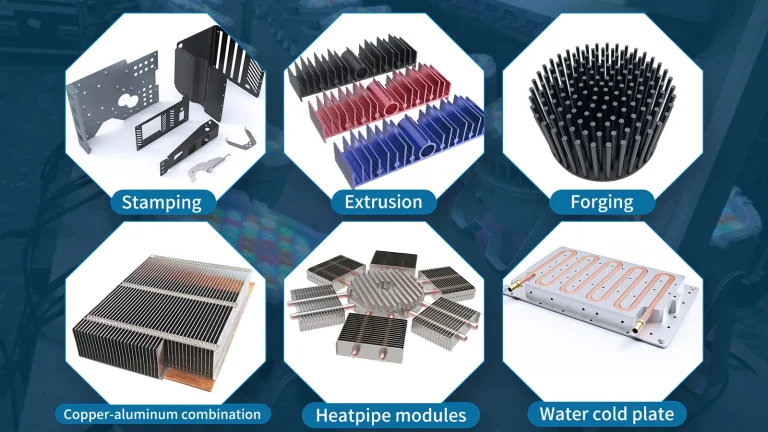
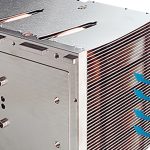
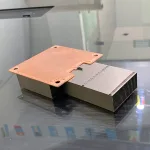
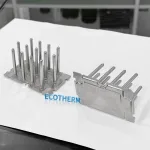
For 200W – 350W TDP (Standard Servers): Skived Fin Heat Sinks are the most efficient. They offer a monolithic structure (no thermal interface resistance between the base and fins) and can achieve extremely thin fin pitches (down to 0.2mm), increasing the surface area by 40% compared to extrusions.
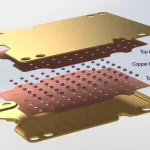
For 350W – 500W TDP (High-Density Nodes): 3D Vapor Chambers (VC) integrated with Zipper Fins are recommended. They provide two-dimensional heat spreading, eliminating localized hot spots on large CPU dies.
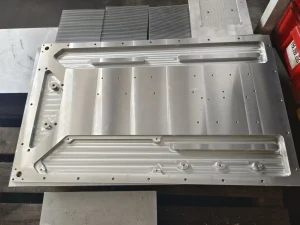
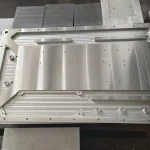
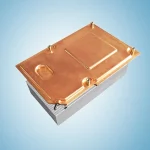
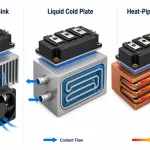
For >700W TDP (AI & GPU Clusters): Air cooling fails here. You must transition to Liquid Cold Plates (often CNC machined with micro-channels) connected to facility piping systems.
If I Upgrade My Heat Sinks, How Much Can I Expect the Cooling Efficiency to Improve?
Upgrading from legacy heat sinks to advanced heat pipe or vapor chamber modules yields measurable improvements in facility-wide energy efficiency.
Impact on Energy Consumption: By reducing the thermal resistance ($\theta_{JA}$) at the chip level from 0.15 °C/W to 0.05 °C/W, servers require less aggressive fan curves.
Data Dimension: Server fans can consume up to 15% of total rack power. Advanced heat sinks can lower fan speeds by 20-30%, directly reducing the server’s power draw by up to 8%. Consequently, the facility’s overall PUE can drop from an average of 1.5 to approximately 1.35.
How to Efficiently Distribute Heat Sinks and Design a Layout in the Data Center?
The optimal location for placing heat sinks is deeply tied to the server chassis layout and the hot-aisle/cold-aisle containment strategy.
Server-Level Layout: Heat sinks must be placed in a staggered array directly behind the primary intake fans. High-TDP components (like CPUs) should be placed closest to the cold air intake, while lower-TDP components (like memory modules) are positioned downstream.
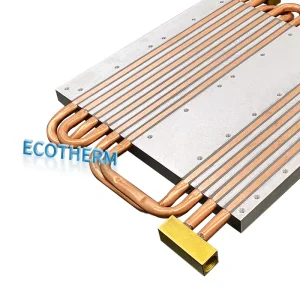
Facility-Level Distribution: To distribute heat efficiently, avoid packing too many high-power 1U servers in the upper third of the rack where ambient temperatures naturally peak. Use specialized Heat Pipe Cooling Modules to transport heat away from densely packed zones to larger remote fin stacks near the server exhaust.
Efficient Data Center Piping Systems: Bridging High-Performance Heat Pipes and Liquid Loops
When discussing pipe systems for high performance data centers, we must distinguish between internal server heat pipes and facility piping solutions.
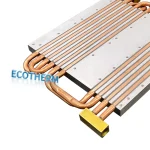
Component Heat Pipes: Copper tubes containing a phase-change fluid (water). They operate passively and have a thermal conductivity of up to 100,000 W/m·K.
Data Center Piping Solutions: For racks exceeding 40kW, traditional HVAC fails. You need efficient data center piping systems (coolant distribution loops). Using stainless steel blind-mate manifolds with drip-free quick disconnects ensures that liquid is delivered safely to D2C (Direct-to-Chip) cold plates. This integration of internal cold plates with external piping is the ultimate sustainable solution for AI data centers.
What is the Life Expectancy of a Heat Sink in a Data Center?
The life expectancy of a purely passive solid-metal heat sink (skived or extruded) is virtually infinite (20+ years), limited only by dust accumulation and severe oxidation.
However, for active phase-change devices:
Heat Pipes and Vapor Chambers: Have a life expectancy of 70,000 to 100,000 hours (roughly 8 to 11 years) in a data center environment.
Failure Modes: The primary cause of failure is the degradation of the vacuum seal or dry-out of the sintered capillary wick due to sustained operation above their maximum temperature threshold (typically >120°C).
Best Practices for Deploying Heat Sinks in European Data Centers
To meet European ESG directives and minimize carbon footprints:
Material Sourcing: Use 100% recyclable AL6063 aluminum or C1100 copper.
Regular Maintenance: Implement a strict schedule to vacuum dust from fin gaps every 12 months. A 1mm layer of dust can increase thermal resistance by 15%.
Transition Plan: Combine advanced air heat sinks for legacy racks and sustainable liquid piping systems for new AI clusters to optimize capital expenditure (CapEx).
Frequently Asked Questions about Data Center Cooling
Heat sinks do not reduce the heat generated; they efficiently transfer it away from critical components into the airflow.
Processors generate heat via electrical resistance. A heat sink increases the surface area exposed to the cooling medium (air or liquid). By minimizing thermal resistance, heat sinks ensure the silicon remains below 85°C, preventing thermal throttling and avoiding hardware failure, which in turn reduces the workload on the facility’s HVAC system.
Directly on high-power chips (CPUs/GPUs), aligned parallel to the primary cold aisle airflow.
Within the server chassis, the fin orientation of the heat sink must exactly match the direction of the system fans blowing air from the cold aisle to the hot aisle. Misaligned fins create aerodynamic impedance, causing air turbulence and destroying cooling efficiency.
Closed-loop, leak-proof manifold systems utilizing recycled materials and eco-friendly coolants.
Sustainable piping systems utilize high-grade stainless steel to prevent corrosion, eliminating the need for frequent part replacements. They deploy environmentally safe, non-toxic dielectric fluids or treated water, and integrate with heat recovery systems to repurpose captured server heat for district heating.
Yes, migrating from extruded to skived fin heat sinks regularly yields double-digit efficiency gains.
A recent case study involving a European cloud provider showed that replacing standard bonded-fin heat sinks with custom copper skived-fin modules on 300W servers reduced CPU core temperatures by 8°C. This allowed a 20% reduction in server fan speeds, saving thousands of kilowatts annually.
Redundant, dual-loop liquid distribution manifolds with drip-free quick disconnects.
High-performance AI data centers require piping systems that distribute chilled fluid directly to the rack. The best systems use a primary facility water loop connected to a secondary, purified IT cooling loop via a Coolant Distribution Unit (CDU), ensuring leaks never affect building infrastructure.
High-efficiency heat sinks drastically lower IT fan power and HVAC load, minimizing overall energy consumption. Poor heat sinks trap heat, forcing internal server fans to spin at 100% RPM (consuming up to 60W per fan). Highly conductive heat sinks (like Vapor Chambers) quickly dissipate heat, keeping fans at idle speeds and allowing the facility to safely raise its ambient temperature, saving massive amounts of compressor energy.