AI Server Cold Plate Requirements: An RFQ Checklist
AI server cold plate requirements should describe the processor interface, heat load and liquid conditions that the component must work with. A GPU name, rack power figure or reference photo alone cannot define a custom plate.
For a useful quotation, connect each CPU or GPU to its mounting geometry, temperature target and available coolant conditions. Then agree what the supplier will manufacture and how the result will be checked. This checklist covers single-phase cold plates for server hardware; two-phase and immersion systems need different requirements.
You do not need a finished design to start a discussion. Share the information you have and identify what remains open, rather than turning an assumption into a fixed specification.
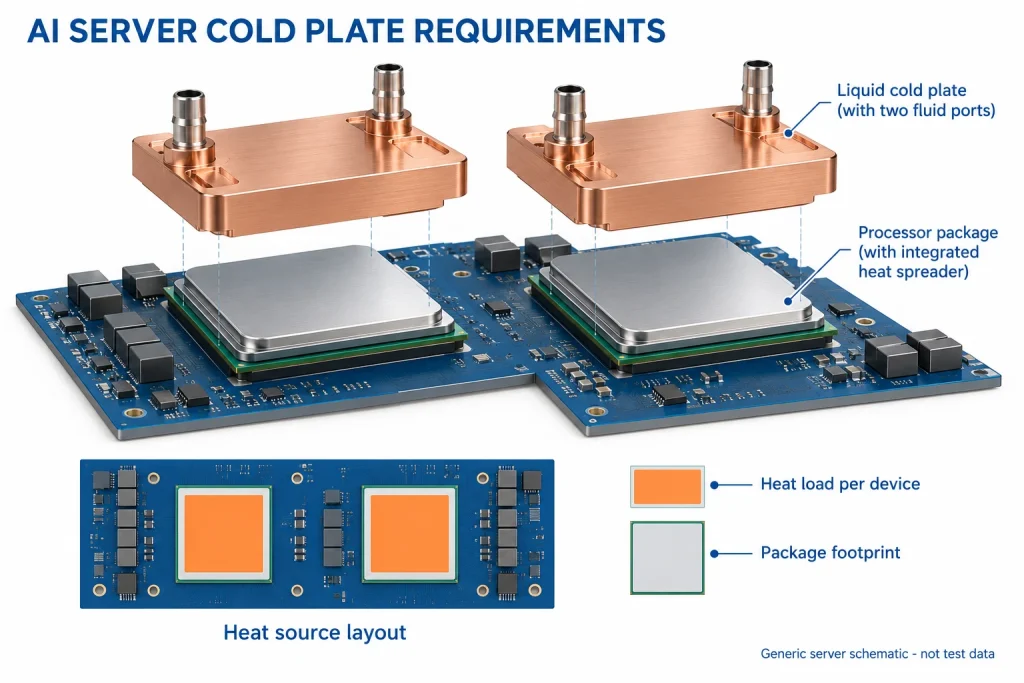
Map the Heat Load to Each CPU or GPU
Identify the server platform and the CPU or GPU package for each cold plate. List each device’s location, footprint dimensions if available, and known areas of concentrated heat. Keep these device-level loads separate from total server or rack power. A PSU’s rated wattage is not the heat load on an individual processor.
Share the design power for each device and the operating cases the cooling design must cover. Label whether a value comes from platform documentation, an engineering estimate or a measurement, and include its source or revision. A processor name alone does not define the workload or design condition.
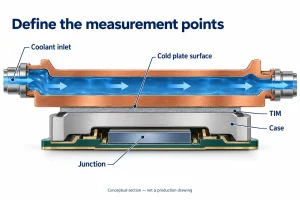
Also state which temperature must remain within a limit: junction, package lid or integrated heat spreader (IHS), case, or cold-plate face. These are different references. A limit at one location cannot simply be transferred to another without the package, interface and thermal model needed to relate them.
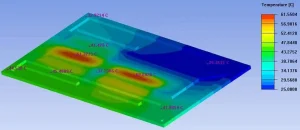
A marked-up layout is useful even when no CFD model exists. Show device outlines, positions, individual heat loads and uncertain values. Eaton’s custom cold-plate design guidance similarly identifies component dimensions, heat-load locations and operating conditions as inputs to a thermal map.
For an early RFQ, a clear layout and a list of open questions are more useful than a detailed-looking heat map with no defined operating condition.
Define Coolant Conditions at the Cold Plate, Not Only at the Rack
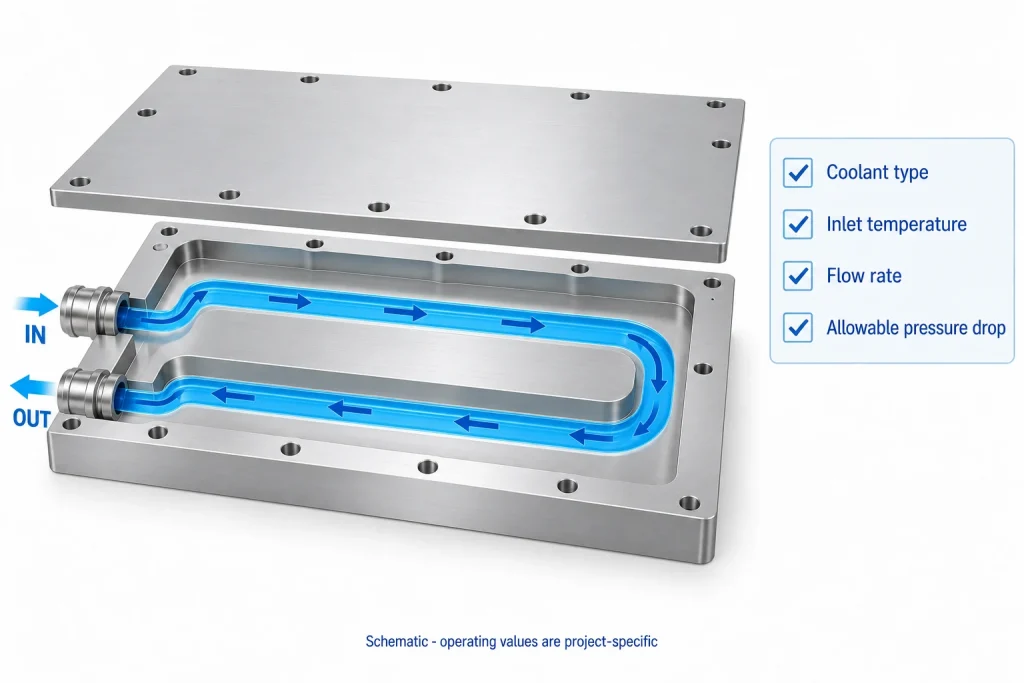
Specify the fluid type, concentration where applicable, and inlet temperature at the cold plate. State the measurement location. A facility-water temperature or a rack-level setpoint does not, by itself, define the fluid condition reaching the processor plate.
Provide the required or available flow per plate or parallel branch. Rack-total flow alone cannot show what each plate receives. If several plates share a loop, include a simple diagram of the series or parallel arrangement, manifolds and other relevant restrictions. Mark the flow distribution as an open design item if it has not been established.
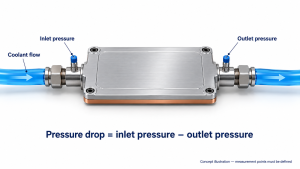
Define allowable pressure drop at a stated flow, coolant composition and temperature. Keep that separate from working pressure and the pressure used for a particular validation or leak test. These describe different requirements. A supplier’s pressure-flow curve also needs a defined configuration: bare plate, plate with fittings, or an assembly with hoses and quick disconnects.
Coolant selection should consider every wetted material in the agreed loop. Do not assume that deionized water, a particular glycol concentration or a surface treatment is universally suitable. Provide the platform’s coolant and material restrictions when available.
Before comparing quotations, check that they use the same fluid conditions and measurement endpoints. Otherwise, apparently similar thermal or pressure-drop values may describe different tests and different supplied assemblies.
Send the Board, Mounting and Service Envelope
The mechanical package needs more than the outside dimensions of the plate. Send 2D drawings and a 3D model if available, together with the relevant board, socket or accelerator-package references and their revisions.
Identify whether the cold plate contacts an IHS or an exposed die. These interfaces are not interchangeable. Include the applicable thermal interface material (TIM), approved loading requirements, mounting-hole pattern and retention arrangement. Do not transfer a flatness, force or tightening value from a different processor package.
OCP’s cold plate development and qualification guidance connects mechanical design to processor specifications, keep-out zones and retention loads. Treat those platform requirements as design inputs rather than assuming that a visually similar cold plate will fit.
Show nearby memory, VRMs, connectors and the available server height. Include port orientation, hose routing, bend-radius constraints and access to quick disconnects. Explain how technicians will reach fasteners and remove the assembly for service. A plate may fit in its installed position yet be difficult to connect or replace.
Our GPU and CPU cold plate design overview provides broader design context. For an RFQ, turn the relevant constraints into drawing references and clearly marked interfaces.
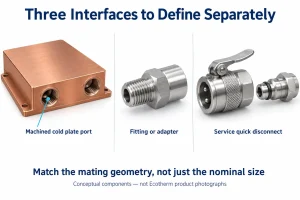
Finally, define the supply boundary: plate only, or a specified assembly. List which fittings, hoses, sensors or connectors the supplier is expected to provide and which parts belong to the customer’s system.
Agree the Validation Scope and Production Records
Separate what must be proven during development from what must be recorded in production. Thermal performance, hydraulic performance, mechanical checks and reliability qualification can require different samples and conditions. Agree which activities belong in the quotation and who approves their results.
For each required test, define the method, setup, operating conditions, acceptance limit, units, sample quantity and report format. Pressure-decay and tracer-gas leak testing are possible approaches to evaluate against the requirement, not interchangeable labels or universal defaults. A leak-test pressure does not establish a burst-pressure rating or lifetime qualification.
Likewise, a successful factory leak test should not become an unrestricted promise that a system can never leak in service. Assembly connections, installation and operation have their own verification requirements.
For recurring production, specify the dimensional and leak-test records required with each shipment. Agree how those records identify the part, drawing revision and lot or serial number. Material traceability, cleanliness, handling and port protection should be included where the project requires them. Ask the supplier to confirm what documentation can actually be provided.
State prototype quantity, qualification samples, production lot size and forecast demand separately. Also distinguish a requested delivery date from a confirmed commitment. Comparing quotations is easier when the same finishing, testing, documentation and assembly scope is included in each offer.
Build an RFQ Package Without Waiting for Every Detail
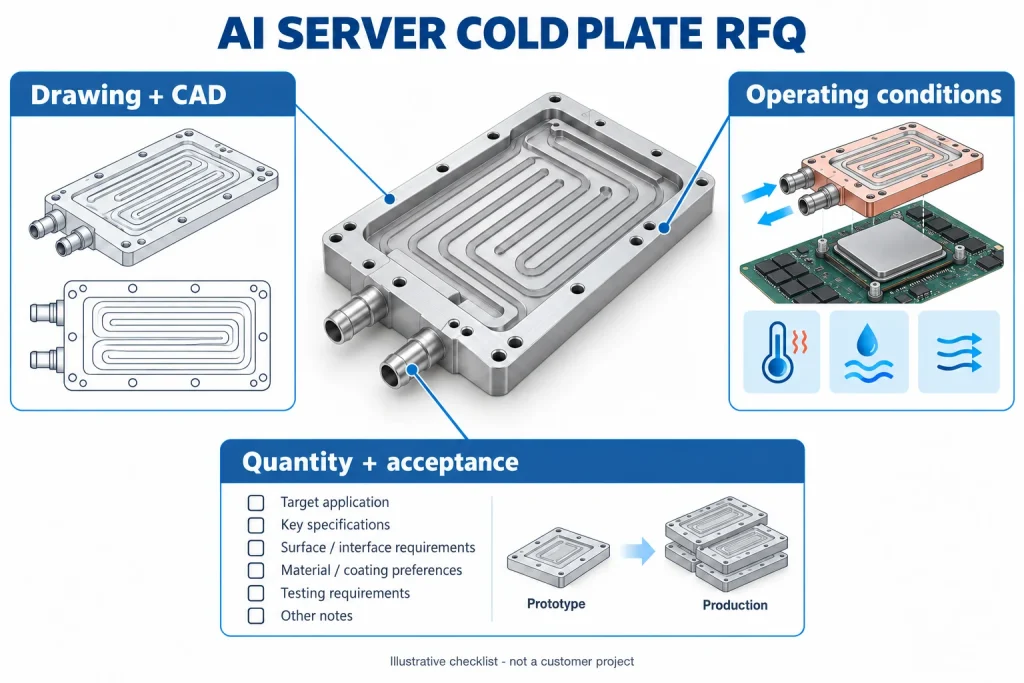
For an initial discussion of AI server and GPU cooling projects, send the application, available drawing or layout, device heat loads if known, and expected quantities. Mark unknown values as TBD. A supplier can then identify which missing inputs affect the next review step.
Use this short package to organize the follow-up:
| File or information group | Include | If not final |
|---|---|---|
| Layout or CAD | Device locations, board envelope, mounting and ports | Send a marked-up image or preliminary layout |
| Thermal brief | Heat load per device, operating cases and temperature references | Identify the source of estimates and open limits |
| Loop conditions | Coolant, inlet temperature, per-plate flow and pressure-drop budget | State which conditions still need system review |
| Quantity and acceptance | Prototype and production quantities, tests and required records | Separate targets from agreed requirements |
This is a starting checklist, not a requirement to complete every field before contacting a manufacturer. Keep conditions consistent across the drawings and specification, and give the supplier a clear revision to quote against.
For custom liquid cold plate manufacturing, send Ecotherm the drawing package and operating conditions you have. Identify whether the request is build-to-print or needs design review, and specify the component or assembly scope. The next discussion can then focus on manufacturability and the information needed to evaluate the proposed plate.