Industrial Server Cooling for High-Density Systems
As servers pack more power into smaller spaces, managing heat becomes critical. AI servers, GPU platforms, HPC clusters, edge computing nodes, and telecom gear all generate high heat in tight enclosures. Without proper cooling, temperatures rise, performance can drop, and components face stress.
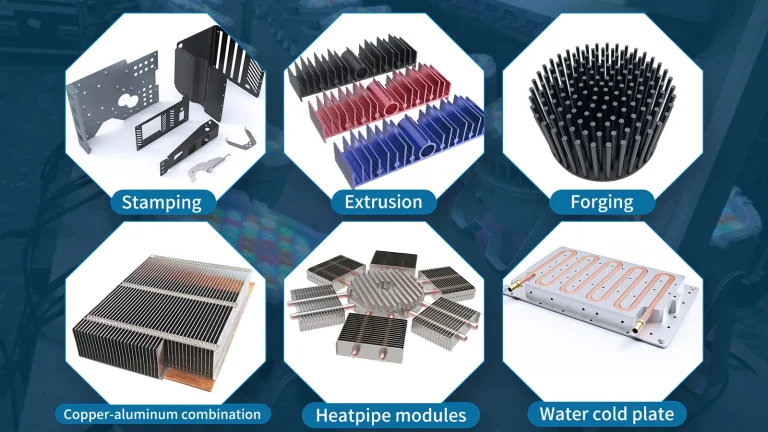
Industrial server cooling keeps processors, accelerators, power electronics, and supporting hardware within safe operating limits. Depending on heat load and space constraints, solutions include custom heat sinks, liquid cold plates, or a mix of both.
Ecothermgroup provides engineering, simulation, prototyping, and manufacturing support for high-performance server cooling projects.
Cooling Approaches
Industrial servers generally use either air-cooled heat sinks or liquid-cooled cold plates.
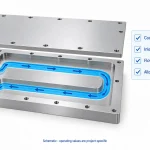
Heat sinks transfer heat to airflow through the chassis and suit moderate-power applications. Liquid cold plates circulate coolant near the heat source, offering higher thermal capacity for dense systems like AI servers and GPU clusters.
| Cooling Method | Typical Application |
|---|---|
| Custom heat sink | Moderate heat loads, standard rack systems |
| Custom liquid cold plate | High-density servers, AI/GPU workloads |
| Copper heat sink | Localized hot spots needing high conductivity |
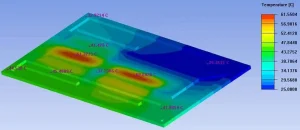
Design starts with heat load analysis, airflow, space, material choice, and target temperatures. Thermal simulation helps validate designs before production.
Applications in AI, GPU, HPC, and Edge Systems
Modern processors and accelerators push traditional cooling to its limits. AI training servers, GPU clusters, and HPC nodes generate concentrated heat, often requiring custom solutions.
Liquid cold plates are used near CPUs, GPUs, and accelerators for direct heat removal, while heat sinks handle lower-power areas or sections with sufficient airflow. Edge and telecom systems need compact designs that maintain reliable operation under varying environmental conditions.
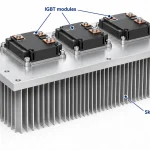
These principles also apply to power electronics like IGBT modules and inverters. Cooling choice depends on thermal load, mechanical constraints, space, and integration requirements.
Custom Heat Sink Solutions
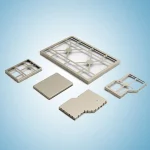
Heat sinks are widely used in industrial servers. Their performance depends on material, geometry, airflow, and interface quality. Aluminum is lightweight and easy to machine, while copper offers higher thermal conductivity for dense or high-power applications.
| Material | Typical Use |
|---|---|
| Aluminum | Lightweight, general server cooling |
| Copper | High-power, compact designs |
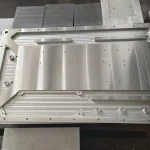
Custom heat sinks are usually CNC machined to fit airflow, mounting, and space constraints. Simulation can optimize fin layout before production.
RFQ essentials for heat sinks:
- Heat load requirements
- 2D drawings or 3D CAD models
- Expected production volumes
Liquid Cold Plate Cooling
For systems beyond air cooling limits, liquid cold plates remove heat via circulating coolant. They are common in AI, GPU, HPC, and high-power electronics.
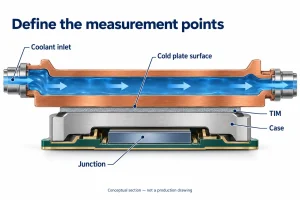
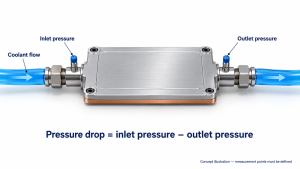
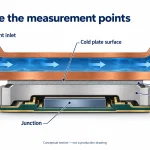
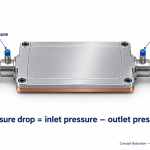
Design factors include thermal load, coolant type, flow rate, pressure drop, channel layout, and mechanical integration. Manufacturing may involve CNC machining, bonded assemblies, leak testing, and surface finishing. Simulation and testing verify performance before production.
Heat Sink vs. Liquid Cold Plate
Choice depends on power density, system design, maintenance, and space.
| Feature | Heat Sink | Liquid Cold Plate |
|---|---|---|
| Thermal Capacity | <200 W/module | >400 W/module |
| Materials | Aluminum, copper | Copper/aluminum with custom channels |
| Integration | Airflow dependent, simple install | Needs coolant loop and support hardware |
| Maintenance | Low | Periodic fluid checks |
Heat sinks suit simplicity and low-maintenance projects. Liquid cold plates handle high-density thermal loads. Custom engineering is often needed for either approach. Sharing thermal data, material choices, and mechanical constraints ensures system compatibility.
Engineering and Manufacturing
Cooling design starts with heat-load assessment and system review. Engineers check heat sources, operating limits, airflow, and mechanical constraints. Early simulation reduces iterations and identifies bottlenecks.
| Component | Purpose |
|---|---|
| Custom heat sink | Increase heat-transfer surface area |
| Liquid cold plate | Remove heat from high-power processors |
| Power module heat sink | Control temperatures in power electronics |
| Thermal interface assembly | Reduce contact resistance |
Manufacturing includes CNC machining for heat sinks and channel fabrication, joining, leak testing, and finishing for cold plates. Design-for-manufacturing checks help avoid production issues. Providing CAD files, thermal load, flow specs, material choice, and forecast volumes speeds development. Validation includes dimensional checks, leak testing, and thermal performance testing.
RFQ Requirements and Planning
Well-prepared RFQs reduce revisions and speed feasibility assessment. For heat sinks and cold plates, share detailed technical information upfront.
| Component | Critical RFQ Details |
|---|---|
| Custom Heat Sink | Material, base thickness, fin density, surface finish, mounting |
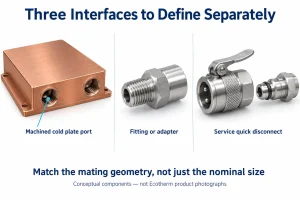
| Liquid Cold Plate | Flow rate, pressure drop, channel layout, thermal load, connectors |
| Thermal Assembly | Chassis integration, airflow path, fan/pump interfaces, overall size |
RFQ Checklist
- Provide server specs, thermal maps, and heat flux data.
- Define materials, tolerances, and thermal targets.
- Submit drawings and CAD files with installation limits.
- Specify coolant, flow, and pressure-drop limits if applicable.
- Identify prototypes and production volumes.
- Align prototype, testing, and production schedules.
- Include environmental requirements like ambient temperature, vibration, or EMI limits.
Project planning should cover prototyping, testing, scalability, MOQ, and lead times. Early supplier engagement supports DFM reviews, simulation, and design refinement.
FAQs
Industrial server cooling options?
Custom heat sinks, liquid cold plates, or integrated thermal assemblies. Choice depends on power density, space, and system design.
Difference between heat sinks and cold plates?
Heat sinks rely on airflow and conduction; cold plates use coolant for direct heat removal in higher-power, dense systems.
Information needed to select a cooling approach?
Power density, airflow, ambient temperature, material, thermal resistance, pressure-drop limits, flatness, and integration constraints.
Why RFQ preparation matters?
It lets suppliers assess feasibility, reduce risk, and give accurate recommendations for custom thermal components.
Can cooling improve server performance?
Lower temperatures reduce thermal throttling, stabilize sustained workloads, and protect long-term reliability in AI, GPU, HPC, data center, and edge systems.
Contact Ecothermgroup
If you need custom heat sinks, liquid cold plates, or full thermal assemblies for AI servers, GPU clusters, HPC systems, telecom, or industrial electronics, provide thermal specs, drawings, and production targets early. Ecothermgroup offers design review, simulation, prototyping, and manufacturing to align cooling with system requirements.