Custom Vapor Chamber Heatsink & 3DVC Thermal Systems
Tailored Solutions for High-Power Applications
Sample MOQ for 1 pc
Free Thermal Evaluation
24h Quick Quotation
100% Full Inspection
Custom Manufacturing of Vapor Chamber Heat Sinks
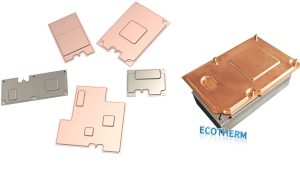
Custom Vapor Chamber Manufacturing: Engineered to Your CAD Specs
From ultra-thin profiles to advanced 3D vapor cooling modules built for AI data center liquid/air cooling loops, we resolve high-heat-flux bottlenecks. Upload your 3D models for immediate manufacturing evaluation.
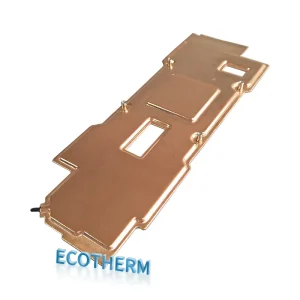
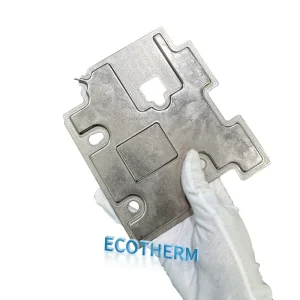
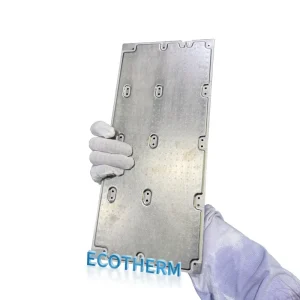
vapor chamber (VC), also known as a vapor chamber heat spreader, is a high-efficiency thermal management device based on liquid phase-change principles. It typically consists of a vacuum-sealed enclosure with microstructured surfaces, containing a working fluid such as water, ethanol, or ammonia.
What is vapor chamber cooling?
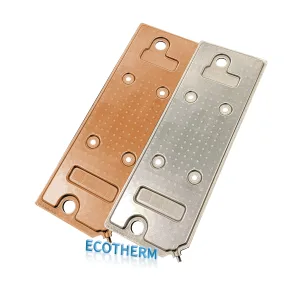
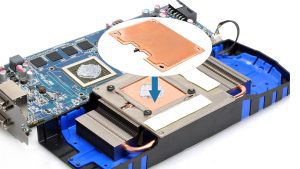
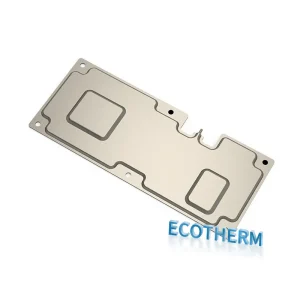
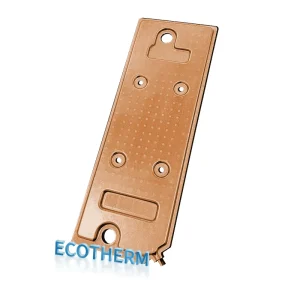
A vapor chamber (also widely referred to as a vapour cooling chamber in European engineering standards) is a vacuum-sealed, planar heat spreader typically manufactured from copper. By utilizing a continuous cycle of liquid evaporation and condensation within an internal wick structure, it achieves exceptional two-dimensional (2D) heat spreading. It is engineered to resolve high-heat-flux bottlenecks in CPUs, GPUs, and compact high-performance electronics where standard solid metal fails.
Vapor chambers—also known as planar heat pipes or vapor heat spreaders—leverage the exceptional heat transfer capacity of two-phase cooling within a planar footprint.
The Heat Dissipation Mechanism
While vapor chambers and heat pipes share the same core working principle of two-phase cooling, their heat transfer pathways differ significantly. Because vapor chambers utilize two-dimensional (2D) planar heat spreading, they are uniquely engineered to resolve far more demanding, high-heat-flux thermal challenges.
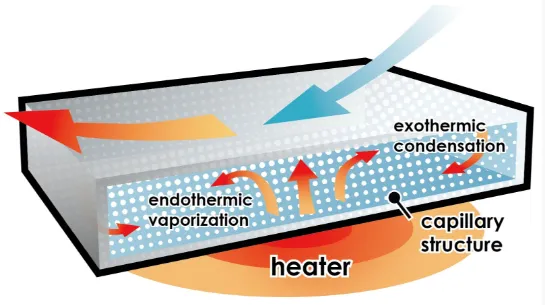
Structurally, a vapor chamber is a vacuum-sealed envelope featuring an internal capillary wick. As the working fluid absorbs heat at the source, it rapidly vaporizes and diffuses toward the cooler condensation zone. After transferring its latent heat to the external environment, the vapor condenses back into a liquid. The internal wick structure then uses capillary action to pull the liquid back to the heat source, creating a continuous, self-sustaining cooling cycle.
3D Vapor Chamber
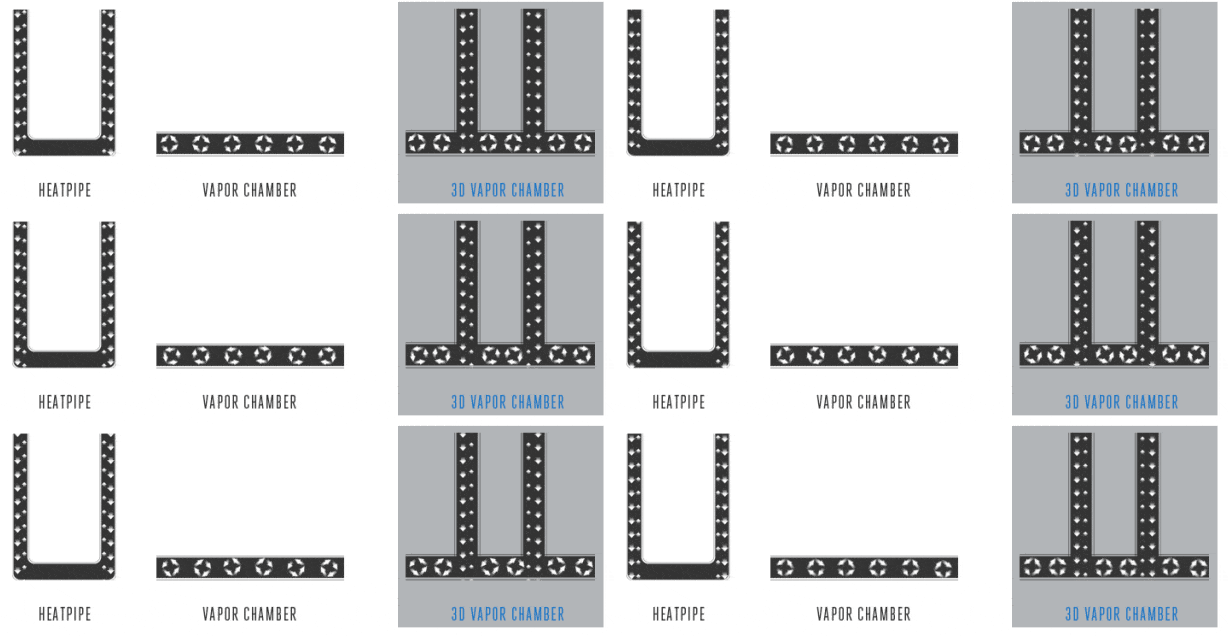
Effect diagrams of the working principles of heat pipes, VC and 3DVC
Heatpipe:Traditional heat pipe technology has good vertical heat conduction performance.
Vapor Chamber:A planar vapor chamber can efficiently transfer heat horizontally within the heat-generating area.
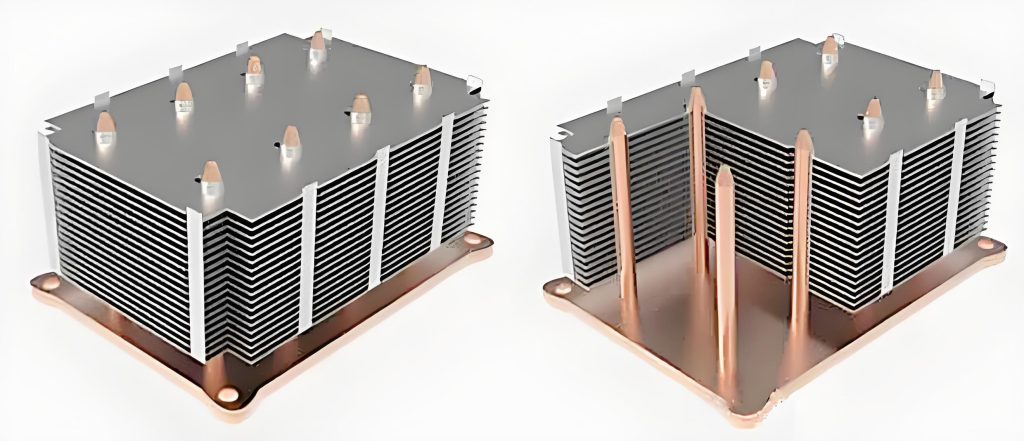
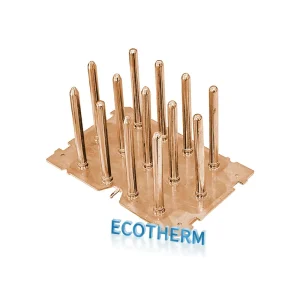
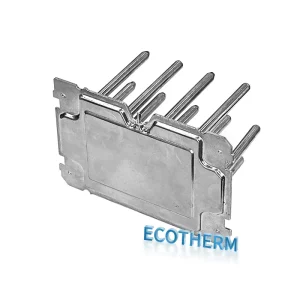
3D vapor chamber:3DVC combines four vertical heat pipes and a planar vapor chamber without barriers, forming an internally connected solid unit that conducts and dissipates heat more effectively.
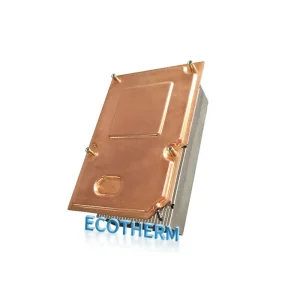
3D vapor chamber heat sink is a device that utilizes 3D vapor chamber technology to achieve efficient heat dissipation. It features a specific structural design and heat dissipation mechanism, typically paired with components like cooling fins and fans to enhance heat dissipation performance. Its primary function is to rapidly dissipate heat generated by electronic devices, ensuring they operate within normal temperature ranges.
How does 3D vapor chamber cooling differ from traditional 2D vapor chambers or heat pipes?
3D vapor chamber heat sink is a device that utilizes 3D vapor chamber technology to achieve efficient heat dissipation. It features a specific structural design and heat dissipation mechanism, typically paired with components like cooling fins and fans to enhance heat dissipation performance. Its primary function is to rapidly dissipate heat generated by electronic devices, ensuring they operate within normal temperature ranges.
What is the core heat dissipation principle of a 3D vapor chamber?
Heat evaporates working fluid at hot spots. Vapor rapidly flows through the chamber’s open core to cooler regions, condenses releasing heat. Condensed liquid returns via capillary action through an internal wick structure lining the 3D walls. The 3D geometry provides shorter vapor paths, larger condensation areas, and integrated wicking throughout the complex shape for efficient return.
What Are The Advantages Of A Vapor Chamber Heat Sink?
Rapid heat conduction, ideal for high power density applications.
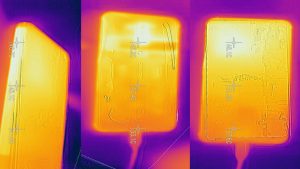
Reduces hotspots and enhances device stability.
Supports various sizes and shapes, compatible with other heat dissipation solutions.
Suitable for high-performance applications like servers, GPUs, and CPUs.