Thermal Management in Electric Vehicle Inverters
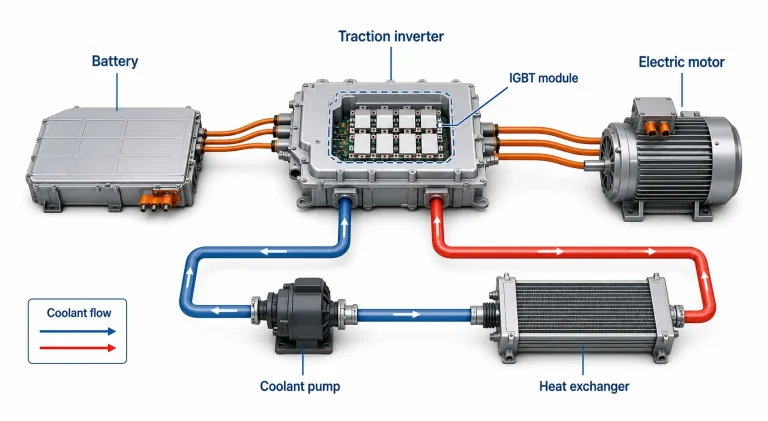
The traction inverter is one of the most thermally demanding assemblies in an electric vehicle. It converts the battery’s DC power into controlled three-phase AC power for the traction motor, while also handling rapid changes in current during acceleration and regenerative braking.
IGBT modules and their free-wheel diodes generate heat through conduction and switching. The resulting temperature must be controlled without adding excessive weight, volume or pumping power. This makes thermal management a central part of electric vehicle control-system design rather than a secondary packaging task.
The Inverter Thermal Challenge
An EV inverter must operate across a wide range of ambient temperatures and load conditions. A vehicle may move slowly in traffic, accelerate at high torque, descend a hill under regenerative braking or remain under continuous load on a highway. Each condition changes semiconductor losses and coolant demand.
The thermal design must control both average temperature and temperature cycling. Repeated temperature swings can fatigue solder layers, bond wires, substrates and other internal connections. A design that achieves a low peak temperature but creates large thermal swings may still have limited service life.
Liquid Cold Plates in EV Applications
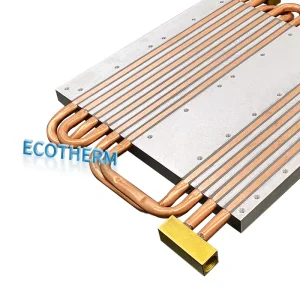
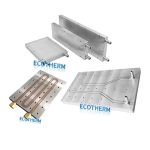
Liquid cold plates are commonly used because they can remove a high heat load within a compact volume. The cold plate receives heat from the module baseplate or package and transfers it to the coolant. The coolant then carries that energy to a vehicle heat exchanger.
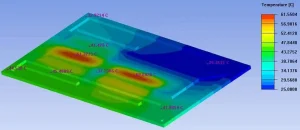
Channel geometry should be matched to the module’s heat map. Coolant should reach the hottest areas without creating unnecessary pressure drop. The cold plate must also withstand vibration, thermal cycling, pressure changes and long-term exposure to the selected coolant.
Thermal Interface and Electrical Insulation
The interface between the module and cold plate affects both thermal resistance and electrical safety. Grease, insulating pads, phase-change materials or direct-bonded structures may be used depending on the package design. The interface must remain stable under vibration and repeated temperature changes.
Surface flatness and mounting pressure are particularly important. A small air gap can introduce significant thermal resistance, while excessive pressure can deform the module or damage the package.
Reliability Validation
EV inverter cooling systems should be tested under representative electrical and environmental conditions. Thermal cycling, vibration, pressure testing, coolant compatibility and long-duration operation help reveal problems that cannot be found through a room-temperature performance check alone.
Ecothermgroup provides custom thermal management solutions for power electronics applications. For project evaluation, send the module drawing, heat load, coolant information, mounting requirements and installation envelope through the Ecothermgroup website).
FAQ
Why is liquid cooling widely used in EV inverters?
It provides high heat-removal capability in a compact package and can maintain more uniform temperatures than a large air-cooled heat sink.
What causes EV inverter thermal failure?
Common causes include underestimated losses, poor interface contact, uneven coolant distribution, inadequate sealing and excessive thermal cycling.
Can the same cold plate be used for every vehicle inverter?
No. The cold plate must match the module layout, heat distribution, coolant circuit, pressure drop and vehicle packaging requirements.