Liquid Cold Plate Design Guide: Comparing 5 Flow Channel Structures (ΔT=30℃)
A Comparative Analysis of 5 Structural Designs Based on ΔTfluid=30℃ — Practical Engineering Guidelines for Thermal Fluid Adaptability and Value.
1. Introduction: The Core Challenge in High-Power Liquid Cooling
With the exponential growth of computing power in AI data centers, the upgrade of high-power IGBT inverters, and the advancement of military radar systems, heat flux densities are skyrocketing. Traditional air cooling has reached its physical limits. As the core of advanced thermal management, the internal channel design of Liquid Cold Plate directly dictates cooling efficiency, pressure drop, and manufacturing costs.
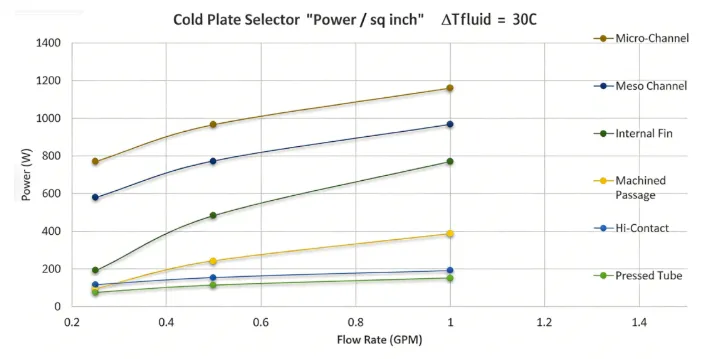
Given the variety of channel structures available, how can engineers quickly select the optimal solution during the initial project phase? Based on standardized testing (fixed coolant temperature difference ΔTfluid=30℃), this article provides a quantitative analysis of 5 mainstream internal channel structures, offering actionable selection criteria for thermal design engineers.
2. Testing Methodology and Core Parameters
To ensure the data holds practical value for engineering, we eliminated temperature variable interference by using unified boundary conditions:
Core Constraint: ΔTfluid=30℃. Comparing structures under the exact same heat transfer scenario prevents distortion in cooling power measurements.
Core Testing Flow Rate: 3.79 L/min (approx. 1 GPM), representing the most typical operating parameter for industrial liquid cooling systems.
Key Evaluation Metric: Heat dissipation power per unit area (W/cm²). A higher value indicates superior thermal exchange capability for your Custom Heat Sink Design.
3. In-Depth Analysis of 5 Mainstream Cold Plate Structures
At a flow rate of 3.79 L/min, we analyzed the 5 most widely utilized channel structures in industrial applications:
1. Micro-Channel — The Performance Limit for Extreme Heat Flux
Performance: ~181.4 W/cm² (Highest).
Engineering Traits: Channel dimensions are typically under 100 μm, achieving ultra-high convective heat transfer coefficients by maximizing surface area.
Applications: Strictly recommended for high-end semiconductors, high-density AI servers, and high-power laser diodes.
Warning: Extremely high pressure drop requiring significant pumping power. Relies on expensive Vacuum Brazing processes and is highly susceptible to clogging from coolant impurities.
2. Meso Channel — The Optimal Industrial Balance
Performance: ~150.4 W/cm².
Engineering Traits: Sized between macro and micro levels (100 μm – 1 mm). It bypasses the high pressure drop and clogging risks of micro-channels while retaining excellent heat transfer efficiency.
Applications: The ideal choice for high-power industrial scenarios such as Energy Storage Systems (ESS) and large-scale military electronics. Offers excellent manufacturability and low maintenance costs.
3. Internal Offset Fin — The Reliable Choice for Medium-High Power
Performance: ~120.9 W/cm².
Engineering Traits: Implants offset strip fins inside the cold plate to constantly break the fluid boundary layer, creating continuous turbulence. Highly mature technology with stable performance.
Applications: Widely used in standard industrial IGBT cooling and mid-tier servers. It offers the best cost-to-performance ratio among Custom Liquid Cold Plates.
4. Machined Passage — The Most Cost-Effective Solution
Performance: ~60.5 W/cm².
Engineering Traits: Channels are directly created in aluminum/copper bases using precision CNC milling or Gun Drilling.
Applications: Suitable for standard power electronics with moderate heat flux and strict cost constraints. Features fast processing and high volume production efficiency.
5. Pressed Tube — The Entry-Level Foundation
Performance: ~24.0 W/cm² (Lowest).
Engineering Traits: Copper tubes are mechanically pressed into an aluminum base plate.
Applications: Only suitable for basic auxiliary cooling or very low-power components. If heat flux requirements exceed 24 W/cm², this option must be eliminated.
4. Performance Summary at 3.79 L/min Flow Rate
| Cold Plate Structure | Dissipation Power (W/cm2) @3.79 L/min | Performance Rank | Strategic Application / Core Positioning |
| Micro-Channel | 181.4 | 1 | Premier choice for ultra-high power density. |
| Meso Channel | 150.4 | 2 | Optimal balance of performance and manufacturability. |
| Internal Fin | 120.9 | 3 | Mature and reliable solution for medium-high power. |
| Machined Passage | 60.5 | 4 | Cost-effective solution for medium-low power. |
| Pressed Tube | 24.0 | 5 | Entry-level, low-cost solution for ultra-low power. |
5. Practical Engineering Selection Guide
Based on real-world project constraints, we recommend thermal engineers follow this logic for channel selection:
Selection by Heat Flux:
>150 W/cm²: The only viable option is the Micro-Channel, requiring upgraded high-pressure pumps.
120~150 W/cm²: The Meso Channel is the premier choice, offering the perfect balance of performance and manufacturability.
60~120 W/cm²: We recommend Internal Fin or Machined Passages.
<60 W/cm²: Opt for Machined Passages or Pressed Tube plates to strictly control budgets.
Selection by Flow Rate Constraints:
If the available system flow rate is < 1.90 L/min, strictly avoid Micro-Channels, as this will lead to pump overload and thermal failure. Offset fin structures, which are less sensitive to flow rate drops, are highly recommended.
Conclusion: The core of liquid cold plate design is “matching requirements while balancing pressure drop and cost.” As a specialized factory with 22 years of expertise, EcoTherm provides comprehensive Custom Thermal Management Solutions———from CFD simulation to precision manufacturing—ensuring the reliable operation of your industrial and defense-grade projects.