Vapor Chamber vs. Heat Sink: When to Upgrade for High-Power Industrial Cooling?
Effective cooling is essential for high-power industrial systems, as overheating can result in expensive downtime or equipment damage. With advancements in technology, solutions like vapor chambers and traditional heat sinks each offer unique advantages. Deciding when to upgrade can be complex, so this article highlights their differences to help you determine the best option for your cooling requirements.
Takeaway
- Heat sinks are a reliable and cost-effective option for moderate cooling needs, but their efficiency can decrease as power densities rise in industrial applications.
- Vapor chambers offer superior thermal conductivity and consistent heat distribution, making them well-suited for high-power and high-density cooling demands.
- Key differences between vapor chambers and heat sinks include heat transfer efficiency, size limitations, and their suitability for compact designs or uneven heat loads.
- Switch to vapor chambers for high-performance systems, space-constrained setups, or applications requiring precise temperature management.
- Assess cooling requirements based on power density, environmental conditions, and system durability to choose the best solution.
- Although vapor chambers are more expensive than heat sinks, their efficiency and performance can lead to significant savings in maintenance and operational costs over time.
- For hybrid solutions, combining vapor chambers with heat sinks can enhance cooling performance in demanding industrial environments.
Introduction to Cooling Technologies
Why Cooling Matters in High-Power Applications
Efficient cooling systems are vital for maintaining the reliability and performance of high-power electronics. Devices like AI servers, aerospace electronics, and military-grade equipment generate significant heat during operation, which can lead to thermal failure if not properly managed. Cooling technologies help prevent overheating, reduce thermal resistance (Rth), and ensure optimal thermal conductivity. For applications such as IGBT thermal management or remote telecom base stations, precise cooling solutions directly impact operational efficiency and equipment lifespan.
Heat dissipation becomes more challenging in systems with high thermal design power (TDP) or hot spots concentrated in small areas. This is particularly critical in compact designs, such as modern CPUs and GPUs, where heat flux density often exceeds 50 W/cm². Advanced cooling solutions like vapor chambers can improve heat spreading efficiency and eliminate localized overheating. Ecothermgroup provides cutting-edge cooling technologies designed to meet industrial demands, ensuring both performance and durability under extreme conditions.
Overview of Vapor Chamber and Heat Sink Technologies
Vapor chambers and heat sinks are two common cooling methods, each offering distinct benefits. Heat sinks rely on conduction and convection to dissipate heat into the surrounding air. They are typically made using materials like aluminum extrusion bases or skived fin integration, providing a balance between cost and performance. However, heat sinks may struggle with concentrated heat loads, limiting their effectiveness in high-power applications.
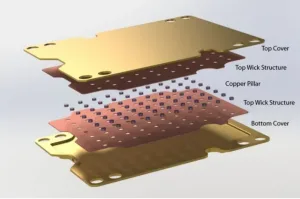
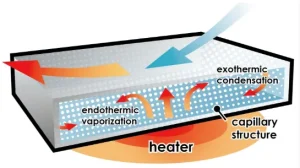
Vapor chambers, on the other hand, use phase-change cooling for superior thermal management. These chambers feature a hermetically sealed design filled with a working fluid. When heat is applied, the fluid evaporates at the heat source and condenses at cooler areas, enabling isothermal properties and efficient heat distribution. Advanced vapor chambers may include sintered copper powder or copper mesh wick structures to handle high heat flux densities more effectively.
The weight-to-performance ratio further sets vapor chambers apart from traditional heat sinks. Vapor chambers are thinner and lighter, making them ideal for space-constrained applications like smartphones, laptops, and AI servers. While they come with higher manufacturing costs, their improved thermal conductivity and ability to eliminate hot spots make them the preferred choice for systems requiring military-grade reliability or aerospace electronics cooling.
| Feature | Heat Sink | Vapor Chamber |
|---|---|---|
| Cooling Mechanism | Conduction & Convection | Phase-Change Cooling |
| Material | Aluminum, Copper | Copper, Sintered Copper Powder |
| Applications | Low-to-Medium Power Systems | High-Power, Compact Designs |
| Heat Flux Density | Up to 20 W/cm² | 50+ W/cm² |
| Weight-to-Performance Ratio | Moderate | High |
- Heat sinks are cost-effective but less efficient for concentrated heat loads.
- Vapor chambers offer superior isothermal heat spreading for high-density systems.
- Upgrading is recommended for power densities exceeding 20 W/cm².
How Heat Sinks Work
Material Selection and Design Factors
Heat sinks are essential for managing the heat generated by high-power electronics. Their performance is largely determined by the materials used. Aluminum and copper are common choices due to their excellent thermal conductivity. Aluminum is lightweight and cost-effective, making it suitable for weight-sensitive applications like aerospace electronics. Copper, with its superior thermal conductivity, is better for high TDP (Thermal Design Power) scenarios where efficient heat dissipation is critical.
Modern heat sink designs often include advanced features like skived fins or sintered copper powder bases to boost performance. Manufacturers such as Ecothermgroup enhance industrial cooling by combining aluminum extrusion bases with copper inserts, improving heat spreading efficiency. These designs also promote uniform temperature distribution, which is crucial for AI server cooling and IGBT thermal management in telecom base stations.
Thermal resistance (Rth) is a key factor in heat sink design, measuring how effectively heat is transferred. Lower Rth values indicate better performance. Heat sinks with optimized fin density and surface area enhance passive cooling by improving convection. However, they may struggle with hot spots, a challenge effectively addressed by vapor chambers through phase-change cooling.
Types of Heat Sink Configurations
Heat sinks are available in various configurations to suit different needs, ranging from passive designs to active systems with fans for enhanced convection. Passive heat sinks, common in consumer electronics, rely on natural convection and are cost-effective but less suitable for high-power systems. Active heat sinks, often used in military-grade applications, incorporate fans to improve airflow, reduce thermal resistance, and enhance heat dissipation.
For high-power industrial cooling, configurations may include embedded vapor chambers. These hybrid designs combine the rapid heat spreading of vapor chambers with the durability and cost-efficiency of aluminum or copper extrusions. They are increasingly popular in compact, high-performance devices like CPUs and GPUs.
| Configuration | Best Applications |
|---|---|
| Aluminum Extrusion | Weight-sensitive applications, aerospace electronics |
| Copper Base with Skived Fins | High TDP systems, IGBT thermal management |
| Embedded Vapor Chambers | Compact devices, AI server cooling |
When choosing between a traditional heat sink and an embedded vapor chamber design, consider factors such as thermal load, space constraints, and cost. While traditional heat sinks work well for many applications, vapor chambers are ideal for systems requiring uniform cooling and efficient heat management.
- Passive heat sinks rely on natural convection and are cost-effective.
- Active heat sinks with fans enhance cooling but add complexity.
- Hybrid designs like vapor chamber-embedded heat sinks provide optimal performance.
Vapor Chambers Explained
Structure and Function of Vapor Chambers
A vapor chamber is an advanced thermal management solution designed to handle intense heat loads using phase-change cooling. It works through liquid-vapor conversion, where a fluid evaporates at the heat source, transfers heat as vapor, and condenses in cooler areas to disperse it evenly. This process enhances heat distribution and prevents hot spots, making vapor chambers ideal for applications needing high thermal conductivity and uniform temperature control.
The main structure of a vapor chamber consists of a hermetically sealed enclosure, typically made of copper or aluminum. Inside, a wick structure—often crafted from sintered copper powder or a copper mesh—supports capillary action to return the fluid to the heat source after condensation. Advanced designs may include skived fins or aluminum extrusion bases to boost thermal resistance (Rth) and durability, making them suitable for demanding uses like AI server cooling, aerospace electronics, and military-grade systems.
Compared to traditional heat sinks, vapor chambers provide superior performance in high-power density scenarios. While copper heat sinks offer thermal conductivity up to 400 W/m·K, vapor chambers achieve between 20,000 and 100,000 W/m·K. This significant improvement allows them to handle higher TDP values and minimize temperature disparities. For industries such as remote telecom base stations and IGBT thermal management, vapor chambers provide efficient cooling in compact designs while maintaining an optimized weight-to-performance ratio.
| Key Feature | Vapor Chamber | Heat Sink |
|---|---|---|
| Thermal Conductivity | 20,000–100,000 W/m·K | Up to 400 W/m·K |
| Isothermal Heat Spreading | High | Moderate |
| Weight-to-Performance Ratio | Optimized | Higher weight |
| Applications | High-power density, compact layouts | Standard cooling needs |
Advancements in Vapor Chamber Technology
Recent innovations in vapor chamber technology have focused on improving efficiency and adaptability for high-power industrial cooling. Developments such as micropillar evaporators and enhanced wicking structures have expanded the capabilities of heat flux management. These advances enable vapor chambers to handle power densities over 20 W/cm², making them essential for next-generation GPUs, CPUs, and laser cooling systems.
For challenging environments like aerospace and military applications, companies like Ecothermgroup have introduced durable designs with reinforced sealing and robust materials to ensure long-term performance. Integrating active cooling systems further enhances their effectiveness, combining the advantages of passive heat spreading with improved convection and airflow.
While vapor chambers involve higher manufacturing complexity and cost compared to traditional heat sinks, the benefits—such as lower thermal resistance and better hot spot elimination—justify the investment for critical applications. As industries strive for smaller, more powerful devices, vapor chambers continue to evolve, addressing challenges in size and cooling efficiency.
- Ideal for high-power density applications
- Reduces hot spots and improves thermal uniformity
- Supports compact and complex layouts
- Offers superior weight-to-performance optimization
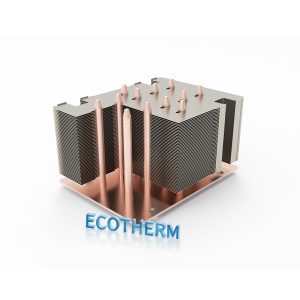
Vapor Chamber vs. Heat Sink: Key Differences
Performance Comparison in High-Heat Scenarios
Vapor chambers and heat sinks play crucial roles in thermal management, but their performance varies significantly in high-power applications. Vapor chambers are highly effective in scenarios requiring fast and uniform heat dissipation across flat surfaces. Using phase-change cooling, they transfer heat efficiently across a two-dimensional plane, minimizing hot spots and lowering thermal resistance (Rth). This makes them ideal for applications with high heat flux densities exceeding 50 W/cm², such as AI server cooling and IGBT thermal management.
Heat sinks, on the other hand, rely on one-dimensional heat transfer and are better suited for systems with lower thermal design power (TDP). They primarily dissipate heat through conduction and convection, performing well in applications with moderate thermal loads, such as aluminum extrusion bases used in industrial equipment. However, their efficiency drops in situations with hotspots or when compact designs require advanced thermal spreading.
| Feature | Vapor Chamber | Heat Sink |
|---|---|---|
| Heat Transfer Mechanism | Phase-change cooling | Conduction and convection |
| Thermal Resistance (Rth) | Low | Moderate to high |
| Ideal Application | High-power-density electronics | Moderate thermal loads |
| Hot Spot Mitigation | Excellent | Limited |
Applications in Electronics and Industrial Cooling
Vapor chambers are designed for applications requiring precision and reliability in extreme thermal conditions. They are commonly used in aerospace electronics, military-grade systems, and remote telecom base stations. Their ability to distribute heat evenly makes them especially effective for compact electronics like high-end GPUs and CPUs, where space constraints limit bulky cooling solutions.
Heat sinks, by comparison, are widely used in general-purpose industrial cooling. They are a cost-effective choice for devices with larger form factors and lower heat flux densities. Examples include skived fin designs and aluminum extrusion bases commonly found in automotive electronics and industrial machinery, where weight-to-performance ratio is less critical.
- Vapor chambers: AI server cooling, aerospace electronics, IGBT thermal management
- Heat sinks: Laser cooling, industrial power supplies, automotive electronics
Cost and Efficiency Considerations
Vapor chambers deliver superior thermal performance, but their advanced manufacturing processes, including sintered copper powder and hermetic sealing, result in higher costs—typically 30–50% more than traditional heat sinks. They are a strategic choice for applications where performance outweighs cost, such as AI servers and military electronics, where reliability and efficiency are paramount.
Heat sinks are more affordable and scalable, making them a practical option for larger systems with less demanding thermal requirements. However, their efficiency decreases in compact designs or when managing concentrated heat sources. For applications where thermal power density or design constraints exceed the capabilities of heat sinks, upgrading to vapor chambers is recommended.
Ultimately, the choice between vapor chambers and heat sinks depends on specific application needs, thermal design power, and budget considerations. Brands like Ecothermgroup offer customized solutions to meet diverse cooling requirements, ensuring both high performance and cost efficiency.
When to Upgrade to Vapor Chambers
Signs Your Heat Sink is Insufficient
Traditional heat sinks work well for moderate thermal loads, but as power densities rise, they may struggle to maintain optimal temperatures. Persistent overheating is a clear indicator of an inadequate heat sink, often leading to thermal throttling or even component failure. Devices with power densities over 50 W/cm² are particularly prone to these issues, especially in compact designs where airflow is limited. If your system shows noticeable temperature differences across components, it could be a sign of poor heat spreading efficiency—an area where vapor chambers excel compared to heat sinks.
Hot spots are another issue to monitor. In high-power applications like IGBT thermal management or AI server cooling, uneven heat dissipation can hurt performance. For example, traditional heat sinks with aluminum extrusion bases may fail to manage concentrated heat effectively. If these problems persist despite adequate airflow or active cooling, switching to vapor chambers could be the solution.
Factors to Consider Before Upgrading
Before upgrading to vapor chambers, it’s crucial to evaluate your system’s thermal needs and constraints. Start by analyzing the thermal design power (TDP) of your components. Vapor chambers are ideal for systems with high TDP values or where phase-change cooling is required to handle intense heat flux density. Additionally, consider the weight-to-performance ratio; vapor chambers offer excellent thermal conductivity in slim designs using advanced materials like sintered copper powder or copper mesh wicks, without adding significant weight.
Compatibility with your existing cooling system is also key. Vapor chambers can be integrated with skived fin configurations or embedded into heat sink bases to boost performance, but the design must fit your system’s layout. Industries such as aerospace electronics or military-grade applications often favor vapor chambers for their durability, isothermal properties, and hermetic sealing, which ensure reliability in extreme conditions.
Cost is another factor to weigh. Although vapor chambers are more expensive than traditional heat sinks, their ability to handle high heat flux and eliminate hot spots can justify the investment, especially for high-performance or mission-critical systems. Ecothermgroup’s advanced vapor chamber solutions deliver excellent heat spreading efficiency, making them a popular choice for remote telecom base stations and compact industrial applications.
| Heat Sink Limitations | Vapor Chamber Advantages |
|---|---|
| Struggles with high heat flux density | Handles power densities >50 W/cm² |
| Poor heat spreading across large surfaces | Superior isothermal properties |
| Limited efficiency in compact designs | Space-saving and lightweight |
| Susceptible to hot spot formation | Eliminates localized heat issues |
- Assess the thermal design power (TDP) of your system
- Check compatibility with current cooling setups
- Account for industry-specific needs such as reliability or durability
- Compare cost against long-term performance benefits
People Also Ask
What is the primary function of a vapor chamber in industrial cooling?
A vapor chamber efficiently manages heat by using phase-change cooling. It transfers heat through a continuous evaporation and condensation cycle of a working fluid, ensuring uniform heat dissipation across high-power electronics.
How does a vapor chamber differ from a traditional heat sink?
Heat sinks rely on conduction and convection to dissipate heat, while vapor chambers use phase-change technology to spread heat more uniformly. Vapor chambers excel in high heat flux applications where consistent cooling is essential.
What are the key advantages of vapor chambers over heat sinks for high-power applications?
Vapor chambers provide superior thermal conductivity, even heat distribution, and better performance in compact designs compared to heat sinks. They are ideal for addressing localized hot spots in high-power electronics like processors and lasers.
When should you consider upgrading from a heat sink to a vapor chamber?
Upgrading to a vapor chamber is recommended when dealing with high heat flux, uneven heat distribution, or space-constrained designs where traditional heat sinks fall short in cooling performance.
What types of electronic devices typically benefit from vapor chamber cooling?
Devices like high-performance microprocessors, GPUs, laser systems, and other high-power electronics benefit from vapor chambers due to their efficiency in managing extreme heat flux.
Is a vapor chamber more expensive than a heat sink, and why?
Vapor chambers are generally more expensive because of their advanced design, materials, and manufacturing process. However, their enhanced performance in high-power applications often justifies the cost for critical cooling needs.
Can vapor chambers be used in combination with heat sinks?
Yes, vapor chambers are often incorporated into heat sink designs to enhance thermal performance. The vapor chamber spreads heat evenly, allowing the heat sink to dissipate it more effectively.
What are the limitations of vapor chambers compared to heat sinks?
Vapor chambers may be less effective in low-power applications where simpler conduction-based heat sinks are sufficient. They are also more complex to design and can be sensitive to orientation and environmental conditions.