Custom Cold Plate Heat Sink for AI Servers and Power Electronics
Keeping high-performance AI servers and power electronics cool is becoming increasingly challenging as devices grow more powerful and compact. A custom heat sink cold plate from Ecothermgroup can efficiently manage heat, preventing overheating and enhancing reliability. This article examines how tailored designs improve cooling for demanding applications.
Takeaway
- Cold plate heat sinks are essential for managing high thermal loads in AI servers and power electronics, helping maintain performance and reliability.
- AI and high-density computing systems face unique thermal challenges due to concentrated heat and compact layouts.
- Custom-designed cold plate heat sinks can be optimized for specific device layouts, fluid channels, and thermal requirements.
- Advanced manufacturing methods, including CNC machining, additive manufacturing, and micro-channel fabrication, improve thermal efficiency and design flexibility.
- Integrating cold plate solutions from Ecothermgroup can lower energy consumption and extend system life by keeping operating temperatures stable.
- Industry trends show increasing use of liquid cooling and tailored thermal solutions in data centers and high-performance electronics.
- Collaboration between thermal engineers and system designers early in the process maximizes the effectiveness of custom cold plate implementations.
Introduction to Heat Sink Cold Plates
Heat sink cold plates are a key part of modern thermal management for AI servers and high-power electronics. Unlike traditional air-cooled heat sinks, a liquid cold plate heat sink directly contacts heat-generating components such as GPUs, CPUs, or IGBT modules, transferring heat efficiently to a circulating coolant. This direct-to-chip cooling approach lowers thermal resistance and reduces hotspots, which is essential for devices with power densities above 500W per chip. Ecothermgroup provides custom cold plate solutions designed for these demanding applications.
Role in AI Servers and Power Electronics
In AI server clusters, especially those using NVIDIA GPUs or other high-performance accelerators, managing heat is a major challenge. Custom liquid cold plates allow precise channel designs, including microchannel and serpentine patterns, optimizing coolant flow and keeping temperatures uniform across the chip surface. Copper cold plates are often chosen for their high thermal conductivity, while aluminum cold plates offer a lighter, more cost-effective option when weight or budget is a concern. Implementations in hyperscale data centers have shown that liquid cooling cold plates can lower server inlet air temperatures by up to 15°C compared to standard air cooling.
For power electronics such as IGBT modules in industrial inverters or battery packs in electric vehicles, cold plate cooling ensures reliable performance under high thermal loads. Friction stir welded and brazed cold plates are commonly used to provide durability and prevent leaks during thermal cycling.
| Application | Recommended Cold Plate Type |
|---|---|
| AI GPUs / CPUs | Microchannel copper cold plate, direct-to-chip cooling |
| IGBT Modules / Batteries | Brazed or friction stir welded aluminum/copper cold plate |
Limitations of Traditional Air Cooling
Air cooling struggles with high-density electronics because convective heat transfer is limited and removing heat from tightly packed chips is difficult. Finned heat sinks, while inexpensive and simple to implement, often create uneven temperatures and higher system energy use as fans work harder to maintain safe operating limits. Liquid cooling heat sinks provide lower pressure drops and more consistent thermal performance.
- Air cooling can’t efficiently handle >500W per chip
- Fans increase noise and energy costs
- Uneven heat distribution causes hotspots
Overall, cold plate thermal management offers a scalable, efficient solution for AI server cooling, high-power electronics, and applications requiring precise temperature control. Custom designs from Ecothermgroup ensure compatibility with system layout, coolant type, and reliable operation.
Thermal Challenges in AI and High-Density Computing
High Power Density of GPUs and AI Accelerators
The rapid growth of AI workloads has sharply increased the thermal demands on server hardware. Modern AI GPUs, including NVIDIA A100 and H100, can generate thermal loads exceeding 500–1000W per chip, far higher than traditional CPU requirements. In dense server setups, conventional air-cooled heat sinks often struggle to remove heat effectively, leading to hotspots and potential performance throttling. Custom cold plate heat sinks provide a more efficient solution by enabling direct-to-chip cooling, improving junction temperature stability and ensuring consistent thermal performance across GPUs and CPUs.
Material selection is crucial for high-density cooling. Copper cold plates are favored for their excellent thermal conductivity, while aluminum cold plates provide a lighter, cost-effective option. Advanced manufacturing methods, such as friction stir welding and microchannel fabrication, allow engineers to optimize liquid cold plate heat sinks for minimal thermal resistance and lower pressure drop, which is essential for maintaining high coolant flow rates in dense server racks.
| Cold Plate Type | Key Benefits |
|---|---|
| Microchannel cold plate | High heat transfer, low thermal resistance, ideal for GPUs |
| Serpentine channel cold plate | Even coolant distribution, manageable pressure drop |
| Friction stir welded cold plate | Strong mechanical durability, reliable long-term performance |
| Brazed cold plate | Compact design, excellent thermal conductivity, suitable for high-power IGBT cooling |
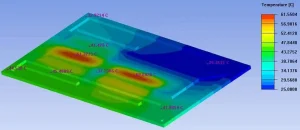
Flow optimization is equally important. Uneven coolant distribution can create localized hotspots, reducing both AI server reliability and power electronics performance. Engineers often simulate liquid cooling cold plate behavior to ensure consistent temperature distribution across all high-power components, preserving system efficiency and preventing accelerated wear.
Impact on Data Center Efficiency and PUE
Using custom liquid cold plate systems in AI servers addresses thermal challenges while boosting overall data center efficiency. Liquid cooling heat sinks reduce dependence on large air conditioning systems, lowering power usage effectiveness (PUE). Studies indicate that data centers with direct-to-chip liquid cooling can achieve PUE improvements of 10–20% over traditional air-cooled setups, especially in hyperscale environments.
Custom cold plate designs also support modular, scalable cooling. This is critical in AI clusters where workloads shift quickly between training and inference. By adjusting flow rates dynamically, liquid cooling cold plates maintain thermal balance, allowing GPUs and CPUs to run at peak performance without unnecessary energy use.
- Evaluate thermal load per server or rack
- Select the appropriate cold plate type based on power density and material preference
- Simulate coolant flow to minimize pressure drop and hotspots
- Integrate with data center liquid cooling systems to optimize PUE
Ecothermgroup has extensive experience designing and manufacturing custom cold plate solutions for high-power electronics and AI servers. Their expertise ensures minimal thermal resistance, controlled pressure drop, and reliable system performance, making liquid cooling cold plates a key component for modern, energy-efficient, high-density computing environments.
Design and Customization of Cold Plate Heat Sinks
Materials and Thermal Conductivity
Selecting the right material is key to an effective heat sink cold plate. Copper and aluminum are the most common choices for AI servers and power electronics. Copper, with thermal conductivity around 400 W/m·K, is ideal for high-power components like GPUs and IGBTs. Aluminum is lighter and more cost-effective, with conductivity around 205 W/m·K. Ecothermgroup often recommends copper for high-density AI server racks to ensure fast heat dissipation and prevent thermal throttling.
Material compatibility with the coolant also matters. Aluminum cold plates need corrosion inhibitors for long-term reliability, while copper cold plates work well with standard water-glycol solutions. Thermal resistance and pressure drop are critical parameters: a well-designed cold plate balances low thermal resistance with acceptable flow resistance to reduce pump energy consumption.
| Material | Thermal Conductivity (W/m·K) |
|---|---|
| Copper | 400 |
| Aluminum | 205 |
Advanced fabrication techniques like friction stir welding or brazing improve structural integrity and reduce leak risks in high-pressure liquid cooling systems. These methods align with best practices for continuous operation in AI servers and industrial power electronics.
Custom Shapes and Microchannel Designs
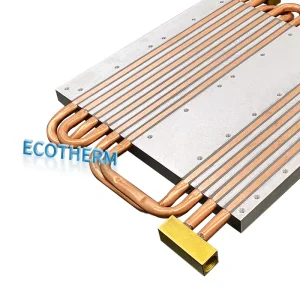
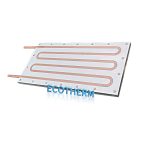
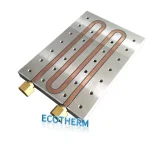
Cold plate designs are often customized to match the layout of CPUs, GPUs, and power modules. Microchannel and serpentine channel cold plates are common because they provide high surface area contact and even coolant distribution. A serpentine channel cold plate, for example, maintains consistent cooling across all GPU cores, reducing hotspots that can trigger performance throttling.
Designers must balance channel size, flow rate, and pressure drop. Microchannels with narrow passages improve heat transfer but increase friction, demanding more pump energy. Ecothermgroup uses computational fluid dynamics (CFD) simulations to optimize flow paths, achieving efficient cooling while keeping pressure drop around 0.3–0.5 bar for most AI server setups.
- Microchannel cold plate for high-density GPUs
- Serpentine channel cold plate for uniform flow
- Brazed or friction-stir-welded designs for durability
Customization also includes modular designs that adapt to different server chassis and GPU layouts, supporting scalability and shortening lead times. Advanced designs may integrate direct-to-chip cooling, where the cold plate contacts the processor directly, further improving thermal performance compared to standard liquid cooling heat sinks.
Integration with Server Racks and Modules
Integrating cold plate heat sinks into AI servers requires careful attention to space and maintenance access. Water-cooled heat sinks must align with rack-mounted GPUs and CPUs without blocking airflow or cabling. High-power electronics often need cold plates capable of handling 300–1000 W per chip, depending on module size.
Designers often collaborate with server manufacturers to create liquid cold plates that fit existing rack footprints. Direct-to-chip cooling combined with cold plate solutions can reduce overall data center PUE (power usage effectiveness) by 10–15% compared to traditional air-cooled heat sinks. Reliability is enhanced through redundant sealing and pressure-cycle testing to prevent leaks.
| Use Case | Recommended Cold Plate Design |
|---|---|
| AI GPU Cluster | Microchannel copper cold plate, direct-to-chip integration |
| Power Electronics Module | Serpentine channel aluminum or copper cold plate with brazed joints |
| Battery Thermal Management | Custom modular liquid cold plate with uniform flow distribution |
Designing and customizing cold plate heat sinks for AI servers and power electronics focuses on maximizing thermal efficiency, minimizing energy use, and ensuring long-term reliability. By combining careful material selection, advanced microchannel designs, and precise integration strategies, Ecothermgroup delivers solutions that meet the demands of next-generation AI and high-power applications.
Advanced Manufacturing Techniques
Modern heat sink cold plate production for AI servers and power electronics relies on advanced manufacturing methods to achieve optimal thermal performance and reliability. Ecothermgroup focuses on precision and material selection, combining copper for high conductivity with aluminum for weight and cost advantages. The chosen technique affects cold plate thermal resistance, pressure drop, and manufacturability, ensuring liquid cooling cold plates meet demanding specifications for high-power electronics, GPUs, and CPUs.
Friction Stir Welding and Additive Manufacturing
Friction stir welded cold plates are preferred in high-power applications because the process forms strong, leak-resistant joints without melting the base metals. This is critical for liquid cooling heat sinks in dense AI server racks, where coolant leakage could affect performance and safety. Friction stir welding also reduces thermal distortion, keeping the chip interface flat and lowering thermal resistance.
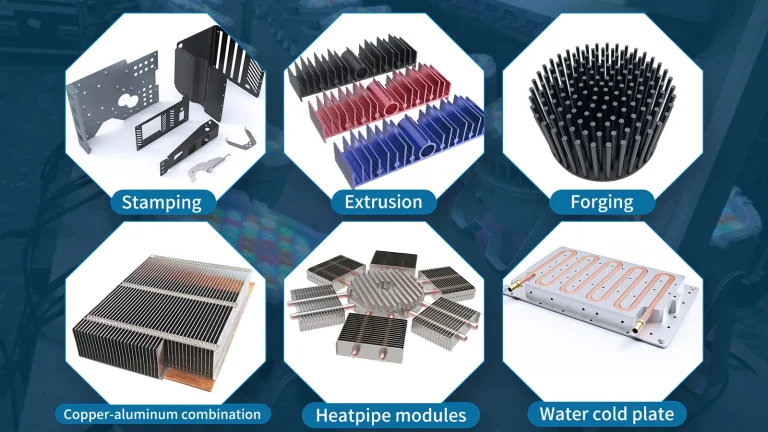
Additive manufacturing, especially metal 3D printing, is becoming popular for custom cold plate designs where conventional CNC machining cannot efficiently create complex internal geometries. Microchannels, lattice structures, and intricate serpentine paths can be fabricated directly, enhancing heat transfer while managing pressure drop. Although costs and qualification requirements are higher, additive manufacturing enables tailored solutions for next-generation AI server cooling and battery thermal management.
Skived Fins and Microchannel Fabrication
Skived fin cold plates offer a cost-effective way to increase surface area without reducing flow efficiency. Microchannel cold plates allow precise liquid distribution over high-power components. Engineers optimize channel width, depth, and arrangement to balance heat removal and pump energy, which is essential for liquid cooling cold plates in GPU clusters exceeding 1000W per module. Pressure drop and thermal resistance are carefully analyzed to prevent operational issues and maintain reliability.
| Technique | Advantages |
|---|---|
| Friction Stir Welded Cold Plate | Strong joints, minimal distortion, leak-resistant, suitable for copper/aluminum assemblies |
| Additive Manufactured Cold Plate | Complex geometries, optimized microchannels, reduced thermal resistance, tailored to custom liquid cold plate needs |
| Skived Fin Cold Plate | High surface area, lower cost, efficient coolant flow |
| Microchannel Cold Plate | Precise liquid distribution, excellent heat removal, adjustable channel design |
Applications in Aerospace and Power Electronics
Advanced cold plate manufacturing extends beyond AI servers into aerospace and high-power electronics. IGBT cooling, battery thermal management, and data center liquid cooling benefit from direct-to-chip cooling using copper or aluminum cold plates. Custom liquid cold plates allow designers to meet specific size constraints and thermal loads while ensuring long-term reliability. In aerospace, weight-sensitive aluminum cold plates with skived fins provide efficient thermal solutions, while high-power electronics often use brazed or friction stir welded copper plates for peak thermal performance.
- AI server cooling: custom cold plates for GPUs and CPUs, supporting high thermal loads
- Power electronics: IGBT modules and battery packs requiring precise liquid cold plate heat sink integration
- Aerospace: weight-optimized aluminum cold plates with skived fins for avionics and high-density circuits
Manufacturers like Ecothermgroup combine these techniques with careful material selection and flow optimization to deliver reliable, efficient thermal management solutions. Whether through friction stir welded assemblies, additive manufacturing, or microchannel design, advanced manufacturing methods are essential to meet the evolving demands of high-performance computing and power electronics cooling.
Benefits and Industry Trends
Energy Efficiency and Reduced Cooling Costs
Custom heat sink cold plates are changing thermal management in AI servers and high-power electronics by delivering much higher cooling efficiency than traditional air-cooled systems. Liquid cooling cold plate solutions, especially those designed for GPUs and CPUs, remove heat more effectively, lowering the risk of thermal throttling during sustained workloads. Data from AI data centers show that using liquid cold plate heat sinks can cut energy use for cooling by up to 30% compared with standard finned heat sinks. This improvement leads to lower operational costs and better overall power usage effectiveness (PUE).
Choosing between aluminum and copper cold plate designs depends on thermal conductivity requirements and weight considerations. Copper plates provide superior thermal performance, while aluminum plates are lighter and more cost-effective for large-scale installations. Custom cold plates allow engineers to design coolant channels that minimize pressure drop while maintaining high heat transfer, which is crucial in dense server racks with multiple GPUs per node.
| Cold Plate Type | Typical Thermal Conductivity |
|---|---|
| Aluminum cold plate | 180–220 W/m·K |
| Copper cold plate | 380–400 W/m·K |
Industry trends favor microchannel and serpentine channel cold plates in applications requiring precise temperature control. These designs balance thermal resistance with manageable frictional losses, reducing pump energy requirements and enabling efficient operation of water-cooled heat sink systems. Experts at Ecothermgroup note that friction stir welded or brazed cold plates create strong thermal paths and leak-resistant performance, extending component life while lowering total cost of ownership.
Sustainability and Adoption in AI Data Centers
Hyperscale AI server facilities are adopting liquid cooling cold plates not only for energy savings but also for sustainability benefits. Servers with rack power densities above 30 kW gain from direct-to-chip cooling, which reduces heat recirculation and supports higher-density setups. Analysts predict that by 2025, over 40% of U.S.-based AI data centers will use liquid cooling heat sinks, advancing both sustainability goals and efficient thermal management for next-generation GPUs.
Outside of data centers, high-power electronics such as IGBT modules and battery systems also benefit from custom cold plate designs. Consistent temperatures from liquid cooling cold plates reduce thermal cycling stress, improving reliability and system stability. Recommended practices include selecting cold plates that match component layouts, checking long-term coolant compatibility, and ensuring maintainable sealing solutions.
- Identify thermal hotspots and calculate the required heat flux.
- Choose material (aluminum or copper) based on performance and cost trade-offs.
- Select microchannel or serpentine designs for optimal flow and low pressure drop.
- Validate custom cold plates with lifecycle and leak testing.
The move toward direct liquid cooling, highlighted by GPU and CPU cold plates, represents a shift from air cooling to high-performance thermal solutions. Custom cold plates, supported by advanced manufacturing methods, are now essential for energy-efficient, sustainable operation of AI servers and power electronics, delivering measurable cost savings and improved thermal reliability. Ecothermgroup continues to support this trend with tailored solutions for high-performance cooling needs.
People Also Ask
What is a heat sink cold plate and how does it differ from traditional air-cooled heat sinks?
A heat sink cold plate is a liquid-cooled thermal management component that sits directly on high-power chips and transfers heat to a coolant. Unlike finned air-cooled heat sinks, cold plates deliver higher thermal efficiency and are well suited for AI servers and dense GPU clusters.
Why are custom cold plate heat sinks becoming essential for AI servers?
AI servers with high-density GPUs generate intense heat that traditional air cooling often cannot dissipate efficiently. Custom cold plate heat sinks provide more precise thermal management, helping reduce energy consumption and maintain stable performance under heavy workloads.
What design considerations are important when customizing a cold plate for power electronics?
Designing a custom cold plate requires optimizing fluid channels, surface area, and material selection to match specific thermal loads. Engineers also evaluate flow rates, pressure drop, and chip layout to ensure uniform cooling and help prevent hotspots.
How do advanced manufacturing techniques improve cold plate performance?
Techniques such as additive manufacturing, friction stir welding, and microchannel fabrication enable complex geometries and precise channel designs. These methods improve heat transfer efficiency and support the high thermal loads common in AI and power electronics applications.
Can cold plate heat sinks reduce energy costs in data centers?
Yes. By removing heat more efficiently from high-power components, cold plate heat sinks can reduce reliance on energy-intensive air conditioning. This helps improve overall Power Usage Effectiveness (PUE) in AI-focused data centers.
What types of liquids are commonly used in cold plate cooling?
Water-based coolants and dielectric fluids are commonly used in cold plate cooling systems. Water offers strong thermal conductivity, while dielectric fluids reduce electrical risk in the event of a leak, making them suitable for sensitive power electronics.
Are cold plate heat sinks suitable for retrofitting existing AI server racks?
Yes, many systems can be upgraded with custom cold plates from specialists such as Ecothermgroup, but careful assessment of flow loops, space constraints, and connector compatibility is required. Retrofitting can improve cooling efficiency without requiring a complete redesign of the server infrastructure.
What are the main industry trends driving adoption of cold plate heat sinks?
Key trends include the rise of high-performance AI GPUs, greater focus on sustainability, and growing demand for energy-efficient data centers. Adoption is accelerating as organizations use liquid cooling solutions to manage thermal challenges and support next-generation computing workloads.