
Custom Double-Sided Skived Fin Heat Sinks
Tailored Solutions for High-Power Applications
Up To 3000mm Length
Free Thermal Analysis
Double-side Skived Fin
Wavy Skived Fin
Types of skived heat sinks manufacturing processes
- Wavy Heatsinks
- Double-sides Skived Heat Sink
- Heat Pipe Skived Heat Sink
- Copper & Aluminum Skived Heat Sink
Other cooling solutions
Custom Double-Sided Skived Fin Heat Sinks
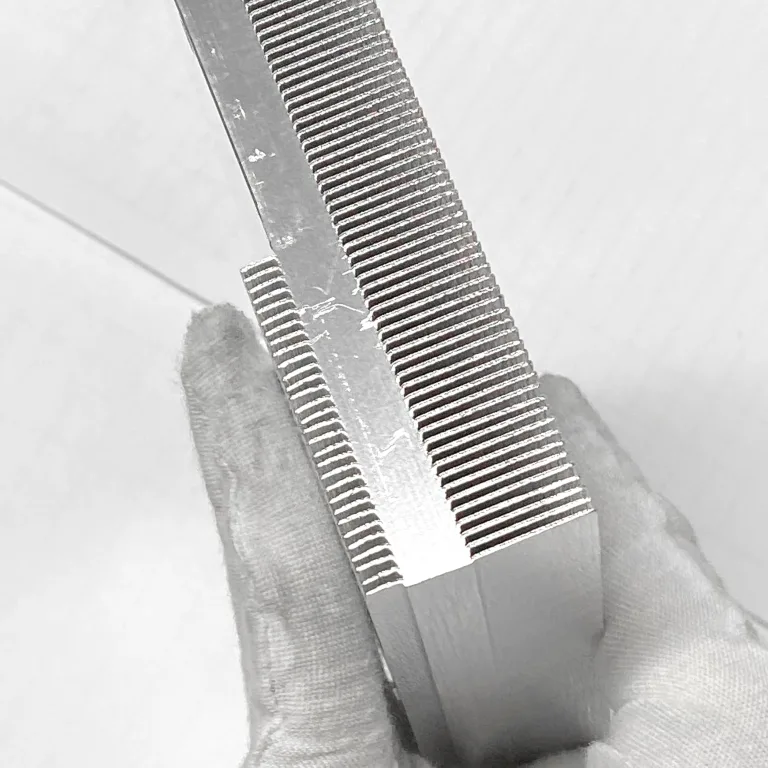
When space constraints are severe but Thermal Design Power (TDP) remains exceptionally high, a single-sided heat sink may not suffice. The double-sided skived fin heat sink is an advanced thermal solution where high-density fins are precisely shaved from both the top and bottom of a single, solid metal block.
EcoTherm specializes in this highly complex manufacturing process, providing 100% monolithic thermal transfer for industrial, defense, and power-conversion applications.
If you are exploring our full range of skiving capabilities, please visit our main Custom Skived Heat Sink Products page.
The Production Process of a Double-Sided Skived Fin Heat Sink
Understanding the manufacturing workflow is crucial to appreciating the value of a double-sided skived fin heat sink. The precision skiving process involves a specialized cutting blade that peels the metal at an exact angle and pitch to form vertical fins.
First-Side Skiving: A solid block of pure copper or aluminum is secured, and the top fins are skived sequentially.
Flipping and Re-clamping: The partially finished heat sink is turned over to machine the opposite side.
Second-Side Skiving: The blade creates the bottom fins, completing the double-sided skived fin heat sink structure.
The Manufacturing Difficulty:
Producing a reliable double-sided skived fin heat sink is notoriously difficult. Once the first side is skived, the remaining solid base becomes significantly thinner and loses its structural rigidity. When the dedicated skiving machine exerts immense pressure to peel the second side, the risk of base deformation, fin crushing, and severe machining stress is extremely high. Most standard manufacturers cannot maintain base flatness during this step. Relying on 22 years of precision thermal manufacturing expertise, EcoTherm utilizes proprietary stress-relief techniques and customized clamping fixtures to successfully manufacture every double-sided skived heat sink without compromising its structural integrity.
When to Choose a Double-Sided Skived Fin Heat Sink?
Thermal engineers should specify a double-sided skived fin heat sink under the following stringent conditions:
“Sandwich-Style” Heat Sources:
When active heat-generating components (such as power modules) are mounted on both sides of a central cold plate, a double-sided skived fin heat sink absorbs and dissipates heat simultaneously from dual directions.
Extreme Space Constraints:
If the Z-axis (height) and X-Y footprint are strictly limited, utilizing both sides of the base plate effectively doubles the convective cooling surface area without expanding the component’s footprint.
Internal Ducted Airflow:
When forced air is routed directly through a central system channel, placing a double-sided skived heat sink in the airstream maximizes thermal transfer to the fluid path.
High-Power Industrial Applications
While commercial markets might use basic double-sided skiving for PTC heaters, EcoTherm focuses strictly on mission-critical sectors requiring a high-performance double-sided skived fin heat sink
Our custom solutions are engineered for:
Thermoelectric Coolers (TEC / Peltier Modules): A double-sided skived fin heat sink acts as both the hot-side heat dissipator and the cold-side thermal collector.
High-Density IGBT Modules: Providing sandwich-cooling for massive power grids and industrial inverters.
Internal Liquid Cold Plate Channels: Serving as the high-density internal flow structure inside vacuum-brazed liquid cooling systems for aerospace and military radar.
Energy Storage Systems (ESS): Compact, dual-sided thermal management for high-capacity battery management systems (BMS).
DFM Limits & Engineering Specifications for Skived Fins
Because the structural integrity of a double-sided skived fin heat sink depends entirely on the delicate ratio between fin height, fin pitch, and the remaining solid base thickness, all manufacturing limits are strictly evaluated on a case-by-case basis. A design that works for one footprint may cause deformation in another.
General starting parameters for a double-sided skived fin heat sink using Aluminum (AL1060/AL1050) or Pure Copper (C1100):
Minimum Fin Thickness: $0.15 \text{ mm}$
Minimum Base Thickness: Strongly dependent on overall dimensions. Must be thick enough to withstand the second skiving pass without deformation.
Maximum Aspect Ratio: Custom evaluated based on base rigidity and material yield strength.
Surface Finishes: Anti-oxidation coatings, Nickel plating, or Anodizing available depending on the operating environment.
⚠️ Start Your Custom Project:
Designing a double-sided skived fin heat sink is a unique engineering challenge. The exact manufacturability must be verified against your specific 3D CAD drawings to ensure base flatness and fin stability.
Important Engineering Note:
Please be aware that the geometric limits provided above are general guidelines. The exact manufacturability, achievable aspect ratios, and tolerances are highly dependent on the overall dimensions and structural constraints of your project. Skived fin specifications are strictly evaluated on a case-by-case basis according to your specific technical drawings and thermal design power (TDP).
To determine the exact DFM feasibility for your design, please contact our engineering team directly with your 3D CAD files for a comprehensive review.
Request a CFD Simulation>>> support@ecothermgroup.com
Q&A: Engineering Insights
What are the main disadvantages or limitations of a double-sided skived fin heat sink?
The primary challenge of a double-sided skived fin heat sink is the extreme manufacturing difficulty. The pressure of the skiving blade can easily cause the thin central base to deform or warp. Additionally, the ultra-thin fins can be mechanically fragile. Thermally, the tight fin pitch creates a higher airflow pressure drop, which means your system will require high-static-pressure fans to force air through the channels efficiently.
Why choose pure copper over aluminum for a double-sided skived fin heat sink?
Choosing between materials depends entirely on your system’s Thermal Design Power (TDP) and weight constraints. An aluminum skived fin heat sink is cost-effective and lightweight, offering excellent thermal conductivity (~210-240 W/m·K) for standard industrial power electronics. However, for extreme heat flux densities where aluminum becomes a thermal bottleneck, a pure copper skived fin heat sink (~390-400 W/m·K) is required to rapidly spread concentrated heat across the monolithic base before it damages the component.
Is there a Minimum Order Quantity (MOQ) for a custom double-sided skived fin heat sink?
No, we do not enforce strict minimums. One of the greatest advantages of the skiving process is that it requires absolutely zero upfront tooling costs (NRE) or expensive extrusion dies. We understand that high-power industrial and defense projects require rigorous thermal validation. Therefore, we support an MOQ as low as 1 piece for your double-sided skived fin heat sink prototypes, while maintaining the machine capacity to smoothly scale up to high-volume mass production.
Can a double-sided skived fin heat sink be combined with phase-change cooling?
Yes. For applications struggling with severe, highly concentrated hot spots (such as IGBT arrays or AI processors), we can precision-machine pockets into the central base of the double-sided skived fin heat sink. This secondary machining allows us to embed heat pipes or vapor chambers directly into the core. This hybrid approach leverages the rapid heat-spreading capability of phase-change materials alongside the massive convective surface area of the skived fins. You can learn more about this hybrid technology on our Heat Pipe Skived Fin Heat Sink page.