
Custom Aluminum & Copper Skived Fin Heat Sinks
Tailored Solutions for High-Power Applications
Up To 3000mm Length
Free Thermal Analysis
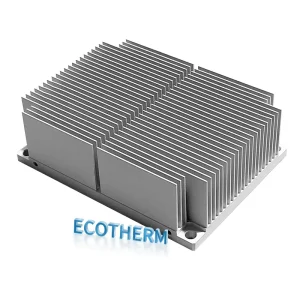
Double-side Skived Fin
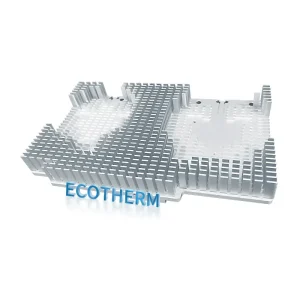
Wavy Skived Fin
Types of skived heat sinks manufacturing processes
- Wavy Heatsinks
- Double-sides Skived Heat Sink
- Heat Pipe Skived Heat Sink
- Copper & Aluminum Skived Heat Sink
Other cooling solutions
Aluminum & Copper Skived Fin Heat Sinks: High-Density Thermal Solutions
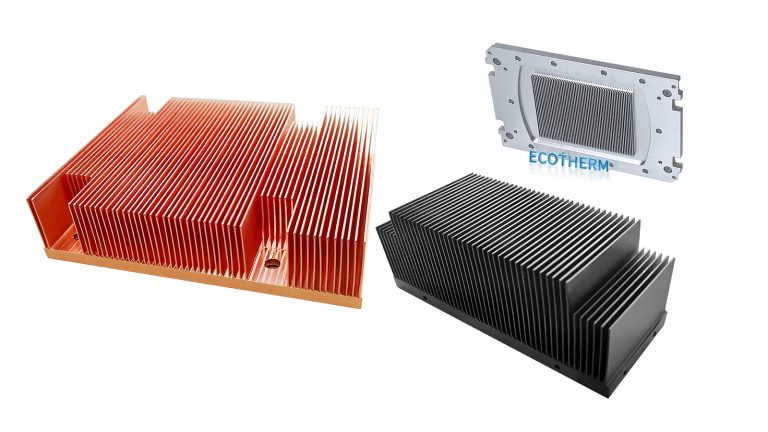
When thermal loads exceed the capabilities of standard extrusions, the skived fin heat sink provides a high-performance alternative. By peeling fins directly from a solid block of metal, the skiving process achieves a monolithic construction with absolute zero thermal interface resistance between the base and the fins.
EcoTherm engineers and manufactures precision Custom Skived Heat Sinks tailored for high-power applications. Understanding the distinct material behaviors and manufacturing limits of aluminum and copper is critical for optimizing your thermal management system.
The Skiving Process: Beyond Monolithic Construction
The primary advantage of a skived fin heat sink is its high fin density and extremely thin fin profiles, achieving aspect ratios of up to 50:1. However, the manufacturing process offers a hidden thermal advantage: Micro-Roughness.
During CNC skiving, the cutting blade leaves a microscopic textured pattern on the surface of each fin. In forced convection environments, this micro-roughness disrupts the laminar boundary layer of the airflow. This induced micro-turbulence significantly increases the convective heat transfer coefficient compared to the perfectly smooth surfaces of extruded or bonded fins.
Material Selection: Aluminum vs. Copper Skived Fins
Selecting the right material requires balancing thermal conductivity ($W/m\cdot K$), weight, and manufacturing economics.
Aluminum Skived Fin Heat Sinks (AL1050 / AL1060)
Why not AL6061? While AL6061 is common in CNC machining, it is too brittle for the peeling action of skiving, often leading to fin fracture. Therefore, we utilize AL1050 or AL1060 series aluminum.
Thermal Conductivity: $\approx 210-230 \text{ W/m}\cdot\text{K}$.
Advantages: Lightweight, highly cost-effective, and excellent ductility for forming ultra-thin, tall fins.
Best For: Telecommunications infrastructure, LED arrays, and general high-power industrial electronics.
Copper Skived Fin Heat Sinks (C1100)
For extreme heat flux densities where aluminum creates a thermal bottleneck, we utilize C1100 Oxygen-Free Pure Copper.
Thermal Conductivity: approx 390-401 W/m ·K.
Advantages: Rapid heat spreading, eliminating localized hot spots in highly concentrated heat loads.
Engineering Note: Copper is highly ductile but “sticky,” leading to increased blade wear during manufacturing. It is also 3.3 times heavier than aluminum. For weight-sensitive applications, we often recommend hybrid designs or Heat Pipe Integrated Skived Fins.
Best For: AI data center processors, IGBT power modules, and military-grade radar components.
DFM Limits & Material Specifications for Skived Fins
Achieving optimal thermal performance requires precise material selection paired with strict geometric tolerances. Below is our actual production data detailing the thermal properties of the specific alloys we process, alongside our general manufacturing capabilities.
1. Accurate Material Selection
Selecting the right alloy dictates both the heat spreading capability and the manufacturing economics of your skived fin heat sink.
| Material / Alloy Model | Thermal Conductivity | Key Industrial Applications |
| C11000 Pure Copper | 390-400 W/m·K | 5G base stations, enterprise servers (cost-sensitive high-density cooling) |
| C10100 Oxygen-Free Copper | 390-400 W/m·K | Aerospace electronics, vacuum environments, defense radar |
| 1060 / 1070 Pure Aluminum | 230-240 W/m·K | Industrial LED lighting, general high-power electronics |
| 6063 Aluminum Alloy | 200-210 W/m·K | Industrial frequency converters, heavy-duty power equipment |
(Note: In alignment with our strict focus on high-reliability industrial and defense sectors.)
2. General Geometric Limits
Our advanced CNC skiving equipment is calibrated to push the boundaries of fin density and thinness, supporting the following extreme tolerances:
| Specification Parameter | Aluminum Series | Copper Series |
| Minimum Fin Thickness | $0.1 mm | 0.1 mm |
| Minimum Fin Pitch (Gap) | $0.2 mm | 0.2 mm |
| Maximum Aspect Ratio | Up to 50:1 | Up to 45:1 |
| Base Flatness | 0.01 mm /100 mm | 0.01 mm / 100 mm |
Important Engineering Note:
Please be aware that the geometric limits provided above are general guidelines. The exact manufacturability, achievable aspect ratios, and tolerances are highly dependent on the overall dimensions and structural constraints of your project. Skived fin specifications are strictly evaluated on a case-by-case basis according to your specific technical drawings and thermal design power (TDP).
To determine the exact DFM feasibility for your design, please contact our engineering team directly with your 3D CAD files for a comprehensive review.
Request a CFD Simulation>>> support@ecothermgroup.com
Airflow Constraints & Design Considerations
When integrating a skived fin heat sink into your system, engineers must account for airflow direction. The skiving process curls the metal at the end of the cutting stroke, naturally creating a closed end. Consequently, airflow must be strictly unidirectional (parallel to the fins). If your system design requires cross-flow air routing, secondary CNC machining is required to open the channels, or alternative technologies like Double-Sided Skived Fins should be evaluated.
Optimize Your Thermal Design with EcoTherm
Whether you require the lightweight efficiency of aluminum or the extreme thermal performance of pure copper, EcoTherm delivers precision-engineered solutions. Our engineers provide comprehensive thermal simulations and DFM reviews to ensure your skived fin heat sink meets the exact thermodynamic demands of your application.
Q&A: Engineering Insights
Why choose a skived fin heat sink over a standard extruded heat sink?
Extrusion processes are typically limited to a fin aspect ratio of 10:1 or 15:1. CNC skiving achieves extreme aspect ratios of up to 50:1, providing significantly more cooling surface area within the exact same footprint. Furthermore, because the fins are carved directly from the base material, the monolithic construction guarantees absolute zero thermal interface resistance.
Pure copper (C11000 / C10100) oxidizes easily. How do you protect copper skived fins?
Exposed copper oxidizes over time, which can degrade its thermal performance. For copper skived fin heat sinks deployed in demanding environments, we provide industrial-grade surface treatments, including anti-tarnish passivation and electroless nickel plating. These finishes ensure long-term environmental durability for critical telecom and defense electronics.
Your material data lists AL6063, but AL1060/1070 is often recommended. Why?
AL1060 and AL1070 are commercially pure aluminum alloys with exceptional ductility, making them the optimal choice for peeling ultra-thin, high-density fins without fracturing the metal. While AL6063 is the industry standard for extrusion and can be skived for thicker fin profiles (commonly used in industrial frequency converters), AL1060/1070 allows for tighter fin pitches and delivers a slightly higher thermal conductivity (up to 240 W/m·K).
Does the high fin density of a skived heat sink cause a high pressure drop?
Yes. Because the fin pitch can be as narrow as 0.2 mm, a skived fin heat sink naturally creates a higher airflow pressure drop compared to standard heat sinks. It requires a forced convection system (high-performance fans or blowers) capable of delivering sufficient static pressure to drive air through the dense fin channels efficiently.
Can skived fins be combined with phase-change cooling technologies?
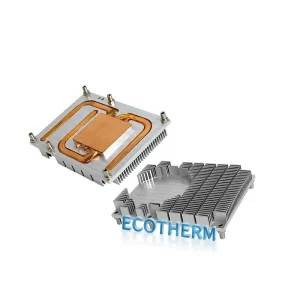
Absolutely. For applications with severe localized hot spots (such as AI processors or high-power IGBTs), we can machine pockets into the base of the skived heat sink to embed heat pipes or vapor chambers. This creates a hybrid thermal solution that utilizes phase-change technology for rapid heat spreading, combined with the extreme surface area of skived fins for heat dissipation. Learn more about our Heat Pipe Integrated Skived Fins.
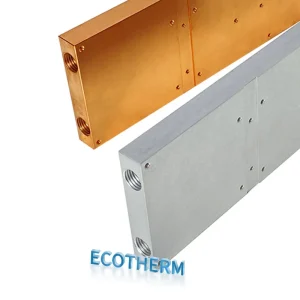
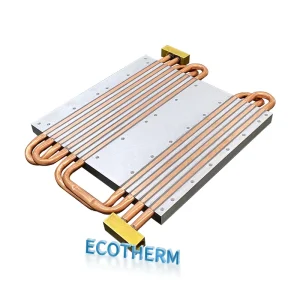
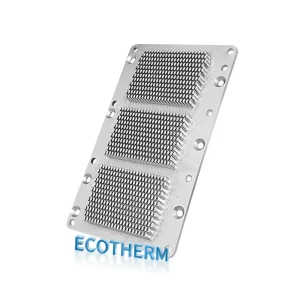
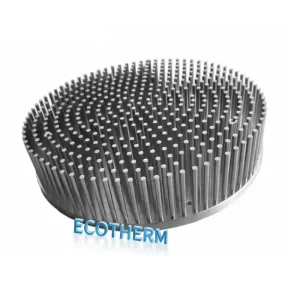
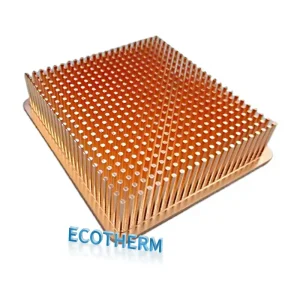
Custom Cold Plate Gallery
Custom designs for every unique need.
Crafting Custom
Heatsinks for Your Needs
Email: Support@ecothermgroup.com
Feel free to get in touch with us to discuss your project specifics, request quotes, or inquire about our capabilities.
Our team of experts is dedicated to delivering top-notch quality and precision in every heatsink we produce
Free 24 Hours Feedback Thermal Analysis
Focus On Customized Cooling Solutions
22 Years Experiences OEM Factory
Send Your Drawing For Evaluation
CONTACT ECOTHERM
Please contact us to get in touch with our experts. We can provide design services for your project and thermal simulation services within 24 hours.
Note: Ecotherm does not provide a standard thermal model.We focus on providing professional design and production services for your new projects