Integrating Vapor Chambers with Liquid Cold Plates for High-Density AI Data Centers
As AI data center rack densities aggressively scale toward and beyond 100kW, thermal management has reached a critical inflection point. Next-generation AI processors and GPUs operate at TDPs exceeding 1000W.
The core engineering challenge is no longer just total heat dissipation, but extreme heat flux. When immense power is concentrated within a highly constrained silicon die area, standard direct-to-chip liquid cooling systems encounter significant physical limitations. To bridge this gap, thermal architects are increasingly adopting a hybrid approach: utilizing a vapor chamber as an isothermal heat spreader directly beneath the liquid cold plate.
Thermal Bottleneck in AI Data Centers
High Heat Flux vs. Limited Contact Area
AI accelerators and GPUs typically present:
Heat flux exceeding 200 W/cm²
Small die footprint
Uneven heat distribution
Liquid cold plates rely on microchannels, but:
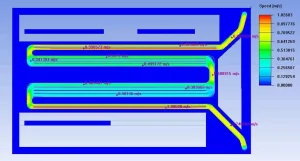
Channel density is limited by pressure drop
Flow cannot be infinitely concentrated
Direct cooling at die level is inefficient
Why Cold Plates Alone Are Not Enough
A liquid cold plate removes heat effectively only if heat is already distributed.
Without proper heat spreading:
Local hot spots remain
Thermal resistance increases at the interface
Cooling efficiency drops despite high flow rates
This is where a vapor chamber becomes necessary.
Vapor Chamber as a Heat Spreader Layer
A vapor chamber acts as an intermediate heat spreading layer between the chip and the liquid cooling system.
Function in the System
Spreads heat from a small die area
Converts localized heat into uniform surface load
Feeds heat evenly into the cold plate
This transforms the cooling problem from:
“cool a hotspot” → “cool a distributed surface”
How It Works in This Configuration
Heat from the chip enters the vapor chamber
Working fluid evaporates at the hotspot
Vapor distributes heat laterally
Condensation occurs across a larger surface
Heat transfers to the cold plate above
The liquid cooling system then removes heat efficiently.
3D Vapor Chamber for Extreme AI Heat Loads
Standard vapor chamber designs are effective, but at extreme heat flux, limitations appear.
Where 2D Vapor Chamber Reaches Its Limit
Lateral spreading becomes insufficient
Vapor flow congestion occurs
Temperature gradients increase
Role of 3D Vapor Chamber
A 3D vapor chamber introduces vertical heat transport pathways.
This provides:
Faster heat redistribution
Reduced vapor travel distance
Improved liquid return paths
Performance Impact
Compared to standard designs:
Lower thermal resistance under high load
Reduced Delta-T across the surface
Better handling of localized heat spikes
For AI chips with aggressive power density, a 3D vapor chamber is often required to maintain stable operation.
System-Level Integration: Vapor Chamber + Cold Plate + Heat Sink
An effective high-density cooling solution is not a single component, but a system.
Layered Thermal Architecture
Chip (Heat Source)
Vapor Chamber / 3D Vapor Chamber (Heat Spreader)
Liquid Cold Plate (Heat Removal)
Heat Sink / Radiator (Final Dissipation)
Why This Combination Works
Vapor chamber handles heat spreading
Cold plate handles heat transport via liquid
Heat sink handles final heat rejection to ambient
Each component operates within its optimal range.
Design Challenges in Integration
Combining phase-change devices with liquid cooling introduces engineering challenges.
Interface Thermal Resistance
Contact between chip → vapor chamber
Vapor chamber → cold plate
Poor interface control can negate performance gains.
Mechanical Constraints
Flatness tolerance
Clamping pressure distribution
Material compatibility
Manufacturing Complexity
Bonding vapor chamber to cold plate
Maintaining vacuum integrity
Ensuring structural stability under thermal cycling
When to Use Vapor Chamber in Liquid Cooling Systems
A vapor chamber should be considered when:
Heat source area is significantly smaller than cold plate area
Heat flux exceeds ~150–200 W/cm²
Hot spots persist despite liquid cooling
Thermal resistance at the interface becomes dominant
When 3D Vapor Chamber Is Needed
Upgrade to a 3D vapor chamber if:
Standard vapor chamber cannot reduce hotspot temperature
Power density continues to increase
Transient thermal spikes are critical
Custom Integrated Cooling Solutions
Standard components rarely meet AI data center requirements.
Custom solutions may include:
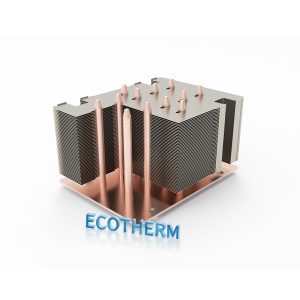
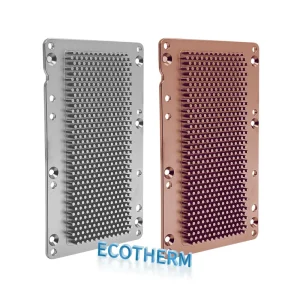
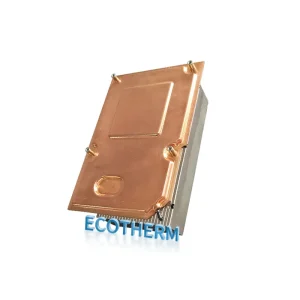
Vapor chamber + cold plate integrated modules
3D vapor chamber with optimized internal structures
Co-designed heat sink and liquid cooling paths
The goal is to match heat generation profile with cooling architecture, not just increase cooling capacity.
Engineering Capability for Advanced Cooling Systems
For high-density AI applications, manufacturing capability directly impacts thermal performance.
Key capabilities include:
Precision vapor chamber fabrication
3D internal structure design
Reliable vacuum sealing
Integration with liquid cold plates and heat sinks
Facing Thermal Limits in AI Servers?
If your system shows:
Localized overheating
Inefficient cold plate performance
Increasing thermal resistance
then the issue is likely heat spreading, not cooling capacity.
Next Step
Upload your design files or thermal requirements for evaluation.
This allows a direct assessment of:
Whether a vapor chamber is sufficient
Whether a 3D vapor chamber is required
How to integrate with your existing heat sink and liquid cooling system
FAQ
Why use a vapor chamber with a cold plate?
Because a vapor chamber spreads heat before it reaches the cold plate, improving overall cooling efficiency.
What is the advantage of a 3D vapor chamber in AI cooling?
It improves heat transfer in high heat flux conditions by enabling three-dimensional heat transport.
Can a heat sink replace a vapor chamber?
No. A heat sink dissipates heat, while a vapor chamber spreads it. They serve different functions.
Is liquid cooling enough without a vapor chamber?
Not in high-density AI applications where heat is highly localized.