The Liquid Revolution: Cooling AI Servers in the High-TDP Era
In today’s era of rapid Generative AI advancements, we are witnessing not only miracles in computing power but also the absolute physical limits of chip wattage. As the power consumption of a single server skyrockets from a few hundred watts to several kilowatts, traditional air cooling has become fundamentally inadequate. To prevent expensive AI processors from thermally throttling, data centers are undergoing a massive revolution: transitioning from “air” to “liquid.”
Liquid, once considered the natural enemy of electronic equipment, has transformed into the closest ally of High-Performance Computing (HPC). This article will take you deep into the world of liquid cooling, breaking down the core technologies that keep modern servers running at peak performance.
What is Liquid Cooling?
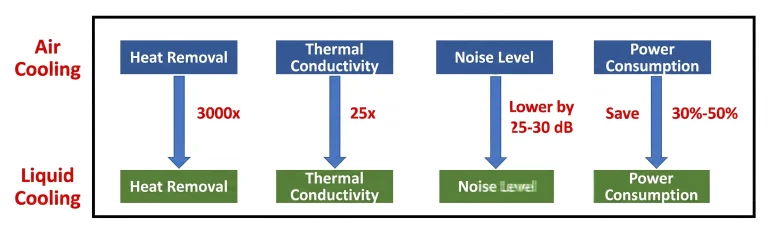
Liquid cooling involves using flowing water or liquid refrigerants to absorb and carry away the heat generated by equipment, rather than relying on air circulation. Compared to air cooling, liquid cooling offers significantly higher efficiency and lower energy consumption. It is the ultimate technological revolution addressing the high compute gap and the “power wall” presented by generative AI and ultra-high-density data centers.
Liquid cooling can be broadly categorized into contact and non-contact methods:
Contact Liquid Cooling: The coolant comes into direct physical contact with the heating components. This includes immersion cooling and spray cooling configurations.
Non-Contact Liquid Cooling: The coolant does not touch the electronic components directly. Heat is transferred indirectly through a heat sink, primarily utilizing cold plate solutions.
Liquid cooling can be broadly categorized into contact and non-contact methods:
Contact Liquid Cooling: The coolant comes into direct physical contact with the heating components. This includes immersion cooling and spray cooling configurations.
Non-Contact Liquid Cooling: The coolant does not touch the electronic components directly. Heat is transferred indirectly through a heat sink, primarily utilizing cold plate solutions.
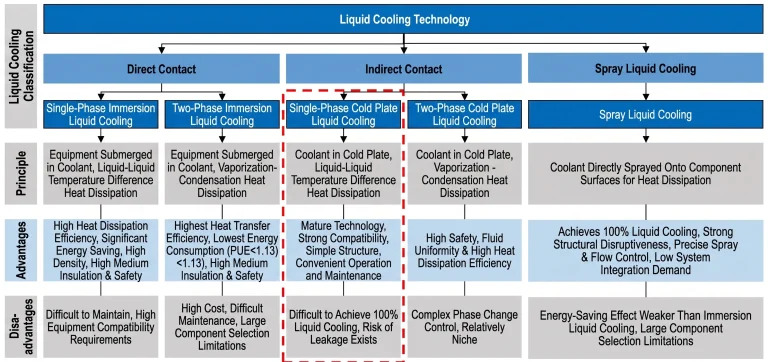
Direct contact methods (single-phase immersion, two-phase immersion, and spray cooling) achieve 100% liquid cooling with superior energy-saving effects. However, indirect cooling—specifically direct-to-chip cooling via cold plates utilizing micro-channel enhanced heat transfer—currently boasts the highest industry maturity and widespread adoption.
02. Cold Plate Liquid Cooling
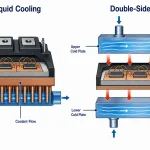
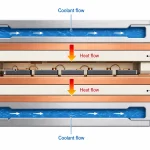
Cold plate liquid cooling transfers the heat from high-power components (like AI chips) indirectly to a fluid via a metal plate. The heat passes through the metal into the liquid, which then flows out of the server to exchange heat with an external source. Water is the most commonly used coolant. The core logic here is “no direct contact.”
Depending on whether the fluid undergoes a phase change, cold plates are divided into two types:
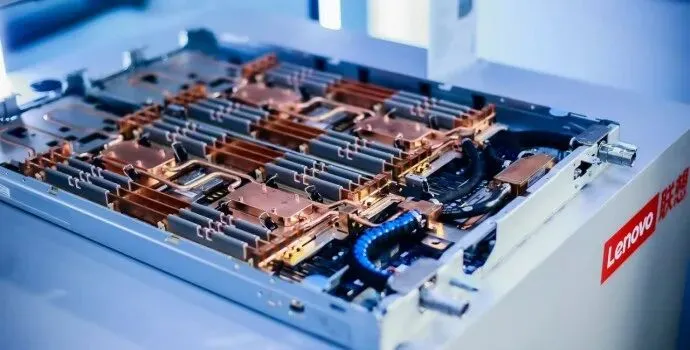
Single-phase Cold Plate: The coolant (usually water or a glycol solution) remains in a liquid state throughout the entire process. It acts as a thermal carrier, physically moving heat away via flow velocity.
Two-phase Cold Plate: The liquid boils and turns into vapor (phase change) as it flows over the hot chip. By absorbing a massive amount of “latent heat” during vaporization, the cooling efficiency is exponentially multiplied.
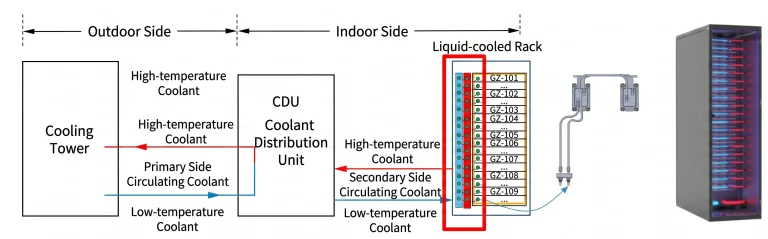
(1) The Heat Transfer Loop
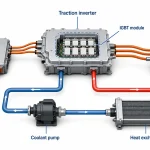
Driven by the CDU (Coolant Distribution Unit) circulating pump, the liquid enters the cold plate. It absorbs heat through forced convection, and the high-temperature fluid flows back to the CDU’s heat exchange unit to cool down before re-entering the server.
The primary loop uses the CDU as a medium to exchange heat with the secondary loop, ultimately discharging the heat into the atmosphere via a cooling tower.
(2) Core Components of a Cold Plate System
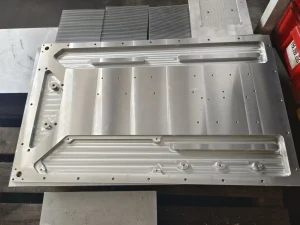
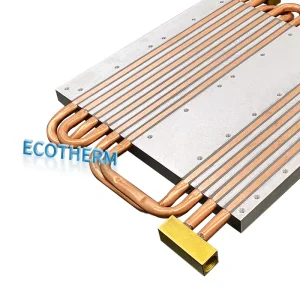
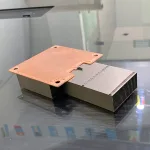
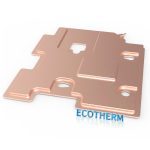
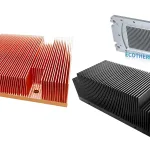
Liquid Cold Plate: Typically made of high-purity oxygen-free copper due to its exceptional thermal conductivity. Inside the cold plate are densely packed channels to increase the heat exchange area. As an expert Liquid Cold Plate Manufacturer, Ecotherm knows that the core barrier to entry lies in the design and vacuum brazing of the micro-channel cold plate.
Quick Disconnect (QD): Crucial for maintenance. High-quality QDs must be 100% leak-proof during plugging and unplugging, featuring robust self-sealing mechanisms.
CDU (Coolant Distribution Unit): The “heart and brain” of the system. It provides power (pumps), regulates temperature, filters impurities, and monitors pressure.
03. Immersion Liquid Cooling
Immersion liquid cooling is the most common direct-contact technology. By submerging the heating components entirely in a dielectric fluid, heat is dissipated through “circulation” (single-phase) or “evaporation and condensation” (two-phase cooling). This method requires fluids with high insulation, low viscosity, low corrosiveness, and high thermal stability.
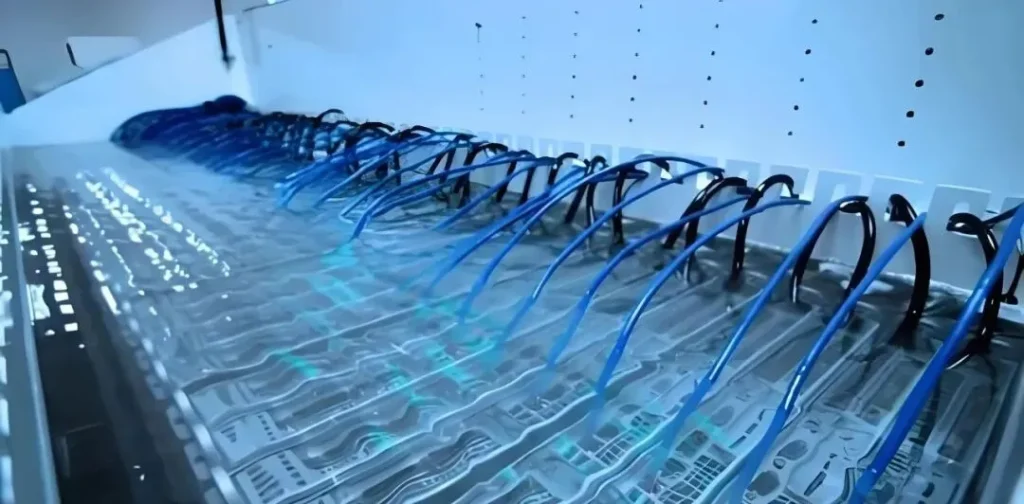
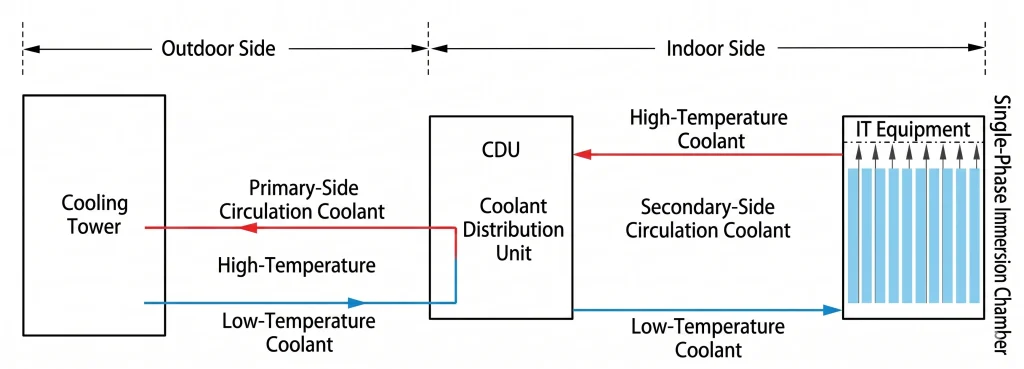
Single-phase Immersion Cooling: IT equipment is submerged in a sealed tank. The fluid absorbs sensible heat without changing its physical state. The warmed liquid is pumped to a cooler and returned to the tank.
Two-phase Immersion Cooling: The fluid continuously transforms from a liquid to a gas and back to a liquid during the cooling cycle, utilizing latent heat for extreme cooling capacity.
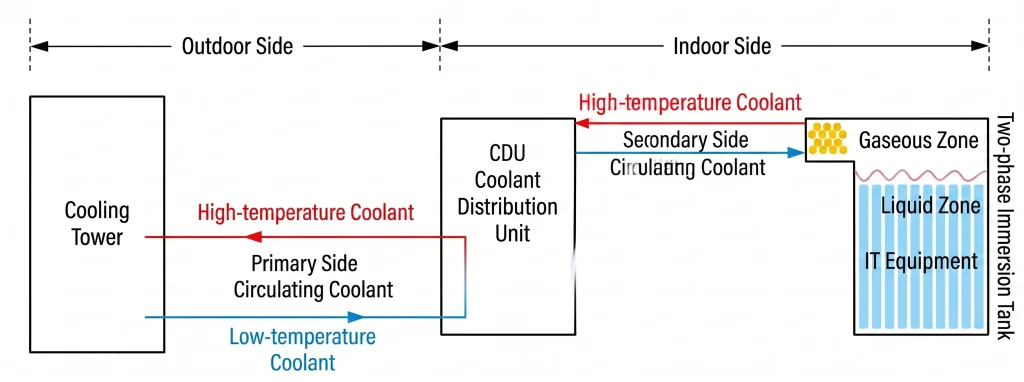
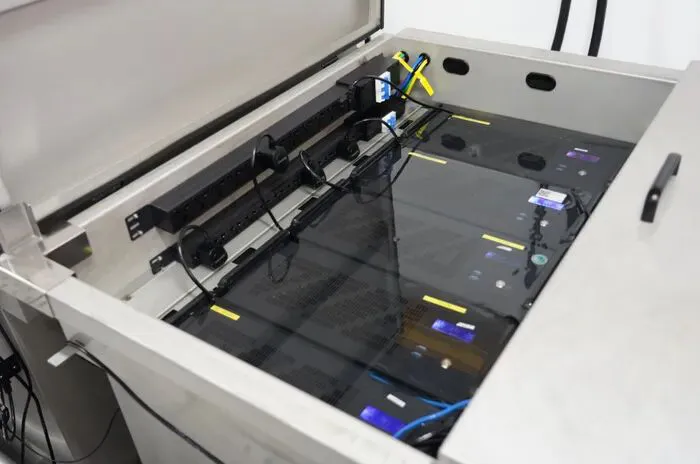
The immersion system mainly consists of the cooling medium, the Tank, the CDU, and outdoor cooling equipment. The Tank is the core component, serving as the primary location for heat exchange.
04. Spray Liquid Cooling
Spray liquid cooling involves precisely spraying the cooling medium directly onto the heating components. Depending on whether a phase change occurs on the surface, it can be divided into single-phase and phase-change spray. While spray cooling offers exceptional chip-level heat transfer, it is technically demanding. Potential issues with liquid drift affecting the server room mean it has not yet been widely adopted in large-scale data centers.
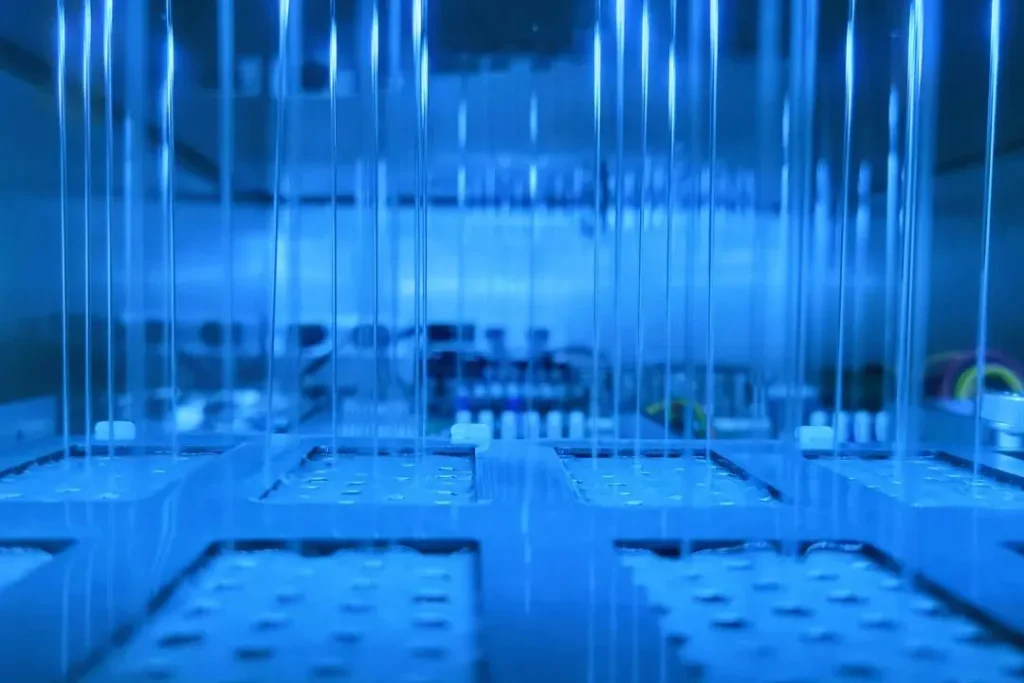
Single-phase Spray: Larger droplets form a thin boundary layer on the component surface for heat exchange without phase change.
Phase-change Spray: The cooling medium is atomized into tiny droplets, carrying away heat through vaporization upon hitting the hot surface.
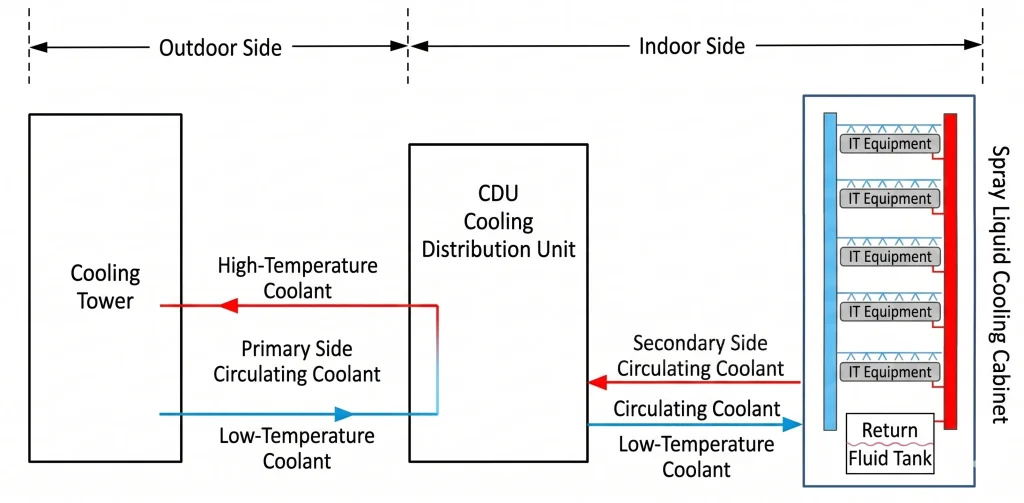
A complete spray liquid cooling system primarily consists of a cooling tower, a Coolant Distribution Unit (CDU), primary and secondary liquid cooling loops, the cooling medium, and the spray liquid cooling cabinet. The cabinet itself typically integrates a piping network, a fluid distribution system, spray modules, and a fluid return system.
05. Conclusion: Navigating the New Era of Compute
Through the breakdown of these three liquid cooling technologies, it is clear that choosing the right thermal architecture is a multidimensional balance of cooling efficiency, technological maturity, and commercial cost.
Currently, single-phase cold plate liquid cooling is the undisputed mainstream choice. With its high compatibility with traditional air-cooled architectures and mature supply chains, it is the optimal solution for tackling high thermal resistance. While immersion cooling represents the ultimate form of energy efficiency—capable of pushing PUE (Power Usage Effectiveness) below 1.1—it requires higher initial investments and a restructuring of operational habits.
For engineers and procurement teams navigating this “cold plate now, immersion tomorrow” landscape, finding a reliable manufacturing partner is critical.
Get Your Free Thermal Evaluation Today
Ecotherm is dedicated to providing top-tier Custom Cold Plate Solutions for the AI and HPC industries. Don’t let thermal bottlenecks limit your system’s performance. Upload your CAD/STEP files today for a Free Thermal DFM analysis. We support a Custom Heat Sink Low MOQ of just 1 piece, ensuring rapid prototyping and 100% full inspection to get your high-TDP projects running cooler and faster.