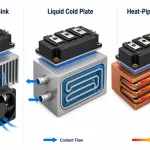
Heat Sink Fin Attachment: Reflow Soldering vs. Press Fit
When designing custom heat pipe modules, thermal engineers must specify how the cooling fins attach to the heat pipes. While the focus is often on the heat pipes themselves, the attachment method directly dictates the interfacial thermal resistance and the long-term reliability of the entire thermal assembly.
Currently, two primary manufacturing processes dominate the industry: Reflow Soldering and Press Fit (Interference Fit). This guide breaks down the engineering reality behind both methods to help you specify the right process for your application.
The True Function of Heat Sink Fins
Before comparing attachment methods, it is necessary to clarify the exact role of the components.
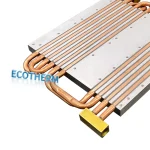
A common misconception is that heat pipes cool the system. In reality, heat pipes are strictly thermal superconductors—they transport heat away from the silicon. The fins are the components that actually dissipate the heat into the ambient air by exponentially increasing the surface area. Without a high-density fin stack and a low-resistance connection to the heat pipes, the thermal transport cycle breaks down.
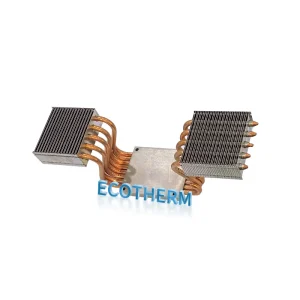
What is Reflow Soldering?
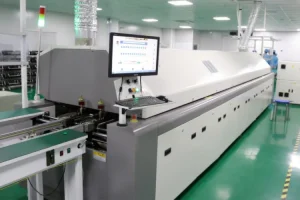
Reflow soldering utilizes a metallurgical bond to secure the fins to the heat pipes.
The Process: Solder paste is applied to the heat pipes, and the fins are slid into position. The entire assembly is passed through a temperature-controlled reflow oven. As the solder melts, capillary action draws it into the microscopic gaps between the fin collars and the heat pipe wall, creating a solid, permanent joint upon cooling.
Engineering Characteristics:
Mechanical Rigidity: Reflow soldering creates an incredibly robust structure. It is highly resistant to shock, vibration, and physical deformation.
Thermal Cycling Durability: Because the joint is metallurgically bonded, it resists loosening over time, making it ideal for mission-critical industrial or server applications intended to run for 5 to 10 years.
The Thermal Resistance Trade-off: Soldering requires compatible materials. Copper and aluminum cannot be directly soldered easily, so the components are often nickel-plated. Nickel has poor thermal conductivity, and the solder layer itself adds thermal resistance. Therefore, while mechanically superior, a soldered joint is not a “zero thermal resistance” connection.
What is Press Fit (Interference Fit)?
Press fit (often referred to as “Finning” or “Swaging”) is a cold-forming mechanical connection.
The Process: Fins are manufactured with precise collar diameters slightly smaller than the outer diameter of the heat pipe. Using mechanical force, the fins are pressed onto the heat pipes. The natural elasticity and deformation of the metal create an extremely tight interference fit.
Engineering Characteristics:
Theoretical Thermal Superiority: Because there is no nickel plating and no intermediate solder layer, high-quality press fitting achieves direct metal-to-metal contact. In a perfect manufacturing environment, this yields lower interfacial thermal resistance than reflow soldering.
Manufacturing Tolerance Dependency: The success of this method relies entirely on extreme stamping and assembly tolerances. If the collar is too large, the fin is loose, destroying thermal transfer. If it is too tight, the heat pipe is crushed.
CTE Mismatch Risks: Copper heat pipes and aluminum fins have different Coefficients of Thermal Expansion (CTE). Under frequent, extreme temperature fluctuations (heating up and cooling down over years), this mismatch can cause the mechanical grip to loosen, degrading performance over the product’s lifespan.
Which Process Should You Specify?
The assumption that “reflow soldering is always thermally superior” is a misconception. From a pure Delta-T perspective, a perfectly executed press fit can outperform a soldered joint due to the absence of solder/nickel thermal resistance.
However, the decision comes down to manufacturing consistency and application environment:
Choose Reflow Soldering when: The equipment will face heavy vibration, physical stress, or requires absolute long-term durability without performance degradation over a decade. The slight thermal penalty is offset by guaranteed reliability.
Choose Press Fit when: You need the absolute lowest thermal resistance for a static environment, and the manufacturer can guarantee strict dimensional tolerances. It is also more cost-effective for high-volume production.
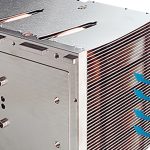
Structural Enhancements: To mitigate the risks of loose fins in press-fit assemblies, engineers often specify [zippered fins]. Zipper fins feature interlocking tabs that lock the entire fin stack together. This maintains a perfect fin pitch and provides the structural rigidity necessary to endure the mechanical stress of the press-fit process without warping.
Ensure Your Manufacturing Tolerances
Whether you require the long-term durability of a reflow-soldered assembly or the low thermal resistance of a precision press-fit design, execution depends entirely on factory capabilities.
If you are developing a custom thermal module and need to verify which fin attachment method aligns with your heat flux and budget constraints, our engineering team can provide a full DFM evaluation of your CAD files.