Liquid Cold Plate Quality Control: Helium Leak Testing, C-SAM, and Surface Treatments
A custom liquid cold plate can have the most optimized bionic micro-channels and utilize the strongest friction stir welding, but without rigorous quality validation, it is simply a liability. In high-density AI servers and EV battery packs, a single micro-leak or internal weld void translates to catastrophic hardware destruction.
Quality control in thermal management is not a final checkpoint; it is a continuously engineered standard. Before you approve a supplier for mass production, you must ensure their testing protocols cover surface corrosion, micro-leakage, and internal structural integrity.
Here is the objective breakdown of the industry-standard quality control processes for high-performance liquid cold plates.
Surface Treatments: Defeating Galvanic Corrosion
Bare aluminum (like AL 3003) offers excellent thermal conductivity, but it is highly vulnerable to galvanic corrosion—especially if the cooling loop contains mixed metals (e.g., copper fittings) or aggressive coolants like Water-Ethylene Glycol (WEG) mixtures.
Sulfuric Acid Anodizing: This is mandatory for long-term reliability. By applying a 12-18V voltage, we generate a 5-20μm thick aluminum oxide layer on the cold plate.
The Engineering Reality: Anodizing increases corrosion resistance by 10x, allowing the plate to survive 1000+ hours of rigorous salt spray testing. Crucially for EV and power electronics, it also acts as an electrical insulator, boosting the breakdown voltage to >500V.
PTFE (Teflon) Coating: For complex fluid routing, a 50-100μm PTFE coating is applied to the internal channels. This reduces the surface friction coefficient to ~0.1, significantly lowering coolant flow resistance and reducing the workload on your system’s pumps.
The Leak Detection Standard: Helium vs. Hydrostatic Testing
“Water testing” is sufficient for plumbing, but unacceptable for aerospace or high-power computing.
Hydrostatic & Pneumatic Testing (The Baseline): Commonly used for standard Energy Storage System (ESS) cold plates. The plate is pressurized with air or water to 1.5x its maximum operating pressure and held for 30 minutes. It catches gross manufacturing defects and weak weld seams.
Helium Mass Spectrometry (The Gold Standard): Helium atoms are exceptionally small and will penetrate micro-fissures that water or air cannot detect.
The Engineering Reality: A helium leak detection cold plate test operates at a precision of $1 \times 10^{-9}$ mbar·L/s. We ensure a strict leak rate of $\le 0.1$ sccm. If your cold plate is going into a server rack above millions of dollars of GPU hardware, Helium testing is non-negotiable.
Internal Inspection: C-SAM Void Analysis and CMM
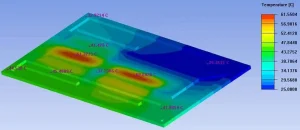
You cannot verify a vacuum brazed joint with the naked eye. Internal voids block heat transfer, creating localized hotspots that destroy silicon.
Ultrasonic C-SAM (Scanning Acoustic Microscopy): Using high-frequency sound waves (50-200MHz), C-SAM penetrates the aluminum to map the internal braze joints with a 50μm resolution.
The Hidden Constraint (Void Distribution): An overall void rate of $<5\%$ is the industry standard. However, that is not enough. Our engineering protocol ensures that no single void exceeding $2mm^2$ exists directly beneath the primary heat source (the component footprint).
CMM (Coordinate Measuring Machine): Thermal Interface Material (TIM) relies on extreme surface contact. If the welding process warps the plate, thermal resistance skyrockets. We utilize CMM probing (precision $\pm 0.002mm$) to verify strict flatness and coplanarity tolerances across the entire mounting surface.
Validate Your Supply Chain
Never finalize a liquid cooling purchase order without reviewing the manufacturer’s testing data. Ensure your engineering team integrates these quality standards into your initial CAD parameters:
Determine your base material limits: Liquid Cold Plate Manufacturing
Verify your internal geometries: Cold Plate Forming & Channel Design: Hydroforming vs. Stamping
Select your sealing method: Liquid Cold Plate Welding: Vacuum Brazing vs. Friction Stir Welding (FSW)
Are you struggling with leaking prototypes or high thermal resistance due to warped base plates? As a specialized custom liquid cold plate manufacturer, we build helium leak testing and CMM validation into every production run.
Upload your 3D CAD models today for a Free DFM review. We will ensure your design is optimized for zero-defect manufacturing and long-term reliability.