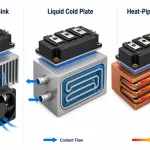
Engineering Liquid Cold Plates: Material Limits & OEM Process Routes
f you are packaging an 800V EV battery platform or a high-density AI server rack, traditional thermal management is no longer viable. The bottleneck has shifted to the liquid cold plate’s manufacturing execution: specifically, balancing the pressure drop, minimizing interfacial thermal resistance, and ensuring long-term leak-proof reliability at scale.
A poorly specified cold plate design will look great in CFD simulations but fail miserably on the production line due to tooling constraints or welding deformation.
This brief details the strict material limitations and the proven manufacturing routes currently deployed by Tier-1 OEMs.
Base Material Selection: The Real-World Trade-offs
You cannot simply specify “copper” for every high-heat project. Material selection dictates your forming method, welding compatibility, and corrosion prevention strategy.

1.Aluminum 3003 (The Scalable Baseline): The dominant choice for EV battery plates. It provides a highly stable balance of thermal conductivity, structural rigidity, and cost. More importantly, it is highly compatible with large-format vacuum brazing and friction stir welding (FSW) without severe thermal distortion.
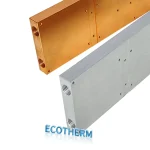
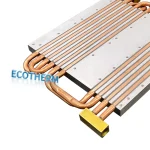
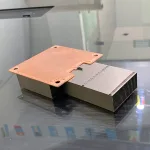
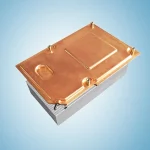
2.Pure Copper (For Extreme Heat Flux): With a thermal conductivity exceeding 400 W/m·K, pure copper is mandatory for localized, high-power compute scenarios (like data center GPUs). However, it introduces significant weight penalties and severe galvanic corrosion risks. Copper cold plates almost always require secondary surface treatments, such as nickel plating, before integration.
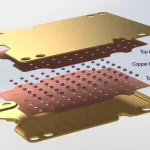
3.Composite Clad Aluminum: When structural integrity must meet high burst-pressure requirements (e.g., in heavy-duty ESS containers), engineers utilize clad materials. This is typically a three-tier structure: a high-strength aluminum core, a pre-clad brazing alloy layer, and a sacrificial anti-corrosion layer designed for a 10+ year operational lifespan.
How Top Tier-1s Scale Production
Analyzing the manufacturing routes of top OEMs reveals how they solve specific thermal challenges through process combinations:
1.CATL (High-Volume Pack Bottom Plates)
Process: Hydroforming + Vacuum Brazing + Helium Leak Testing
The Engineering Reality: Hydroforming allows for massive cooling surface areas (up to 4x larger) with complex, branching channels. Combined with vacuum brazing, it achieves a 35% reduction in manufacturing costs at scale while maintaining a strict leak rate of ≤0.1 sccm.
2.Tesla (4680 Module Integration)
Process: 3D Printing (DMLS) + Bionic Channel Design + Ultrasonic Welding
The Engineering Reality: 3D printing eliminates welding seams entirely for the core cavity, easily handling pressures above 6 bar. The bionic channels reduce pressure drops, pushing industry limits on volumetric efficiency.
3.Valeo (Premium European Platforms)
Process: Extrusion + Bionic Channels + FSW
The Engineering Reality: Extrusion keeps base costs low, while FSW (Friction Stir Welding) provides joint strength at 90%+ of the base material. The added internal bionic structures increase fluid turbulence, boosting the heat transfer coefficient by 20%.
Specify Your Next Process
Material is just the baseline. To finalize your CAD for mass production, you must align your internal channel geometry with the correct forming and welding technologies.
Review our specific process capabilities here:
Cold Plate Forming & Channel Design: Hydroforming vs. Stamping – Determine which forming method matches your pressure drop and tooling budget.
Liquid Cold Plate Welding: Vacuum Brazing vs. FSW – Analyze the burst pressure limits and deformation risks of each sealing method.
Quality Control: Helium Leak Testing and Surface Treatments – Understand the validation protocols required for zero-defect thermal modules.
Do not finalize your thermal CAD without verifying tooling constraints. If you are dealing with extreme heat flux or complex routing, send your STEP/IGES files to our engineering team. We are a specialized custom liquid cold plate manufacturer providing rapid DFM reviews to ensure your design is actually manufacturable.