
Direct-to-Chip Liquid Cooling for 1000W+ Processors
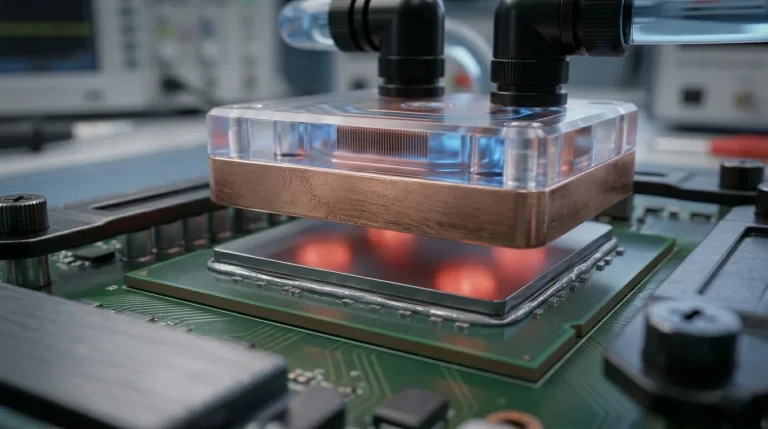
As processor Thermal Design Power (TDP) exceeds 1000W, traditional air cooling and macroscopic liquid management systems fail to extract heat efficiently from the silicon die. Direct-to-chip liquid cooling provides the ultimate thermal intervention, bypassing ambient air transfer to absorb heat exactly where it is generated. By mounting precision-engineered liquid cold plates directly onto the processor, these systems manage extreme heat fluxes, eliminate thermal bottlenecks, and ensure uninterrupted compute performance in hyperscale data centers.
Core Technologies & Manufacturing Specifications
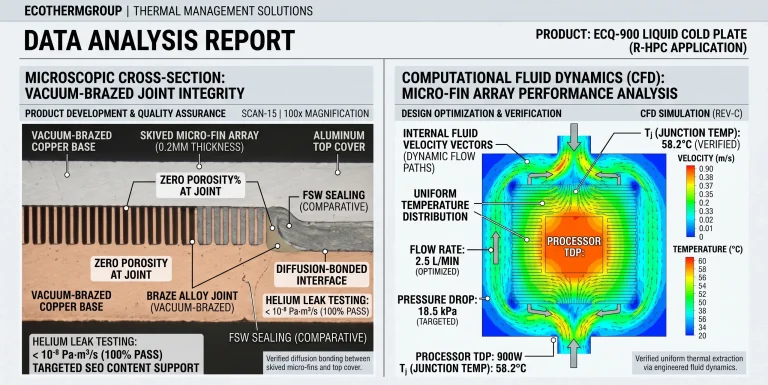
The foundation of reliable direct-to-chip liquid cooling lies in ultra-precise fabrication. A high-performance copper cold plate is machined with micro-skived fins as thin as 0.1mm to maximize the internal wetted surface area. Securing these complex internal geometries requires a state-of-the-art vacuum brazing process, which yields a monolithic, oxide-free joint capable of withstanding massive system pressures without degrading thermal conductivity. Every completed unit undergoes strict helium leak testing to guarantee a zero percent failure rate in production environments.
Key Benefits for High-Density Data Centers
Maximized Heat Extraction:
Direct thermal contact combined with premium Thermal Interface Material (TIM) minimizes thermal resistance from the die to the fluid boundary, allowing for instant heat absorption.
Optimized Fluid Dynamics:
Advanced internal manifold designs balance the coolant flow rate and pressure drop, ensuring uniform liquid distribution across multiple compute nodes without mechanically straining facility pumps.
Uncompromised Reliability:
The vacuum brazing process ensures absolute structural integrity and a 100% leak-free cooling loop, safeguarding high-value silicon assets under continuous load.
PUE Reduction:
Highly efficient heat capture at the source allows for higher facility coolant inlet temperatures, dramatically lowering mechanical chilling costs and improving overall facility Power Usage Effectiveness (PUE).
Engineering FAQ: Direct-to-Chip Integration
How is the balance between coolant flow rate and pressure drop achieved in microchannel cold plates?
Achieving the optimal balance requires iterative Computational Fluid Dynamics (CFD) modeling. Increasing microchannel density boosts thermal transfer but elevates fluidic resistance. Precision engineering adjusts fin pitch, thickness, and internal manifold routing to ensure the target heat dissipation is met within the exact pressure drop limits of the facility’s Coolant Distribution Unit (CDU).
Why is a copper cold plate preferred over aluminum for direct-to-chip applications?
Copper boasts a thermal conductivity of approximately 400 W/m·K, significantly higher than aluminum. For 1000W+ bare-die processors, this rapid heat spreading capability is critical to prevent localized hot spots before the thermal load can be transferred to the circulating liquid.
Initiate Direct-to-Chip Cold Plate Manufacturing
Customizing direct-to-chip liquid cooling architecture requires exact tolerances and rigorous manufacturing validation. Upload STEP/IGES CAD files or detailed system thermal requirement specifications to initiate a comprehensive Design for Manufacturing (DFM) review. Receive a detailed technical feasibility analysis, CFD simulation parameters, and a custom production quote within 24 hours.
Upload CAD Files for Free DFM Review: