
Custom IGBT Heat Sinks & Liquid Cold Plates for VFD & Motor Drive Thermal Management
Ecotherm Custom Cold Plate Manufacturing Capabilities
We provide tailored engineering and manufacturing solutions for different VFD and motor drive applications:
Best Fit Application
High-power, high-heat-flux IGBT modules
Engineering Advantages
Extremely compact, supports complex micro-channels, ultra-low thermal resistance.
Best Fit Application
Industrial drives requiring extreme reliability
Engineering Advantages
Fine internal channels, base-metal joint strength, highly pressure-resistant.
Best Fit Application
Large-format aluminum plates for multi-module VFDs
Engineering Advantages
Solid-state joining with zero porosity, exceptional leak-proof performance.
Best Fit Application
Liquid loops requiring straight-channel designs
Engineering Advantages
Highly robust structure, completely eliminates weld seam leak risks, cost-effective.
Best Fit Application
Cost-sensitive medium-power drive solutions
Engineering Advantages
Mature manufacturing process, highly reliable, easy to scale for mass production.
High-power Variable Frequency Drives (VFDs) and motor controllers generate massive amounts of heat during operation. Insulated-gate bipolar transistors (IGBTs) and power electronic modules are the core heat sources in industrial automation, traction drives, and electric vehicle controllers. Effective thermal management is critical to ensure reliable performance, prevent thermal runaway, and extend the service life of the equipment.
Ecotherm specializes in manufacturing high-performance custom IGBT heat sinks and liquid cold plates designed for direct-to-chip cooling of high-power industrial and automotive drive electronics. By leveraging advanced metallurgical processes such as vacuum brazing, TLP diffusion bonding, friction stir welding (FSW), gun-drilling, and tube-embedding, we provide optimal thermal solutions that protect your power modules from overheating.
Note: We do not manufacture immersion cooling systems or standalone fan assemblies. Our core expertise is 100% focused on engineering and fabricating high-reliability custom metal heat sinks and cold plates. Where necessary, hybrid air-assisted cooling can complement our high-density heat sinks.
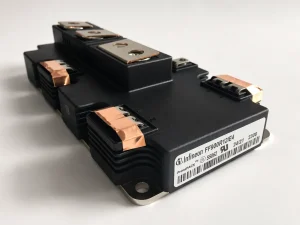
Thermal Dynamics Inside a Variable Frequency Drive
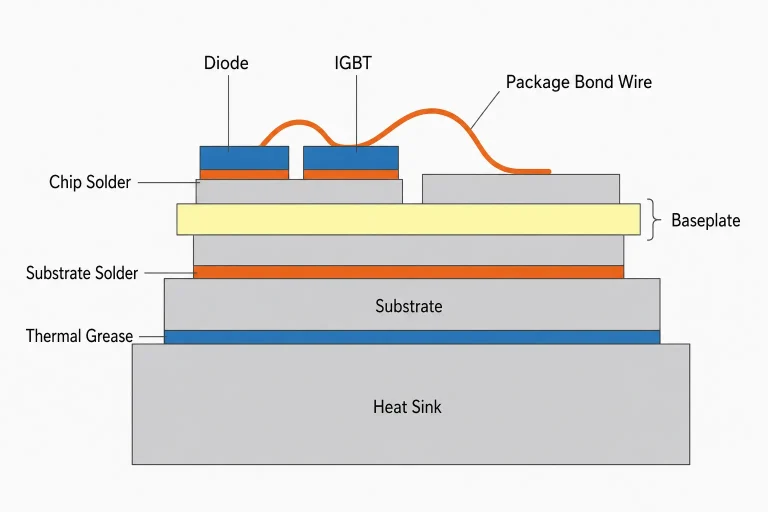
The core of VFD cooling revolves around managing the thermal dissipation of power modules. The thermal loss of an IGBT mainly stems from:
Conduction Losses : Occurs when the transistor is actively conducting current, heavily dictated by the load and internal resistance.
Switching Losses : Occurs during the transition states. The higher the switching frequency of the VFD, the more switching cycles occur, leading to an exponential increase in power loss and temperature rise.
If the heat dissipation structure is inadequate, the forward conduction resistance of the semiconductor device increases, leading to a vicious cycle of higher heat generation and declining electrical efficiency.
Cooling Methods for VFDs and Motor Drives
1. Forced Air-Cooled Heat Sinks
Traditional VFDs rely on large-profile aluminum heat sinks paired with forced convection. This is a highly cost-effective solution for low-to-medium power drives. By utilizing high-density Skived Fin Heat Sinks, we can dramatically increase the heat dissipation surface area while completely eliminating the interfacial thermal resistance found in bonded or folded fin designs.
2. Custom Liquid Cold Plates
For IGBT modules with high heat flux density, liquid cold plates offer unmatched heat removal efficiency. They support extreme power densities, ultra-compact packaging, and superior thermal stability. In megawatt (MW) level drives or space-constrained environments, direct liquid cooling is the optimal choice to keep IGBTs operating safely.
Choosing Between Air-Cooled Heat Sinks and Liquid Cold Plates
Selecting the right thermal architecture depends heavily on the power density and operating environment of the motor drive system.
| Cooling Solution | Power Range & Fit | Engineering Advantages | Manufacturing Focus |
| Aluminum Extrusion Heat Sink | Low-power standard drives | Low manufacturing cost, excellent structural rigidity. | Standard alloy profile limits fin density and aspect ratio. |
| Skived Fin Heat Sink | Medium-to-high power VFDs | High fin density, thin fin profiles, monolithic structure ensures zero interfacial thermal resistance. | Requires high-precision CNC skiving machinery to maintain fin uniformity. |
| Tube Embedded Cold Plate | Medium-power VFD liquid loops | Cost-effective copper/aluminum hybrid, highly reliable fluid paths without fluid-to-aluminum contact. | Precise mechanical pressing or thermal epoxy bonding to eradicate air gaps. |
| Vacuum Brazed Cold Plate | Heavy industrial / MW-level high-voltage VFDs | Extremely low thermal resistance, allows complex internal micro-channels for localized hotspots. | Flux-free high-vacuum oven joining, ensuring 100% void-free joints and high burst pressure resistance. |
| Friction Stir Welded (FSW) Cold Plate | Large-format multi-IGBT power blocks | Solid-state joining guarantees zero porosity and leak-proof sealing across large aluminum surfaces. | Precise DFM review of the weld tool path and structural sealing integrity. |
Maximizing Thermal Efficiency: Surface Treatment & Installation
A premium IGBT heat sink requires meticulous attention to surface characteristics and mounting interfaces to fully minimize the system’s overall thermal resistance (theta_jc).
Engineering the Radiative Surface Treatment
According to industrial testing, treating the aluminum heat sink surface can drastically improve heat dissipation efficiency:
- Anodizing & Electrophoresis Blackening: Applying an electrophoretic coating or black anodization can increase thermal dissipation by 10% to 15% under natural convection, and by 20% to 30% under forced air cooling.
Electrical Insulation: High-quality electrophoretic coatings provide a surface breakdown voltage resistance of 500V to 800V, mitigating the risks of creepage distance and clearance issues in compact VFD enclosures.
Controlling Interface Thermal Resistance
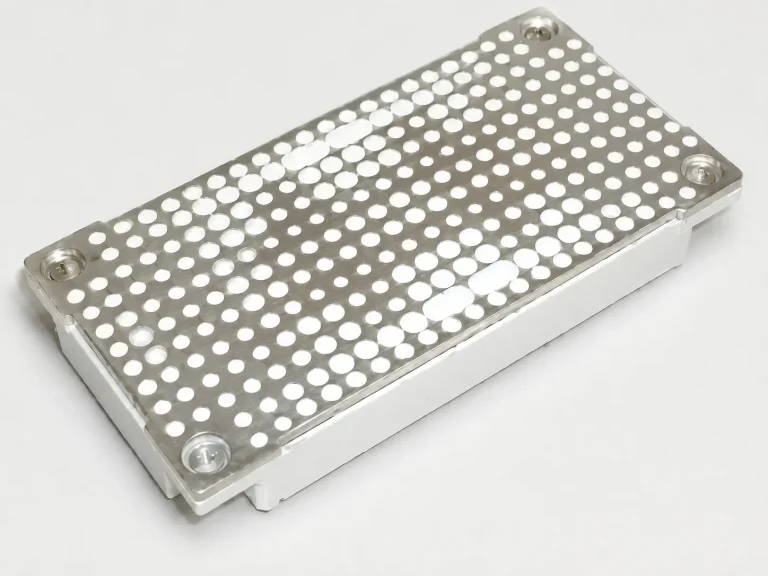
The microscopic air gaps between the smooth metal base of an IGBT module and the heat sink base act as thermal insulators. Ecotherm ensures tight CNC flatness tolerances (often ≤0.02mm), and strongly recommends proper installation protocols:
Applying a uniform, thin layer of high-performance thermal interface material (TIM) or thermal grease can reduce the contact thermal resistance by 25% to 30%.
Ensuring identical fastening torque across all mounting screws prevents localized hotspots and uneven mechanical stress on the silicon dies.
Technical Parameters for Custom IGBT Heat Sink RFQs
To provide an accurate technical review and quotation for your custom VFD thermal solution, our engineering team utilizes specific data. Please review the following checklist before submitting your drawings:
Mechanical Package:
3D CAD step files, mounting footprint, baseplate thickness limitations, and maximum envelope size.
Power & Loss Specs:
Total power loss (Watts) to be dissipated, heat flux density (W/cm²), and specific IGBT layout pattern.
Target Boundaries: Maximum allowable junction temperature (Tj), target case temperature (Tc), and maximum ambient temperature of the operating environment.
Cooling Fluid Attributes (For Cold Plates):
Coolant type (e.g., Water/Glycol), inlet temperature, volumetric flow rate (LPM), and maximum allowable pressure drop (Delta P).
Environmental Constraints:
IP rating needs (e.g., IP54/IP65), exposure to chemical/dust environments, and salt spray testing hours requirements.
Why Partner with Ecotherm for Your VFD Thermal Projects?
Ecotherm bridges the gap between complex thermal simulation designs and factory-floor manufacturing. By controlling all critical fabrication steps—from raw material extrusion and high-density CNC skiving to advanced vacuum brazing and friction stir welding—we guarantee that your custom IGBT heat sink meets the rigorous demands of industrial automation, traction drives, and renewable energy converters.
Frequently Asked Questions (FAQ)
Why does the VFD switching frequency impact the selection of the IGBT heat sink?
Higher switching frequencies reduce current harmonics and motor noise but drastically increase the switching losses within the IGBT modules. This extra power loss converts entirely into heat, elevating the heat flux density and forcing the thermal design to shift from standard extrusion to high-density skived fins or direct liquid cold plates to maintain safe junction temperatures.
How does Ecotherm ensure zero-leak reliability for VFD liquid cold plates?
We implement rigorous quality control protocols for all liquid cooling paths. Utilizing flux-free vacuum brazing or friction stir welding prevents weld joint porosity. Every single cold plate undergoes 100% helium mass spectrometer leak testing and high-pressure water pressure drop validations before shipment, ensuring complete protection for high-voltage cabinets.
Can we implement a hybrid air-liquid cooling solution on an IGBT heat sink?
Yes. In many high-power or high-voltage VFD configurations, the main heat-generating power units (IGBTs) are mounted directly onto high-efficiency vacuum brazed liquid cold plates, while the secondary components like capacitors and DC busbars utilize localized copper heat pipes integrated into aluminum skived fin modules to spread and dissipate heat efficiently.