
Data Center Liquid Cooling Architecture for High-Density AI Clusters
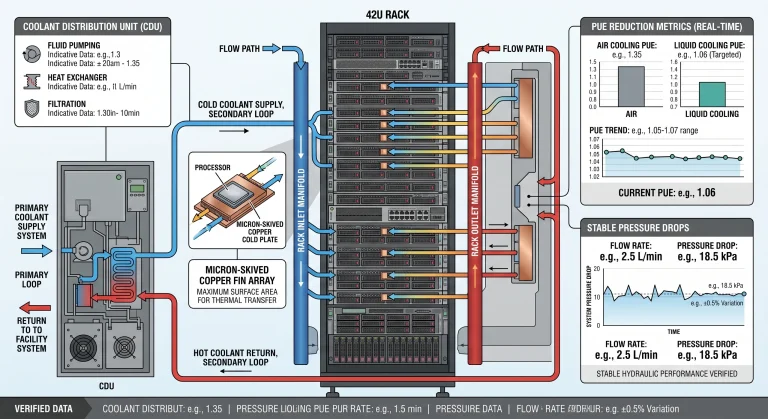
As server racks push past the 100kW threshold, traditional HVAC and air-based thermal extraction methods become mechanically and economically unviable. Implementing robust data center liquid cooling infrastructure is essential to manage the extreme heat fluxes generated by modern AI and machine learning nodes. Utilizing direct-to-chip (D2C) liquid cooling architecture allows facility managers to intercept heat directly at the silicon level, bypassing ambient air transfer and ensuring absolute thermal stability for high-density compute environments.
Core Technologies & Manufacturing Specifications
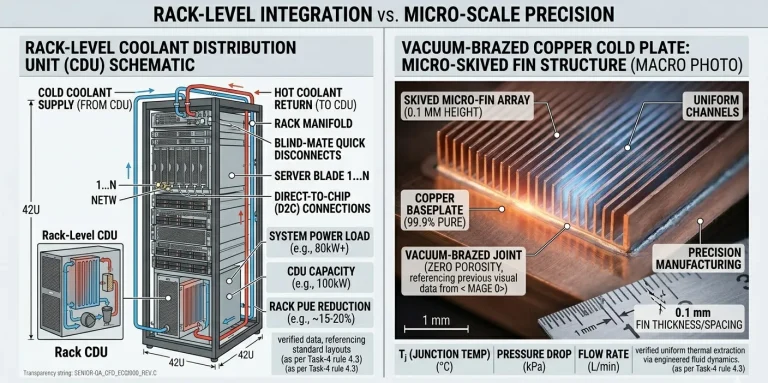
The efficacy of any fluid-based thermal system relies on the absolute integrity of its components. Custom cold plate manufacturing leverages advanced vacuum brazing to construct leak-free, high-performance copper cold plates. This controlled atmospheric joining process ensures oxide-free internal channels capable of withstanding extreme pumping pressures. Furthermore, precision CNC-machined internal flow channels and high-density skived fin structures are engineered to maximize the wetted surface area within the fluid boundary layer, while rigorous mass spectrometer helium leak testing (up to 10^-6 mbar l/s) guarantees zero failure rates in mission-critical facility deployments.
Key Benefits for Data Center Facility Management
Power Usage Effectiveness (PUE) reduction:
By capturing heat efficiently at the source, facility inlet water temperatures can be elevated. This drastically reduces reliance on energy-intensive mechanical chillers, driving down overall facility PUE and operational expenditures.
High-density server thermal management:
Advanced liquid solutions enable the packing of high-TDP processors into dense rack configurations, maximizing compute capacity and hardware utilization per square foot of raised floor space.
Optimized Direct-to-chip (D2C) liquid cooling integration:
Standardized quick-disconnect (QD) fittings and precise blind-mate manifold routing allow for seamless integration and maintenance of fluid loops within existing 19-inch or 21-inch OCP (Open Compute Project) racks.
Superior Thermal Conductivity:
Utilizing premium copper cold plates ensures rapid heat spreading from the processor die to the circulating fluid, preventing localized hot spots and maintaining sustained peak clock speeds across the entire cluster.
Engineering FAQ: Facility-Level Liquid Integration
What is the optimal coolant flow rate for rack-level liquid cooling?
Determining the optimal flow rate requires balancing the thermal extraction requirements against the allowable pressure drop within the server loop. Iterative Computational Fluid Dynamics (CFD) analysis during the design phase ensures that the pumping infrastructure is not overstressed while maintaining the precise delta-T required across the compute node.
How does custom cold plate manufacturing mitigate catastrophic leak risks?
Leak prevention is engineered at the metallurgical level. Utilizing flux-free vacuum brazing combined with Friction Stir Welding (FSW) for larger enclosures creates monolithic, seamless joints. Every individual unit is then validated via helium leak testing to ensure absolute structural integrity before integration into the facility loop.
Initiate Custom Liquid Loop Engineering
Transitioning legacy air-cooled infrastructure to advanced liquid loops requires precise thermal engineering and stringent manufacturing validation. Upload facility requirements, rack loop layouts, or server blade CAD models to initiate a comprehensive Design for Manufacturing (DFM) review. Receive a detailed thermal feasibility analysis, structural recommendations, and a custom production quote within 24 hours.
Upload CAD Files for Free DFM Review: