
Edge Data Center Liquid Cooling: Custom Cold Plates for Edge Computing Thermal Management
Edge data centers are moving closer to users, smart factories, 5G telecom sites, and AI inference nodes. Compared with traditional centralized data centers, edge facilities often face severely limited space, fewer on-site maintenance resources, harsher ambient conditions, and a rapidly growing demand for high-density compute.
As AI, IoT, industrial automation, and real-time analytics increase compute density at the edge, traditional air cooling struggles to efficiently control the soaring temperatures of CPUs, GPUs, ASICs, and AI accelerators. Liquid cooling provides an extremely compact and efficient way to remove heat directly at the source.
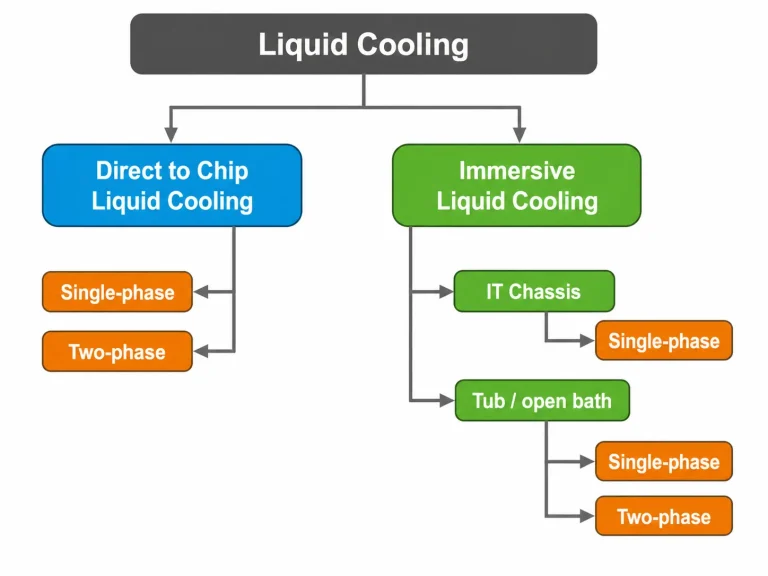
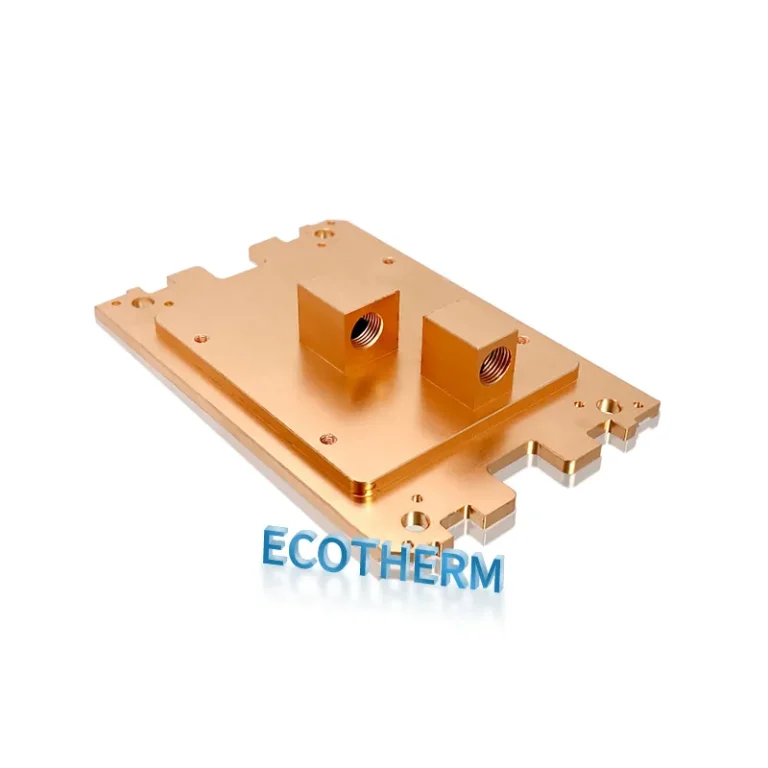
Ecotherm specializes in manufacturing custom liquid cold plates for edge computing thermal management. Our direct-to-chip cold plates are widely used for CPUs, GPUs, AI acceleration modules, high-power supply modules, and high-density server components.
We do not manufacture immersion cooling tanks or systems.
Our core capability is 100% focused on providing highly reliable custom metal cold plates for direct-to-chip liquid cooling architectures.
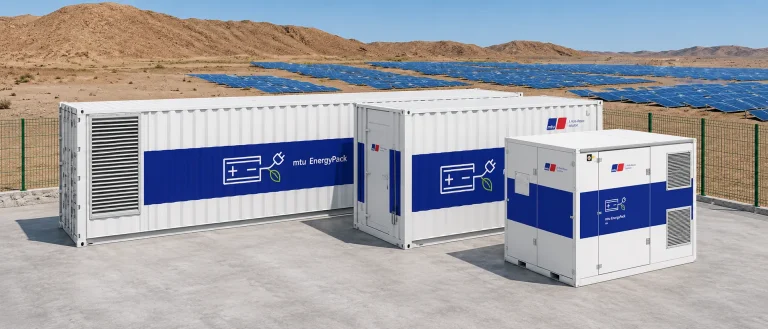
Why Edge Data Centers Need Better Thermal Management
Edge data centers are designed for low latency and fast deployment, but their operating conditions are often much harsher than traditional data halls.
| Thermal Challenge | Impact on Thermal Design & Cold Plate Architecture |
| Severely Limited Space | Cooling components must be ultra-compact (e.g., 1U/2U servers). Massive air-cooled heat sinks simply cannot fit. |
| Extreme Rack Power Density | Relying purely on air requires excessive airflow and fan power, causing PUE to skyrocket. Liquid cold plates are a necessity. |
| Remote or Unmanned Operation | Cooling components (especially internal channels) must have absolute leak-proof reliability and require zero maintenance. |
| Harsh Environments | Dust, humidity, temperature swings, and vibration are common. Liquid cooling isolates the core compute units from dirty external air. |
| AI Inference Workloads | GPUs and accelerators create extreme local heat fluxes (hot spots) that require micro-channel cold plates to suppress. |
What Is Edge Data Center Liquid Cooling?
Edge data center liquid cooling uses a liquid loop to efficiently remove heat from high-power server components. In a direct-to-chip architecture, custom metal cold plates are mounted directly onto heat-generating modules.
A typical direct-to-chip cold plate path includes:
Heat Source: CPU, GPU, AI accelerator, or high-power module.
Thermal Interface: Thermal Interface Material (TIM) between the chip package and the cold plate.
Core Component: A custom liquid cold plate with precision-machined internal micro-channels.
Heat Removal: Coolant absorbs the heat and exits the cold plate into the rack’s fluid loop.
In edge data centers, this is often combined with auxiliary air cooling. The cold plates handle the 70%-80% of heat generated by core high-power components, while low-speed fans cool lower-power areas like memory and storage.
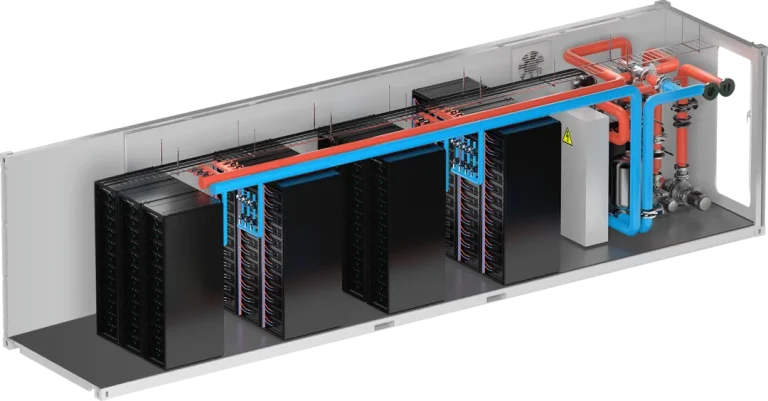
Direct-to-Chip Cold Plate Cooling vs. Traditional Air Cooling
| Feature | Traditional Air Cooling | Direct-to-Chip Cold Plate Cooling (Ecotherm) |
| Heat Transfer Path | Heat sink -> Cabinet air -> HVAC | Chip -> Low-resistance cold plate -> Coolant |
| Edge Suitability | Good for low-density, vulnerable to the environment | Perfectly suited for compact, high-density, remote deployments |
| Space Requirement | Very high (Requires massive fin spacing and air ducts) | Ultra-low profile (Hugging the chip surface) |
| System Stability | Affected by intake temperature fluctuations and clogged filters | Precise junction temperature control with excellent thermal stability |
| Maintenance Pain Points | Dust buildup, fan wear, airflow blockages | Requires high manufacturing cleanliness and leak-proof pressure testing upfront |
Where Custom Cold Plates Are Used in Edge Computing
Ecotherm cold plates can be customized for various heat sources within edge servers and modular edge data centers:
Edge AI Servers (GPU Accelerated): Vacuum brazed or friction stir welded cold plates to manage ultra-high heat fluxes.
CPU Compute Nodes: Direct-to-chip cold plates to ensure stable processor temperatures and prevent thermal throttling.
AI Accelerator Cards: CNC-machined cold plates for perfect fitment within compact spaces.
Power Electronics & Optical Modules: Aluminum or copper mini cold plates for localized rapid heat extraction.
Cold Plate Manufacturing Capabilities for Edge Data Centers
Different edge computing projects require different cold plate structures. The right process depends on heat load, channel complexity, pressure drop limits, coolant type, and reliability requirements.
Vacuum Brazed Cold Plates: Ideal for highly complex internal micro-channels with ultra-low thermal resistance. The top choice for edge CPU/GPU modules.
Friction Stir Welded (FSW) Cold Plates: Suitable for large-area aluminum cold plates. Offers exceptionally strong weld integrity and superior leak-proof performance.
TLP Diffusion Bonded Cold Plates: Designed for compact cold plates requiring extreme bonding strength and high-pressure operation.
Gun-Drilled Cold Plates: Uses deep-hole drilling for straight coolant paths. Structurally robust with zero weld seam leak risks.
Tube Embedded Cold Plates: A highly reliable and cost-effective solution for cost-sensitive edge liquid cooling projects.

Key Design Parameters for Engineers (RFQ Checklist)
To efficiently design and manufacture your edge computing liquid cold plates, please provide the following engineering data during your RFQ:
2D / 3D CAD Drawings: To determine mounting holes, sealing requirements, chip contact area, and overall envelope dimensions.
Heat Source Layout & Heat Load: The power consumption (Watts) of individual chips, used to calculate thermal resistance and micro-channel layout.
Max Junction/Case Temperature: Defines our cooling performance baseline.
Coolant Type & Inlet Temperature: Affects material selection (corrosion resistance) and available thermal delta ($\Delta T$).
Flow Rate & Allowable Pressure Drop ($\Delta P$): Critical for pump sizing and overall system stability.
Operating Pressure & Leak Test Requirements: Determines plate wall thickness, welding process, and final testing standards.
The Absolute Baseline for Edge Deployment: Cold Plate Reliability
In remote or unmanned edge deployments, a cold plate failure (e.g., a coolant leak) is far more catastrophic than in a fully staffed central data center. Reliability is our top priority during manufacturing:
Absolutely hermetic welded channel structures (100% factory leak tested).
Corrosion-resistant surface treatments compatible with various coolants.
Extremely strict internal channel cleanliness control to prevent system blockages.
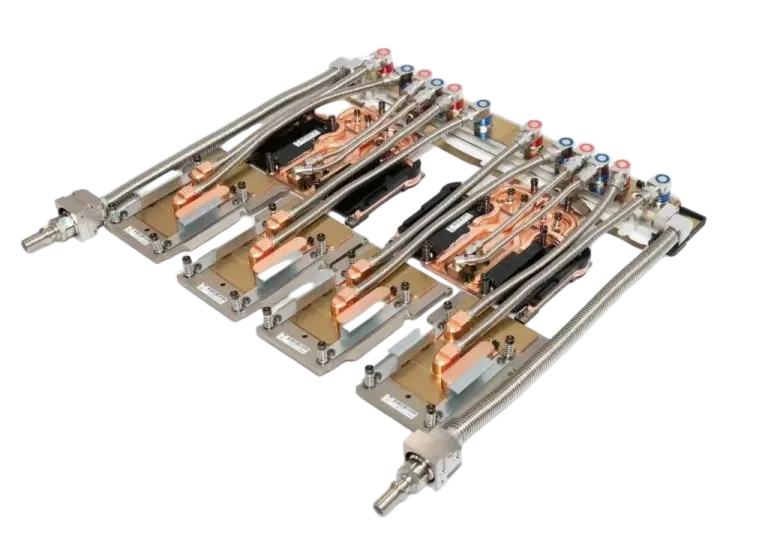
Why Choose Custom Edge Cold Plates?
Off-the-shelf heat sinks rarely fit the compact, complex PCB layouts and custom accelerator cards of edge servers. By choosing custom cold plates, you gain:
Lower Thermal Resistance: Internal micro-channels optimized specifically for your heat sources.
Lower System Pressure Drop: Smooth channel turns and cross-sectional designs.
Comprehensive DFM Review: Identifying leak risks and machining interferences before prototyping.
Seamless Transition from Prototype to Production: From CNC samples to high-volume welded manufacturing.
Frequently Asked Questions (FAQ)
What is edge data center liquid cooling?
It is a technology that uses liquid coolant loops to remove heat from high-power server components (like CPUs, GPUs, and AI accelerators). In a direct-to-chip architecture, custom metal cold plates are mounted directly on the heat sources to absorb heat efficiently.
Do you provide immersion cooling equipment?
No. We do not manufacture immersion cooling tanks or dielectric fluid systems. We are a precision metal thermal component manufacturer, 100% focused on custom liquid cold plates for direct-to-chip and server liquid cooling architectures.
Which cold plate process is best for edge AI servers?
It depends on the heat load, allowable pressure drop, channel complexity, and volume. Edge GPU servers with extreme heat fluxes typically require vacuum brazed cold plates with complex internal micro-channels. Larger server nodes often utilize highly robust friction stir welded (FSW) cold plates.