
Custom Skived Heat Sinks for TEC Hot-Side Cooling
A Peltier module can only perform well when its hot side is properly cooled. The module moves heat from the cold side to the hot side, but that heat still needs to leave the assembly through a heat sink, cold plate, or other thermal component. If the hot side temperature rises, the cold side temperature also becomes harder to control.
Ecotherm manufactures custom Peltier heat sinks and thermoelectric cooler heat sinks for TEC assemblies, compact cooling devices, precision electronics, optical modules, test equipment, and other temperature-sensitive applications. For projects with limited space and airflow, we often recommend high-density skived heat sinks because they provide thin, closely spaced fins from a solid metal base, helping increase heat dissipation area without adding unnecessary assembly complexity.
We do not manufacture Peltier modules, TEC controllers, fans, or complete thermoelectric cooling systems. Our focus is custom thermal components: skived heat sinks, CNC machined heat sinks, heat pipe modules, and liquid cold plates designed around your drawings, heat load, airflow path, and installation space.
Send us your 2D or 3D drawings for a free preliminary thermal simulation review and fast custom heat sink quotation.
Why Hot-Side Heat Rejection is Critical for TEC Modules
The fundamental thermodynamic equation for a thermoelectric cooler is:
Qh = Qc + Pelec
(Hot-side heat rejection = Cold-side heat absorbed + Electrical power consumed by the TEC)
The electrical power (P_elec) consumed by a Peltier module is significant. As a result, the hot side must dissipate considerably more heat than the cold side absorbs. If the thermoelectric cooler heat sink is undersized or poorly designed, the hot-side temperature will rise rapidly.
When heat is not rejected efficiently:
Heat conducts back through the TEC to the cold side, reducing cooling capacity.
The temperature differential (Delta T) collapses.
The module may exceed its maximum operating temperature and suffer permanent damage.
High-Density Skived Heat Sinks for Peltier Cooling
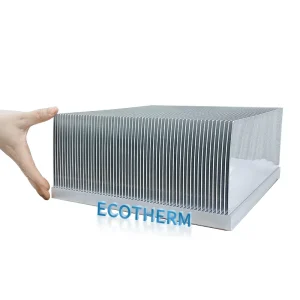
Standard extruded aluminum heat sinks often lack the surface area required for high-power TEC modules, especially in space-constrained equipment. To support fast heat transfer, Ecotherm recommends high-density skived fins.
Why skived heat sinks are suitable for custom TEC thermal assemblies:
Integral Structure:
Unlike bonded or soldered fins, skived fins are carved directly from a single block of pure copper or aluminum. This eliminates the interface thermal resistance between the base and the fins.
Increased Surface Area:
The skiving process allows for extremely thin fins (down to 0.1mm) and narrow fin pitches, providing a compact heat dissipation surface without increasing the overall footprint.
Material Flexibility:
We manufacture skived heat sinks in both aluminum (lightweight, cost-effective) and copper (superior thermal conductivity for highly concentrated heat loads).
Custom Liquid Cold Plates for High-Power TEC Arrays
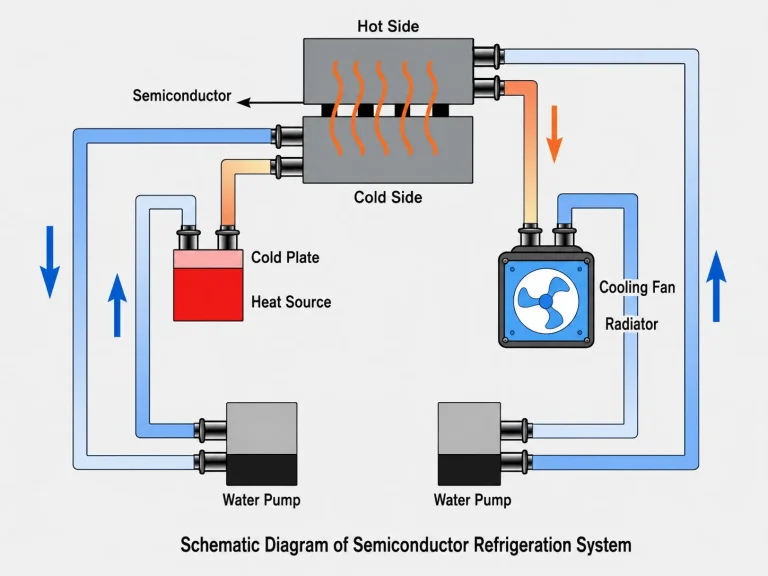
When multiple TEC modules are arrayed for high-capacity cooling (such as in medical imaging or industrial lasers), the massive heat flux outgrows the physical limits of air cooling. The convective heat transfer coefficient of liquid cooling is orders of magnitude higher than that of forced air.
For these demanding applications, we manufacture precision liquid cold plates (water cooling blocks) tailored for TEC hot-side mounting:
Targeted Fluid Routing: We CNC-machine precise internal fluid channels beneath the TEC mounting zone to absorb and transport extreme heat fluxes instantly.
Leak-Proof Integrity: Utilizing flux-free vacuum brazing and friction stir welding (FSW), our cold plates achieve atomic-level metallurgical bonding, ensuring reliable, leak-proof operation even under high system pressures.
Extreme Flatness: The baseplates of our water cooling blocks undergo precision face-milling to achieve micron-level flatness, ensuring maximum contact with the rigid ceramic faces of the Peltier modules.
Peltier Heat Sink Design Factors
A Peltier heat sink should be designed around the full thermal path. The module, interface material, heat sink base, fins, airflow, and surrounding structure all affect final performance.
| Design Factor | Why It Matters for TEC Cooling |
|---|---|
| Heat load | The heat sink must reject both the cold-side load and heat generated by electrical input |
| Hot-side temperature | A higher hot-side temperature reduces available cold-side cooling capacity |
| Base flatness | Better contact helps reduce interface thermal resistance |
| Thermal interface material | TIM fills micro-gaps, but excessive thickness can increase resistance |
| Fin density | Higher fin area can improve heat dissipation in compact spaces |
| Airflow direction | Fin orientation should match the actual airflow path |
| Base thickness | A suitable base helps spread heat before it reaches the fins |
| Mounting pressure | Uneven pressure can reduce contact quality or damage the TEC module |
| Material | Aluminum offers light weight and good machinability; copper offers higher conductivity but adds weight and cost |
| Available space | The heat sink must fit the assembly without blocking airflow or nearby components |
A standard catalog heat sink may be enough for simple TEC kits. For OEM equipment, custom geometry is often required to match the module footprint, mounting holes, enclosure space, and airflow channel.
Advanced Thermal Components for TEC Assemblies
Depending on the heat load, airflow, and installation space, a simple air-cooled heat sink may not be sufficient. We manufacture a variety of components for demanding TEC heat sink applications:
Embedded Heat Pipe Modules:
For small TEC modules generating high heat fluxes, we embed U-shaped or flattened copper heat pipes into the baseplate. This spreads the heat rapidly across a larger fin array, preventing localized hot spots.
Liquid Cold Plates:
In high-power medical or industrial laser applications, the hot side of the Peltier array can be mounted to a custom liquid cold plate. Liquid cooling improves hot-side heat rejection significantly compared to forced air.
Applications We Support
Custom Peltier heat sinks can be used in many thermoelectric cooler assemblies where temperature control and compact packaging matter.
Typical applications include optical modules, laser and photonics equipment, medical and laboratory devices, portable cooling assemblies, semiconductor test equipment, compact electronics, sensor temperature control, and industrial thermal modules.
In these applications, the heat sink is not just a metal accessory. It is part of the temperature-control structure. A well-designed thermoelectric heat sink can help stabilize hot-side temperature, reduce thermal resistance, and support more consistent TEC performance over long operating cycles.
FAQ
What is a Peltier heat sink?
A Peltier heat sink is a thermal management component attached to the hot side of a thermoelectric cooler (TEC). Its purpose is to dissipate the absorbed heat and the electrical waste heat generated by the module into the ambient environment.
Why is surface flatness important for a TEC heat sink?
Thermoelectric modules have rigid ceramic outer plates. If the heat sink surface is uneven, microscopic air gaps form, causing high thermal resistance. A flat, CNC-machined surface ensures maximum contact area and efficient heat transfer.
Can I use a liquid cold plate for the hot side of a Peltier module?
Yes. For high-power TEC arrays, a custom liquid cold plate provides much higher heat transfer coefficients than air-cooled heat sinks, maintaining a lower hot-side temperature and improving overall cooling efficiency.
Do you manufacture the TEC modules or controllers?
No, Ecotherm focuses exclusively on manufacturing custom metal thermal components, such as skived heat sinks, CNC machined parts, and liquid cold plates. We do not manufacture the electronic Peltier chips or controllers.