
Custom Heat Sinks for High-Power LED Lighting
The evolution of solid-state lighting has enabled massive efficiency gains, yet high-power illumination systems—such as stadium floodlights, industrial high bays, and municipal street lights—face severe thermal bottlenecks. Although light-emitting diodes (LEDs) are highly efficient compared to legacy metal halide lamps, they still convert approximately 75% to 85% of their electrical input into waste heat, leaving only 15% to 25% transformed into visible light.
Managing this heat is the single most critical factor determining luminaire performance. High-power LED thermal management requires expanding the heat dissipation area for natural convection while driving down the overall thermal resistance from the semiconductor die to the ambient air.
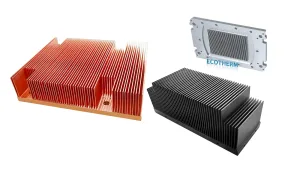
Ecotherm manufactures custom thermal components for LED thermal management, including cold forged pin fin heat sinks, stamped heat sinks, assembled fin heat sinks, CNC machined heat sinks, skived heat sinks and heat pipe modules. Our focus is the metal heat sink and thermal structure that transfers heat away from the LED module and into the surrounding air.
We do not manufacture LED chips, LED beads, LED drivers, complete LED lamps or lighting systems. We also do not provide lighting project installation. Our role is to support lighting manufacturers and engineering teams with custom heat sink components based on drawings, LED power, ambient temperature, installation space and production requirements.
Send us your 2D or 3D drawings for a free preliminary thermal simulation review and fast custom heat sink quotation.
Why High-Power LED Lighting Needs Thermal Management
LEDs are efficient light sources, but not all input power becomes visible light. A large portion of the input energy becomes heat at the LED junction and surrounding package. In low-power products, this heat may be manageable with a simple housing. In high-power LED lighting, the heat load becomes a design constraint.
When junction temperature rises, the LED may experience lower luminous efficiency, faster lumen depreciation, color shift, phosphor performance changes and reduced reliability. For outdoor lighting, the challenge becomes more serious because the fixture may operate under direct sunlight, high ambient temperature, rain, dust and long service cycles.
A reliable LED thermal management design should not only remove heat from the LED module. It should create a complete heat path from the LED package to the ambient air, while keeping the heat sink manufacturable, lightweight and suitable for the lamp structure.
Heat Sources in LED Stadium Lights, High Bay Lights, and Street Lights
High-power outdoor fixtures contain distinct clusters of thermal energy that must be channeled away seamlessly through an optimized thermal path:
LED Chip → Solder Interface → Metal Core PCB (MCPCB) → Thermal Interface Material (TIM) → Custom Heat Sink → Ambient Air
High-power LED fixtures usually contain multiple thermal sources. The LED module is the main heat source, but the driver area, PCB, optical structure and housing layout can also influence the final temperature.
A typical heat path runs from the LED junction to the solder layer, metal-core PCB, thermal interface material, heat sink base, fins and surrounding air. Any weak contact or excessive interface resistance in this path can raise temperature.
| Fixture Type | Thermal Challenge | Heat Sink Design Focus |
|---|---|---|
| Stadium lights | High power, long operating time, outdoor exposure | Large heat dissipation area, stable mounting, corrosion-resistant surface |
| LED high bay lights | Vertical installation, industrial environment, natural convection | Pin fin geometry, airflow access, weight control |
| LED street lights | Outdoor weather, solar exposure, dust and rain | Surface treatment, enclosure integration, passive cooling |
| LED flood lights | Compact housing, high brightness, directional installation | Heat spreading, base thickness, fin orientation |
| LED lamp modules | Limited space, cost-sensitive production | Stamped or assembled heat sink structure |
The heat sink should be selected based on real operating conditions rather than only LED wattage. Ambient temperature, fixture orientation, airflow, enclosure design and mounting method all affect cooling performance.
Cold Forged Pin Fin Heat Sinks for Multi-Directional Natural Convection
Cold forged pin fin heat sinks are widely used in high-power LED lighting because they provide dense pin structures, good mechanical strength and a large heat dissipation surface in a compact form.
Unlike straight fins that perform best when airflow comes from a fixed direction, pin fins can work well when airflow direction is less predictable. This is useful for high bay lights, stadium lights and outdoor fixtures where natural convection and fixture orientation can vary.
Cold forging also allows the pin fins and base to be formed as an integrated metal structure. This helps create a continuous thermal path from the LED mounting surface to the fins. The base can be customized for LED module footprint, mounting holes, driver space, optical clearance and enclosure assembly.
A custom cold forged pin fin heat sink is suitable when the project needs:
- Large surface area for natural convection
- Multi-directional airflow performance
- Compact structure for high-power LED fixtures
- Stable heat transfer from LED module to heat sink base
- Custom geometry based on drawings and lamp housing design
Stamped Heat Sinks for Lightweight LED Lighting Designs
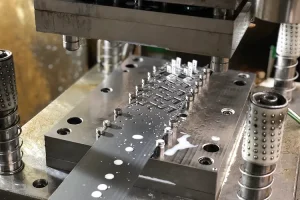
Stamped heat sinks and assembled fin structures are useful when the lighting design requires lighter weight, cost control and scalable production. They can be formed from metal sheets and assembled into shapes that support airflow and heat dissipation.
For LED lighting, stamped heat sinks are often considered when the thermal load is moderate, the fixture needs a large but lightweight surface area, or the design must balance performance with production cost. They can also be combined with other metal structures to create customized air-side heat dissipation surfaces.
Compared with cold forged pin fin heat sinks, stamped heat sinks may offer more flexibility in sheet-metal structure and cost control, while cold forged pin fins are often stronger for compact, high-power, natural-convection designs. The right choice depends on LED power, lamp size, target weight, airflow condition and production volume.
For weight-critical applications, Ecotherm manufactures high-surface-area stamped heat sinks (assembled fin modules).
Minimized Mass with Maximized Area:
Stamping allows for ultra-thin aluminum fins (ranging from 0.5mm to 0.8mm) spaced at tight pitches. These individual fins are mechanically interlocked or bonded to a thick, high-conductivity copper or aluminum carrier baseplate. This delivers a massive heat dissipation surface while stripping away up to 40% of the dead weight compared to solid cast options.
Scalable Mass Production:
Stamping dies allow for highly accurate, high-volume production runs, helping tier-1 lighting OEMs manage strict Bill of Materials (BOM) cost targets without sacrificing thermal capacity.
Optimized Fin Orientation:
We configure stamped fin modules with precision venting gaps to induce the “chimney effect,” drawing cool air up from the bottom of the suspended fixture and venting it out the top, which supports long-term thermal stability in outdoor lighting.
LED Thermal Management Design Factors
A high-power LED heat sink should be reviewed as part of the full fixture structure. The LED module, PCB, thermal interface material, heat sink, housing, surface treatment and mounting environment all affect final temperature.
| Design Factor | Why It Matters |
| LED power | Determines the heat load that must be transferred away from the module |
| Junction temperature target | Affects light output, lumen maintenance and reliability |
| Ambient temperature | Outdoor and industrial fixtures may operate in high-temperature environments |
| Heat sink material | Aluminum is commonly used for weight, cost and manufacturability |
| Base thickness | Helps spread heat from the LED module before it enters the fins |
| Fin or pin geometry | Controls surface area and natural convection performance |
| Fixture orientation | Pin fin designs can support less predictable airflow directions |
| Thermal interface material | Fills micro-gaps between LED board and heat sink |
| Surface treatment | Affects corrosion resistance, appearance and radiation performance |
| Weight limit | Important for stadium lights, pole-mounted fixtures and suspended high bay lights |
| Production volume | Influences whether forging, stamping, CNC machining or assembly is more suitable |
A larger heat sink is not always the best design. The heat sink must fit the optical structure, mounting bracket, enclosure and installation method. Early thermal review can help avoid overbuilt designs, airflow blockage and unnecessary weight.
Custom Thermal Component Comparison Matrix
Choosing the correct thermal structural layout depends entirely on the total system wattage, target weight, airflow dynamics, and physical mounting configuration.
| Heat Sink Configuration | Primary Application | Key Structural Advantage | Thermal Evaluation Metrics |
| Cold Forged Pin Fin Heat Sink | Adjustable stadium floodlights, outdoor directional architectural lighting. | Cylindrical pin layout enables omnidirectional natural convection; zero base-to-fin thermal joints. | Exceptional performance in zero-wind, tilted outdoor configurations. |
| Stamped Fin Heat Sink | High-altitude stadium tower lights, high-clearance warehouse industrial bay lights. | Ultra-thin fins minimize overall weight; massive surface-area-to-weight ratio. | Ideal for high-hanging setups where weight reduction is mandatory. |
| High-Density Skived Heat Sink | Specialized high-heat-flux compact optical projectors, high-power stage studio lights. | Thin fins with micro-pitches carved directly from solid copper or aluminum alloy. | Maximizes thermal performance within highly restrictive linear space envelopes. |
| Integrated Heat Pipe Modules | High-heat-density localized power supplies, extreme kilowatt-class spotlight clusters. | Incorporates phase-change fluid loops inside the metal base to eliminate localized hotspots. | Supports fast heat transfer across large-scale metal structures. |
Applications We Support
Ecotherm supports custom LED thermal management components for:
- High-power LED lighting
- Stadium lighting
- LED high bay lights
- LED street lights
- LED flood lights
- Industrial LED lamps
- Outdoor LED lighting fixtures
- LED lamp modules
- Custom LED lighting heat sinks
For high-power lighting projects, we can help evaluate whether a cold forged pin fin heat sink, stamped heat sink, skived heat sink, CNC machined heat sink or heat pipe module is more suitable for the application.
Frequently Asked Questions (FAQ)
What is the role of a heat sink in LED thermal management?
An LED cannot dissipate waste heat through forward radiation like traditional light sources. Instead, heat travels backward via conduction. An LED lighting heat sink acts as the primary thermal conductor, expanding the physical surface area to safely dissipate internal heat energy into the surrounding atmosphere through natural convection or radiation.
Why do outdoor stadium lights prefer cold forged pin fin heat sinks?
Stadium lights are frequently tilted at severe angles to focus light onto specific field positions. Traditional long linear fins block air movement when tilted, trapping hot air. Custom pin fin heat sinks utilize individual cylindrical pins that allow cool air to rise and escape freely from any direction, preventing thermal blockages in any mounting position.
How does vacuum reflow processing improve the thermal path of an LED lamp?
Standard reflow operations often lock tiny air bubbles (voids) within the solder junction between the LED chip and the PCB board. Because air possesses a dismal thermal conductivity of 0.026 W/m·K, these internal voids act as heat insulators. Vacuum reflow reduces the void rate to under 1%, expanding the effective surface contact area and lowering the internal thermal resistance chain (Rth).
What are the benefits of stamped fin heat sinks in high-power lighting?
Stamped fin designs use thin aluminum fins interlocked onto a structural baseplate. This approach provides a significant surface area for natural convection while stripping away up to 40% of the dead weight compared to traditional solid metal cast modules. This is highly suitable for tower-mounted or high-altitude stadium lighting setups that enforce strict weight and wind-load limits.
Do you provide complete fully assembled waterproof LED lighting fixtures?
No. Ecotherm is a dedicated component-level thermal hardware manufacturer. We machine, forged, stamp, and finish customized metal cooling interfaces (such as custom LED heat sinks, plates, and heat pipe structures) based on your engineering prints. We do not manufacture LED drivers, optical lenses, or complete light fixtures.