Vacuum Brazed vs FSW vs Tube-Embedded Cold Plates: How to Choose the Right Process
Choosing the right cooling solution is crucial for maintaining the performance and longevity of electronic systems. This article compares vacuum brazed cold plates, Friction Stir Welding (FSW), and tube-embedded cold plates to help you make an informed choice. Understanding these processes will guide you in selecting the most effective cooling method for your specific needs.
Takeaway
- Cold plates are crucial for thermal management in various industries, providing efficient heat dissipation solutions.
- Vacuum brazed cold plates deliver high thermal performance and reliability, ideal for applications needing strong joints and leak-proof designs.
- Friction Stir Welding (FSW) cold plates are known for their mechanical strength and uniform heat distribution, suitable for high-load environments.
- Tube-embedded cold plates are versatile, offering cost-effective solutions for less demanding thermal management applications.
- Choosing the right cold plate process depends on factors like thermal performance requirements, budget, and specific application needs.
- Vacuum brazing is best for high-performance needs, while FSW is preferable for mechanical strength, and tube-embedded plates offer flexibility and cost efficiency.
- Understanding each method’s advantages and limitations is essential for making informed decisions on thermal management solutions.
Introduction to Cold Plates
Cold plates are essential components in thermal management systems, especially in electronics and industrial applications where effective heat dissipation is crucial to maintain performance and prevent overheating. Acting as heat sinks, they transfer heat away from critical parts using liquid cooling methods. Among the various manufacturing techniques, vacuum brazed cold plates are notable for their high-pressure resistance and ability to handle complex designs, making them a top choice for advanced cooling solutions.
Purpose and Importance
The main role of a cold plate is to manage heat from electronic components or industrial machinery. By employing a liquid cooling system, cold plates ensure efficient thermal management, enhancing the reliability and lifespan of equipment. Vacuum brazed cold plates are especially important due to their leak-proof joints. This technique uses a filler metal to join components in a vacuum, creating robust joints suitable for high-density micro-channel designs. This is vital for precision applications requiring high-pressure resistance, such as in aerospace and high-performance computing.
Overview of Manufacturing Processes
Several methods are available for making cold plates, each with its own benefits and limitations. Understanding these methods helps in choosing the right type for specific applications.
- Vacuum Brazing: Known for precision in intricate designs, vacuum brazing is ideal for complex geometries and high-pressure resistance.
- Friction Stir Welding (FSW): Favored for its strong mechanical properties, this method is suitable for environments with vibration and mechanical stress.
- Tube-Embedded Cold Plates: This cost-effective and simple method suits applications with moderate thermal performance needs.
| Process | Key Features |
|---|---|
| Vacuum Brazing | High precision, complex geometries, leak-proof joints |
| FSW | Strong mechanical properties, vibration resistance |
| Tube-Embedded | Cost-effective, simple design |
When selecting a cold plate manufacturing process, consider factors like thermal performance, channel complexity, and budget. Vacuum brazing might have higher initial setup costs and longer production times, but its ability to create intricate and reliable designs can justify the investment for high-end uses. On the other hand, FSW offers quicker production and strong mechanical properties, though it may not support complex geometries as well as vacuum brazing. Tube-embedded cold plates offer a budget-friendly solution for less demanding needs.
Companies like Ecothermgroup offer a variety of custom cold plate solutions, assisting clients in selecting the right manufacturing method for specific applications. By understanding the strengths of each process, engineers can make informed decisions to optimize thermal management and ensure the longevity and efficiency of their systems.
Understanding Vacuum Brazed Cold Plates
Benefits of Vacuum Brazing
Vacuum brazing is an effective method for manufacturing cold plates that need intricate designs and high-pressure resistance. This process enables the creation of complex internal channels, crucial for efficient liquid cooling. Vacuum brazed cold plates are known for their leak-proof seals, making them ideal for applications where reliability is key, such as high-powered electronics and demanding industrial environments. Ecothermgroup highlights the importance of vacuum brazing in scenarios that demand precision and durability, ensuring that the structural integrity of the cold plate is maintained under extreme conditions.
One major advantage of vacuum brazed liquid cold plates is their ability to operate under high thermal loads. The technique involves joining metal components in a vacuum chamber, which minimizes oxidation and ensures a clean joint. This results in superior thermal conductivity and heat dissipation, crucial for maintaining optimal performance in electronic devices. Moreover, vacuum brazed cold plates offer the flexibility of custom designs, allowing engineers to tailor solutions to specific cooling needs.
- Enhanced thermal performance
- Complex channel design capabilities
- High-pressure resistance
- Leak-proof construction
Applications and Limitations
Vacuum brazed cold plates are widely used in fields where high reliability and efficiency are required. They are especially beneficial in cooling high-performance computing systems, power electronics, and laser equipment. Their ability to handle high thermal loads and maintain consistent cooling makes them a preferred choice for industries like data centers and telecommunications.
Despite their advantages, vacuum brazed cold plates have some limitations. The complexity of the brazing process can lead to higher manufacturing costs compared to other methods like FSW or tube embedding. Additionally, the need for specialized equipment and skilled labor can further increase production expenses. Engineers must weigh these factors against the benefits of enhanced thermal performance and structural integrity when choosing the appropriate cold plate technology.
| Feature | Vacuum Brazed Cold Plates |
|---|---|
| Thermal Performance | Excellent |
| Channel Complexity | High |
| Pressure Resistance | High |
| Cost | Higher |
In summary, understanding the benefits and applications of vacuum brazed cold plates is essential for making informed decisions in selecting the right cooling solution. While they offer superior thermal management and reliability, the associated costs and manufacturing complexities should be carefully considered. Ecothermgroup and other industry experts recommend evaluating the specific requirements of the application to determine whether vacuum brazing is the optimal choice for your needs.
Exploring Friction Stir Welding (FSW) Cold Plates
Friction Stir Welding (FSW) is a solid-state joining process that is becoming increasingly popular in the manufacturing of cold plates. Unlike traditional welding methods, FSW does not melt the base materials, helping to maintain structural integrity and minimize thermal distortion. This makes it ideal for applications where high reliability and thermal efficiency are essential. FSW is often compared to vacuum brazed cold plates and tube-embedded cold plates regarding thermal performance and cost-effectiveness.
Advantages of FSW
FSW’s main advantage is its ability to create strong, leak-tight joints, crucial for maintaining the performance of liquid cooling systems. This process is particularly beneficial for large-format cooling applications, such as those in electric vehicle battery packs. The structural strength of FSW allows it to withstand significant mechanical stress, making it a preferred choice for industries that demand durability and reliability.
Additionally, FSW cold plates offer excellent thermal performance, comparable to vacuum brazed liquid cold plates. While the initial cost can be higher than tube-embedded cold plates, the long-term benefits of durability and performance often justify the investment. According to Ecothermgroup, FSW is also valued for its environmental benefits, as it does not require fluxes or filler materials, reducing potential contamination.
Technical Challenges
Despite its benefits, FSW does have challenges. The process requires precise control of welding parameters, such as rotational and traverse speeds, to ensure optimal joint quality. Another technical limitation is the difficulty in creating complex internal channel designs compared to vacuum brazed cold plates, which can integrate intricate microchannels.
FSW also presents challenges in tooling and setup, potentially increasing manufacturing costs. For example, the initial setup and tooling for FSW can be more expensive than other methods, making it less suitable for small production runs. However, for large-scale applications, the cost can be offset by the improved performance and longevity of the cold plates.
| FSW Cold Plates | Vacuum Brazed Cold Plates |
|---|---|
| Strong, leak-tight joints | Complex internal channel designs |
| High structural integrity | High-pressure tolerance |
| Suitable for large-format applications | Higher thermal efficiency |
Choosing between FSW and other methods like vacuum brazing depends on specific application needs, including the complexity of channel design, pressure requirements, and budget considerations. For engineers and manufacturers, understanding these factors is crucial in selecting the appropriate cold plate manufacturing process.
Tube-Embedded Cold Plates: Features and Uses
Construction and Performance
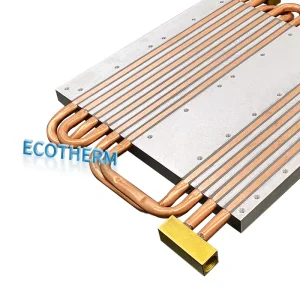
Tube-embedded cold plates are built with copper or stainless steel tubes within a metal base, usually aluminum. This design allows them to handle moderate heat flux applications effectively. The embedded tubes circulate liquid coolant, dissipating heat from electronic components. This is particularly useful where galvanic corrosion isolation is important, as using different materials can prevent corrosion.
The performance of tube-embedded cold plates is marked by cost-effectiveness and simplicity. They are preferred in applications where complex channel geometries aren’t needed, making them ideal for industries seeking economical solutions without compromising quality. However, they may not suit high-density or high-performance systems due to their limited capacity for complex thermal loads. Compared to vacuum brazed cold plates and FSW methods, tube-embedded solutions offer a simpler approach but with lower thermal performance capacity.
Comparative Analysis
When comparing tube-embedded cold plates to vacuum brazed and FSW options, several factors come into play. Each method has its own strengths and suitability, depending on the project’s requirements. Vacuum brazed cold plates provide excellent thermal performance and leak resistance, making them perfect for high-reliability applications like aerospace or automotive systems. FSW cold plates offer strong joint integrity, crucial for maintaining mechanical stability under high pressure.
In contrast, tube-embedded cold plates excel where simplicity and low cost are priorities. They are commonly used in general industry applications that don’t require high thermal performance. For those needing custom cold plate configurations, companies like Ecothermgroup offer tailored solutions to meet specific project needs.
| Cold Plate Type | Key Features |
|---|---|
| Tube-Embedded | Cost-effective, simple design, moderate heat flux handling |
| Vacuum Brazed | High thermal performance, leak resistance, ideal for complex systems |
| FSW | Strong joint integrity, suitable for high-pressure applications |
The choice between these cold plate types should be guided by the specific thermal and mechanical needs of the application, as well as budget constraints. Tube-embedded cold plates are generally more adaptable to simpler, cost-sensitive projects, whereas vacuum brazed and FSW cold plates cater to high-performance, reliability-focused applications.
- Consider thermal performance needs
- Evaluate mechanical integrity requirements
- Assess budget limitations
- Determine project complexity
Choosing the Right Cold Plate Process
Factors to Consider
When selecting a cold plate process for your application, several important factors should be considered. Understanding the thermal and mechanical requirements is crucial. For example, vacuum brazed cold plates are ideal for high-pressure situations and intricate channel designs, offering reliable, leak-proof performance, making them perfect for power converters and high-end servers. Friction Stir Welding (FSW) is preferred for applications that need high structural integrity and excellent thermal performance, such as aerospace components.
Another consideration is the environmental conditions where the cold plate will be used. FSW provides superior mechanical properties by eliminating defects like porosity, making it suitable for environments requiring vibration resistance. Tube-embedded cold plates are cost-effective and often used for medium heat flux applications where galvanic corrosion isolation is important.
- Application Requirements
- Environmental Conditions
- Budget Constraints
- Material Compatibility
It’s essential to evaluate these elements based on your specific needs. For example, industries with significant pressure resistance requirements might prefer vacuum brazed solutions, as noted by Ecothermgroup’s insights. In contrast, cost-sensitive projects might benefit more from tube-embedded cold plates.
Cost vs. Performance
Assessing the balance between cost and performance is crucial. Vacuum brazed cold plates typically offer higher performance with a corresponding increase in cost due to their complex manufacturing process and superior reliability. Ecothermgroup highlights that while they are more expensive, the investment is worthwhile in applications requiring high durability and efficiency.
On the other hand, FSW cold plates offer a middle ground with commendable thermal performance and structural strength at a competitive price point. They are particularly useful in industries where lightweight and robust construction is important. Tube-embedded cold plates are generally the most economical option, suitable for applications with moderate heat flux and budget constraints.
| Type | Best Use |
|---|---|
| Vacuum Brazed | High-pressure, complex design |
| FSW | High structural integrity |
| Tube-Embedded | Cost-effective, moderate heat flux |
To sum up, choosing between vacuum brazed, FSW, and tube-embedded cold plates should be informed by a thorough analysis of your application’s requirements and budget. Consider consulting industry experts or manufacturers like Ecothermgroup to ensure the selected cold plate process aligns with your needs and offers the best balance of cost and performance.
People Also Ask
What are the main advantages of using vacuum brazed cold plates?
Vacuum brazed cold plates offer excellent thermal conductivity and structural integrity. They are perfect for applications that need uniform heat distribution and are often chosen in industries where high reliability is essential.
How does Friction Stir Welding (FSW) compare to vacuum brazing in terms of thermal performance?
FSW cold plates generally provide similar thermal performance to vacuum brazed plates but can be more cost-effective for certain uses. FSW is especially useful for materials sensitive to high temperatures during manufacturing.
What factors should be considered when choosing between brazed and FSW cold plates?
Consider the application’s thermal needs, budget, and material compatibility when choosing between brazed and FSW cold plates. Brazed plates are typically preferred for high-performance demands, while FSW can be more economical for less strenuous applications.
What are the limitations of tube-embedded cold plates compared to brazed cold plates?
Tube-embedded cold plates might not offer the same thermal uniformity as brazed cold plates. They are generally used when cost is a significant factor and design flexibility is required.
What is a brazed cold plate and how is it used?
A brazed cold plate is a heat exchanger designed to dissipate heat from electronic components. It involves joining metal parts with a filler metal that has a lower melting point, creating a strong bond for efficient heat conduction.
Are brazed cold plates suitable for high-pressure applications?
Yes, brazed cold plates are suitable for high-pressure applications thanks to their robust structural integrity. The brazing process creates a strong bond that handles significant pressure, making them reliable for demanding industrial uses.
How do you maintain a brazed cold plate?
Maintaining a brazed cold plate includes regular cleaning to prevent debris build-up and checking for corrosion or leaks. Ensuring proper coolant flow and pressure levels is also key for optimal performance.
What industries commonly use vacuum brazed cold plates?
Vacuum brazed cold plates are commonly used in industries like aerospace, automotive, and electronics, where efficient heat dissipation and reliability are crucial. Their superior thermal performance suits high-stakes applications.