
Custom
Heat Pipe Skived Heat Sinks
Tailored Solutions for High-Power Applications
Up To 3000mm Length
Free Thermal Analysis
Double-side Skived Fin
Wavy Skived Fin
Types of skived heat sinks manufacturing processes
- Wavy Heatsinks
- Double-sides Skived Heat Sink
- Heat Pipe Skived Heat Sink
- Copper & Aluminum Skived Heat Sink
Other cooling solutions
Customn Heat Pipe Skived Heat Sinks
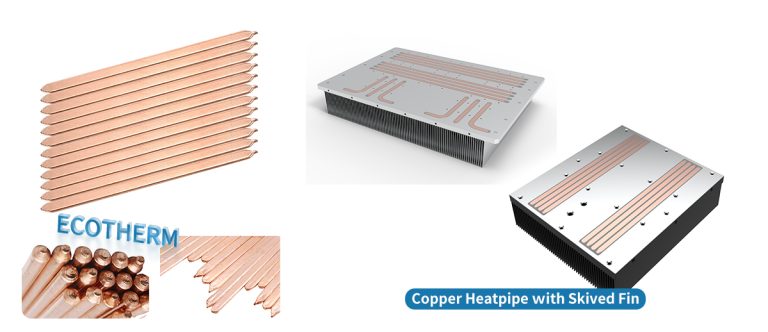
As industrial thermal loads become increasingly concentrated, a standard skived heat sink may experience thermal bottlenecks due to spreading resistance. A heat pipe skived heat sink is an advanced hybrid solution. It combines the massive convective surface area of a monolithic with the instantaneous heat-spreading capabilities of embedded phase-change heat pipes.
How a Heat Pipe Skived Heat Sink Dissipates Heat
The cooling process of a heat pipe skived heat sink relies on a rapid two-phase cycle. First, the localized heat source transfers extreme thermal energy into the exposed evaporator section of the heat pipe at the base of the skived heat sink. The working fluid inside immediately vaporizes, absorbing massive amounts of latent heat. This vapor travels at near-sonic speed along the pipe to the cooler areas of the skived heat sink base. There, it condenses back into a liquid, uniformly releasing the heat across the entire solid base. Finally, the high-density fins of the skived heat sink dissipate this evenly distributed heat into the surrounding airflow, completely eliminating localized hot spots.
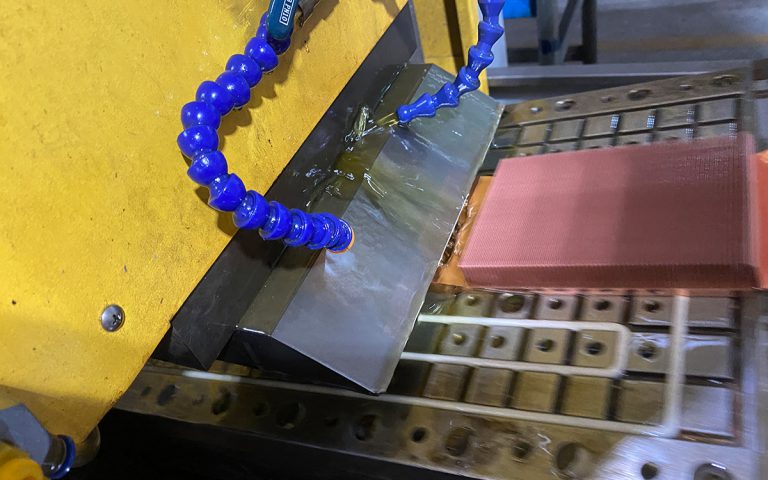
The Production Process of a Heat Pipe Skived Heat Sink
Manufacturing a reliable heat pipe skived heat sink requires combining precise metal peeling with secondary machining. EcoTherm strictly follows this controlled workflow to ensure absolute thermal integrity:
1.Fin Skiving:
The process begins by peeling high-density fins from a solid block of aluminum or copper using a dedicated skiving machine, creating the foundational skived heat sink.
2.CNC Grooving:
We perform precision CNC machining on the bottom base of the skived heat sink to create grooves perfectly dimensioned for the heat pipes.
3.Pressing in Heat Pipes:
Pre-bent, sintered copper heat pipes are precisely pressed into the machined grooves on the back of the skived heat sink.
4.Epoxy Filling:
High-thermal-conductivity epoxy resin is meticulously filled into the gaps to ensure complete contact between the heat pipes and the skived heat sink base.
5.Curing & CNC Fly-Cutting:
After the epoxy is fully cured, the entire base is CNC fly-cut. This ensures the heat pipes and the skived heat sink base form a perfectly flat, uniform mounting surface.
6.Polishing:
The fly-cut surface is polished to achieve the required micro-roughness for optimal thermal interface material (TIM) application.
7.Surface Treatment:
The completed heat pipe skived heat sink undergoes final treatments such as anti-oxidation coating or nickel plating based on the operating environment.
When to Choose a Heat Pipe Embedded Skived Heat Sink?
You should upgrade your standard design to a heat pipe skived heat sink under the following stringent conditions:
Severe Spreading Resistance:
When the heat source (e.g., a 15 * 15 mm ASIC) is vastly smaller than the base of the skived heat sink (e.g., 200 * 200 mm). Without heat pipes, the outer edges of the skived heat sink remain cold and underutilized.
Offset Heat Sources:
If the heat-generating component cannot be mounted directly in the center of the skived heat sink, heat pipes can rapidly draw the thermal load from the edge to the rest of the fin array.
Weight-Restricted High-TDP Systems:
Instead of using a massively heavy pure copper skived heat sink, engineers can embed copper heat pipes into a lightweight aluminum skived heat sink, achieving copper-level heat spreading at a fraction of the weight.
Distinct High-Power Applications
Because this hybrid skived heat sink excels at isothermalizing (evening out) the base temperature, it is uniquely suited for applications distinct from standard cooling fins:
High-Power Laser Diodes: Lasers require absolute temperature uniformity across the mounting base to maintain wavelength stability. A heat pipe skived heat sink prevents thermal gradients.
Broadcast Transmitters & RF Amplifiers: Where highly concentrated, continuous heat must be rapidly dispersed across a large-format skived heat sink in enclosed environments.
High-Performance ASIC/FPGA Switches: Core networking equipment where dense chips create extreme localized hot spots that traditional extrusions cannot resolve.
DFM Limits & Engineering Specifications for Skived Fins
Because the structural integrity of a double-sided skived fin heat sink depends entirely on the delicate ratio between fin height, fin pitch, and the remaining solid base thickness, all manufacturing limits are strictly evaluated on a case-by-case basis. A design that works for one footprint may cause deformation in another.
General starting parameters for a double-sided skived fin heat sink using Aluminum (AL1060/AL1050) or Pure Copper (C1100):
Minimum Fin Thickness: 0.15 mm
Minimum Base Thickness: Strongly dependent on overall dimensions. Must be thick enough to withstand the second skiving pass without deformation.
Maximum Aspect Ratio: Custom evaluated based on base rigidity and material yield strength.
Surface Finishes: Anti-oxidation coatings, Nickel plating, or Anodizing available depending on the operating environment.
⚠️ Start Your Custom Project:
Designing a double-sided skived fin heat sink is a unique engineering challenge. The exact manufacturability must be verified against your specific 3D CAD drawings to ensure base flatness and fin stability.
Important Engineering Note:
Please be aware that the geometric limits provided above are general guidelines. The exact manufacturability, achievable aspect ratios, and tolerances are highly dependent on the overall dimensions and structural constraints of your project. Skived fin specifications are strictly evaluated on a case-by-case basis according to your specific technical drawings and thermal design power (TDP).
To determine the exact DFM feasibility for your design, please contact our engineering team directly with your 3D CAD files for a comprehensive review.
Request a CFD Simulation>>> support@ecothermgroup.com
Q&A: Engineering Insights
Heat Pipe vs. Vapor Chamber: Which is better for a skived heat sink?
Both heat pipes and vapor chambers utilize two-phase liquid cooling to eliminate thermal bottlenecks. The main difference lies in the direction of heat transfer. Heat pipes move heat linearly (along a specific axis), making a heat pipe skived heat sink highly cost-effective for moving heat from a concentrated hot spot to the outer edges of the fin array. Vapor chambers, however, spread heat in planar directions (X and Y axes simultaneously). Because we focus solely on manufacturing custom heat sinks, our engineering team will evaluate your 3D CAD files to recommend the most efficient and cost-effective hybrid solution for your specific thermal load.
Can a heat pipe skived heat sink operate upside down or against gravity?
Yes. The heat pipes embedded in our skived heat sink bases utilize a high-quality sintered copper powder wick structure. This capillary wick creates a strong pumping action that pulls the condensed liquid back to the heat source, allowing it to operate against gravity (anti-gravity performance). However, it is important to note that operating entirely upside down can slightly reduce the maximum heat transfer capacity compared to a gravity-assisted orientation.
Does CNC grooving weaken the structural integrity of the skived heat sink?
If engineered improperly, cutting deep grooves into the base can compromise the rigidity of the fins above. This is a common failure point for standard suppliers. To prevent this, our Design for Manufacturability (DFM) guidelines dictate a strict safety margin for the base thickness. We ensure there is ample solid metal between the root of the skived fins and the embedded heat pipes, guaranteeing your heat pipe skived heat sink maintains complete structural and thermal integrity over its lifespan.
Will a heat pipe skived heat sink leak or dry out over time?
No. The heat pipes we embed into the skived heat sink are vacuum-sealed and hermetically tested. Under normal operating conditions (within their designed temperature limits), the internal fluid continuously evaporates and condenses in a closed-loop cycle. They do not “dry out” or require refilling, ensuring maintenance-free operation for critical industrial and telecommunications equipment.
What is the Minimum Order Quantity (MOQ) for a custom heat pipe skived heat sink?
One of the greatest advantages of the skiving process is that it requires zero upfront tooling costs or expensive extrusion dies. Furthermore, because EcoTherm is a dedicated factory specializing strictly in custom thermal management, we can fully support your R&D phases. We offer an MOQ of just 1 piece for your custom heat pipe skived heat sink prototypes, allowing you to conduct rigorous thermal validation before seamlessly scaling up to mass production.