Liquid cooling feasibility tool
Cold Plate System Calculator
Check whether a proposed liquid cold plate can keep the mounting surface below its temperature limit—and see the flow, pressure drop and pump power that the geometry demands.
1Will the plate stay below the temperature limit?
2How warm will the coolant leave the plate?
3How much pressure does the cold plate consume?
4What minimum pump power is implied?
Start here — model the flow path inside the cold plate
Coolant flow
Heat source
Parallel paths split total flowHeat → plate → coolant
Parallel rectangular channels
Does the channel network remove the heat without excessive pumping?
The flow divides among identical channels. Channel width, height and count set velocity, heat-transfer area and pressure drop.
Thermal path: coolant heating + internal convection + conduction through the plate base.
Hydraulic path: pressure drop is calculated through one representative parallel path, not multiplied by channel count.
Decision: compare predicted maximum mounting temperature with your allowable plate temperature.
Choose the construction closest to your concept
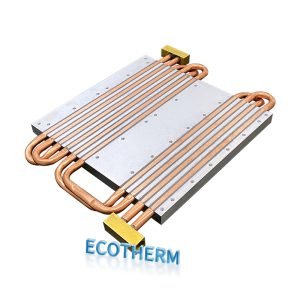
Manufacturing focus: Parallel channels suit vacuum-brazed or friction-stir-welded aluminum cold plates. Confirm manifold distribution and sealing land width before releasing the drawing.
Preliminary system result
Parallel-channel aluminum cold plate
Estimated cold plate R
—
Internal convection + base conductionCoolant outlet
—
Energy balance across the coolantCold plate pressure drop
—
Representative internal flow pathEstimated pump input
—
At entered total loop losses and efficiency—
—
Temperature path
InletOutletPlateLimit
Predicted max plate—
Thermal margin—
Allowable R at outlet—
Flow velocity—
Reynolds number—
Flow regime—
Hydraulic diameter—
Heat transfer coefficient—
Wetted area—
Where the pump pressure is spent
Cold plate
—
Pipe + elbows
—
Other components
—
Total system
—
Use this result for concept screening. The model assumes uniform heat input, equal channel distribution and clean internal surfaces. It does not replace CFD or test data for hotspots, manifold maldistribution, boiling, TIM/contact resistance or transient loads.
For a manufacturable cold plate review, share the heat-source map, mounting drawing, coolant, inlet temperature, required flow and available pump curve. Ecotherm can review drawing feasibility and propose a custom liquid cold plate structure.