
EV Inverter & DC Fast Charger Thermal Management
Electric vehicle thermal management is no longer limited to just battery cooling. As EV platforms accelerate toward 800V architectures, ultra-fast charging, and more compact power electronics, advanced thermal design has become the critical bottleneck for EV inverters, DC fast chargers (DCFC), IGBTs, and SiC power modules.
Ecotherm provides custom heat sinks, liquid cold plates, and CNC machined thermal components specifically engineered for high-power EV electronics. Our engineering team supports DFM review, preliminary thermal simulation, and fast quotation based on your 2D or 3D drawings.
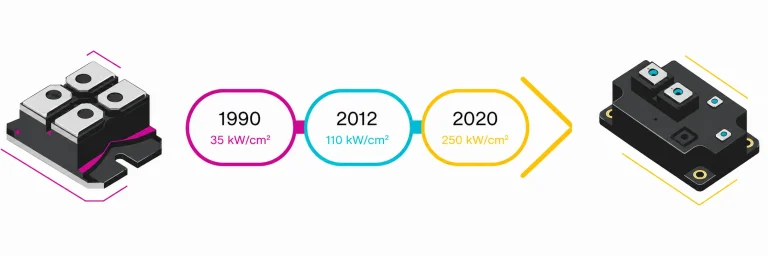
The Heat Challenge in EV Inverters and DC Fast Chargers
EV inverters and DC fast chargers both handle extreme currents, high voltages, and rapid switching loads. Inside these systems, power semiconductors generate intensely concentrated heat. Over the past decade, the heat dissipation required for industrial IGBT modules in charging stations has surged from roughly 1.2 kW to over 12.5 kW.
If this heat is not extracted efficiently, the system faces junction temperature limit breaches, power derating, insulation degradation, and eventual component failure. For engineers, the thermal equation requires answering critical questions:
How much heat flux must be transferred from the SiC/IGBT module?
Does the module require a liquid cold plate, or is an advanced skived heat sink sufficient?
What coolant flow rate and pressure drop ($\Delta P$) are acceptable?
Can the thermal component scale reliably from prototype to mass production?
Thermal Components for EV Applications
Ecotherm focuses exclusively on the custom thermal components utilized inside high-power EV electronics and charging infrastructure.
| Application Area | Typical Heat Sources | Recommended Thermal Components |
| EV Inverters | IGBT modules, SiC MOSFETs, DC-link area | Vacuum brazed cold plates, high-density skived heat sinks |
| DC Fast Chargers (DCFC) | Rectifier modules, power conversion units, resistors | Large-format Friction Stir Welded (FSW) cold plates |
| Liquid-Cooled Charging Cables | High-current (500A+) copper wire cores | Custom cooling loop interfaces and manifolds |
| High-Power EVSE Cabinets | Busbar contact areas, enclosed electronics | Extruded aluminum heat sinks, heat pipe modules |
DC Fast Chargers: The Shift to Liquid Cooling
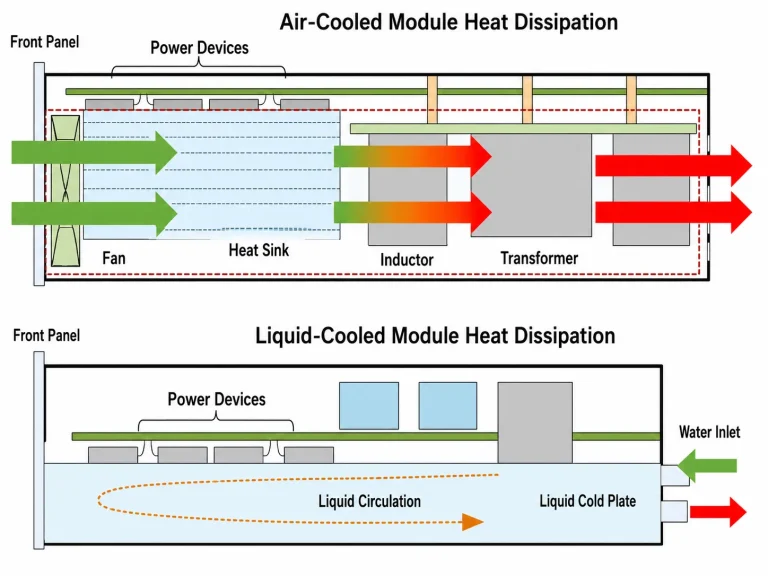
While traditional air cooling is still viable for low-power onboard chargers, utility-scale DC Fast Chargers are rapidly transitioning to liquid cooling due to strict physical and environmental limitations.
| Feature | Air-Cooled DC Charger | Liquid-Cooled DC Fast Charger (DCFC) |
| Max Charging Current | Limited to ~250A. Cables become too heavy to lift. | Up to 500A+, enabling true ultra-fast charging with lighter cables. |
| Cabinet Protection | Low (IP54). Requires open air vents, exposing electronics to dust and salt spray. | High (IP65). Fully sealed enclosures; coolant runs in an isolated closed loop. |
| Acoustic Noise | Very high due to massive, high-RPM industrial fans. | Low noise, utilizing remote heat exchangers. |
Air Cooling vs Liquid Cooling for EV Charging Modules (Performance & Cost Comparison)
| Comparison Factor | Air Cooling (Traditional Solution) | Liquid Cooling (Advanced Thermal Solution) |
|---|---|---|
| Thermal Performance (Power Handling) | Limited heat dissipation capability, typically suitable for ≤30kW charging modules. Performance drops under high power density conditions. | Excellent heat removal efficiency, reduces temperature by 10–20°C, designed for 30kW–350kW+ fast charging systems. Ideal for high power density EV applications. |
| Reliability in Harsh Environments | Basic protection level (usually IP54). Vulnerable to dust, humidity, salt fog, and industrial environments, leading to higher failure risk. | High protection design up to IP65, stable operation in extreme environments such as desert, coastal, and high-humidity regions. |
| Noise Performance (User Experience) | High fan noise, typically ≥60 dB, not suitable for residential or urban fast charging stations. | Ultra-quiet operation, ≤35 dB, significantly improves user experience in urban charging infrastructure. |
| System Lifetime & Stability | Average service life 3–5 years, performance degrades with dust accumulation and fan wear. | Long lifecycle 10+ years, stable thermal performance with minimal degradation over time. |
| Maintenance Requirement & OPEX | Requires frequent maintenance (3–6 times/year), high labor cost and downtime risk. | Low maintenance design, fewer service interventions, significantly reduces operational expenditure (OPEX). |
| Total Cost of Ownership (TCO) | Lower initial CAPEX but higher long-term cost due to maintenance and replacement frequency. | Higher initial investment but lowest lifecycle cost (best ROI) due to long lifespan and low maintenance. |
Custom Liquid Cold Plates for EV Power Modules
Liquid cold plates are mandatory when power density surpasses the limits of air convection, or when the EV platform must maintain absolute thermal stability in a highly compact structure. processes:
Ecotherm manufactures robust, leak-proof cold plates using advanced metallurgical

Vacuum Brazed Liquid Cold Plates
Ideal for highly compact EV inverters, offering complex micro-channels and ultra-low thermal resistance.
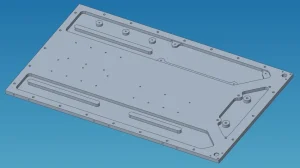
Friction Stir Welded (FSW) Cold Plates
The gold standard for large-area DC fast charging cabinets, ensuring a solid-state, zero-porosity weld capable of withstanding high system pressures.
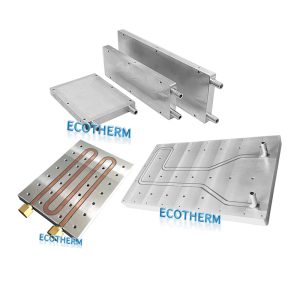
Gun-Drilled & Tube Embedded Cold Plates
Highly reliable and cost-effective solutions for specific fluid routing requirements.
*(We do not manufacture immersion cooling systems; our focus is purely on high-performance direct-to-chip cold plates and heat sinks.)