Passive extrusion feasibility tool
Natural Convection & Vent Area Calculator
Check whether a custom extruded heat sink can reject the heat without a fan, understand the convection/radiation split, and size the lower inlet and upper outlet openings for a vented electronics enclosure.
1Can passive cooling keep the heat-sink base below its limit?
2How much heat leaves by natural convection versus radiation?
3Are the enclosure inlet and outlet vents large enough?
How heat leaves a passive extruded heat sink
Heat source
Buoyant airflowThermal radiationCool air enters low · warm air leaves high
The customer decision
Is a fanless extrusion realistic inside the available envelope?
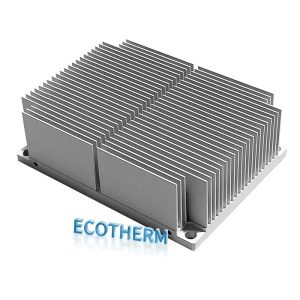
The tool keeps the decision tied to the extrusion and its immediate installation. It estimates passive heat rejection at the mounting-temperature limit and checks whether the enclosure openings support the required buoyant airflow.
Convection: warm air rises along the fin channels; mounting direction and spacing strongly affect performance.
Radiation: surface finish and the view toward cooler surrounding surfaces determine the useful share.
Vents: low inlet and high outlet openings must provide enough free area—not just gross punched area.
Choose the mounting direction
Best passive arrangement: Keep the fin channels vertical and leave clear space below the inlet edge and above the outlet edge. Do not block the channels with horizontal shelves or closely placed components.
Passive extrusion result
Vertical channels · vented enclosure
Passive capacity at temperature limit
—
Natural convection + estimated radiationEstimated equilibrium base temperature
—
Compared with the entered limitRequired gross inlet opening
—
At entered grille free-area ratioRequired gross outlet opening
—
Equal inlet/outlet design assumption—
—
Heat-rejection split at predicted base temperature— W
Natural convection: —Radiation: —
Opening check—
Inlet —
Outlet —
Available stack airflow—
Required convective airflow—
Vent heat-carrying capacity—
Individual fin efficiency—
Effective cooling area—
Clear fin spacing—
Natural convection h—
Radiation h equivalent—
Rayleigh number—
Estimated passive Rθ—
Capacity margin—
Extrusion design boundary: this is a concept estimate for a straight-fin aluminum extrusion. It does not calculate heat-source spreading, TIM/contact resistance, enclosure-wall temperature, solar load, wind, recirculation, neighboring components or transient heating. Complex enclosures need thermal simulation or prototype testing.
If the passive concept is close to the limit, share the heat-source drawing, available extrusion envelope, mounting orientation, enclosure vent layout and surface-finish requirement. Ecotherm can review extrusion feasibility and propose a custom profile without extending the recommendation beyond the actual heat-sink scope.