
Custom Solar Inverter Heat Sinks & Liquid Cold Plates for PV Power Systems
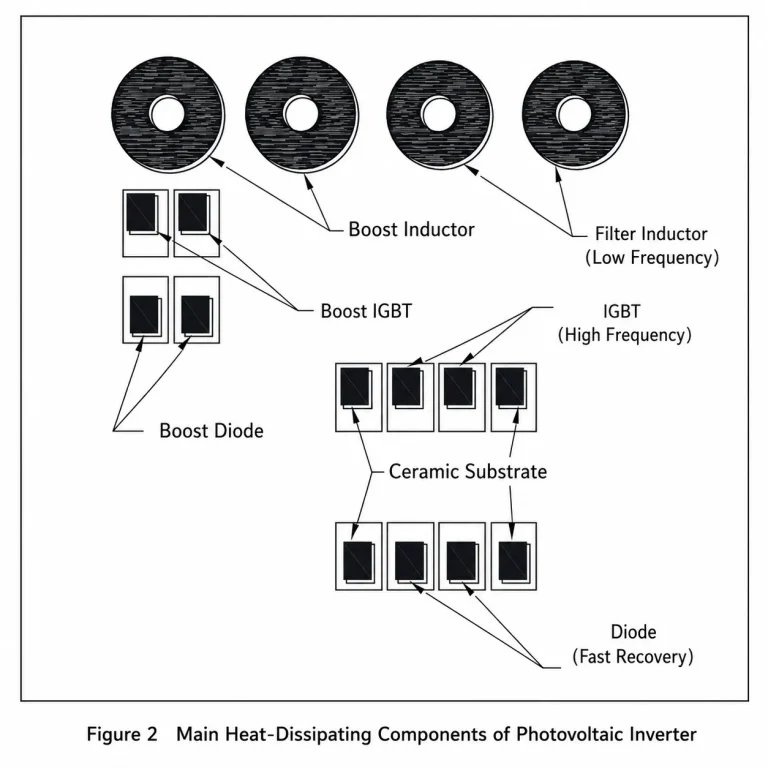
Solar inverters are the heart of photovoltaic (PV) power and energy storage systems, responsible for converting DC power into grid-ready AC power. During this conversion, power components—such as IGBT modules, SiC MOSFETs, and magnetic inductors—generate significant heat, typically converting 1% to 1.5% of the total rated power into thermal loss.
As inverter topologies evolve to support higher switching frequencies and smaller footprints, thermal management must adapt. Ecotherm manufactures high-performance custom solar inverter heat sinks and liquid cold plates designed to maintain optimal junction temperatures, prevent power derating, and ensure long-term reliability in harsh outdoor environments.
| Component Name | Loss / W | Qty per Unit / pcs | Total Loss / W |
|---|---|---|---|
| Boost IGBT | 15.370 | 2 | 30.740 |
| Boost Diode | 3.600 | 2 | 7.200 |
| Inverter High-Frequency IGBT | 15.770 | 4 | 63.080 |
| Inverter Low-Frequency IGBT | 5.800 | 2 | 11.600 |
| Inverter Diode | 7.300 | 2 | 14.600 |
| Boost Inductor | 6.775 | 2 | 13.550 |
| Inverter Inductor | 8.380 | 2 | 16.760 |
| Bus Capacitor | 0.900 | 10 | 9.000 |
| Input EMC Inductor | 0.990 | 1 | 0.990 |
| Output EMI Inductor | 0.932 | 1 | 0.932 |
| SPS Transformer | 5.600 | 1 | 5.600 |
| Relay | 1.500 | 4 | 6.000 |
| Sensor | 0.674 | 1 | 0.674 |
| PCB Copper Foil | 6.000 | 1 | 6.000 |
| Other Losses | 3.000 | 1 | 3.000 |
| Total Loss | — | — | 201.160 |
Why Advanced Thermal Management Matters in Solar Inverters
Heat directly dictates the efficiency, output stability, and lifespan of a PV inverter. Most industrial IGBT modules have an absolute maximum junction temperature (Tj) of 150°C. When a heat sink is poorly designed or fails to dissipate heat effectively, the inverter will suffer from several critical issues:
| Thermal Issue | Physical Impact on Inverter Components | System-Level Consequence |
| Elevated IGBT/MOSFET Temperature | Increased RDS(on)} (conduction resistance) and switching losses. | Overall conversion efficiency drops significantly. |
| Over-Temperature Trigger | Internal sensors detect heat buildup exceeding safe thresholds (e.g., >120°C). | Power Derating: A 50kW inverter may automatically limit output to 30kW, or force a complete system shutdown. |
| Capacitor Overheating | Electrolyte evaporates faster under high temperatures. | For every 10°C rise, the lifespan of electrolytic capacitors is halved. |
| High Ambient Temperature (Outdoor) | Reduced thermal delta (Delta T) between the heat sink and ambient air. | Requires larger surface area or liquid cooling to maintain thermal performance. |
| Thermal Cycling | Repeated expansion and contraction of materials. | Solder joint fatigue, thermal interface material (TIM) degradation, and premature module failure. |
Identifying Heat Sources: From H-Bridge to SiC Topologies
A reliable solar inverter cooling strategy begins with mapping the internal heat sources. The thermal architecture must specifically target:
Power Semiconductors (IGBTs & SiC MOSFETs): The primary heat generators. The shift from traditional silicon to Silicon Carbide (SiC) allows for higher power density but pushes local heat fluxes beyond 300 W/cm², making traditional air cooling obsolete for certain high-density designs.
Magnetic Components (Inductors & Transformers): Generate heat through copper loss and core loss.
DC-Link Capacitors: Highly sensitive to ambient heat; they must be isolated from the main semiconductor heat zones.
Solar Inverter Heat Sink vs. Liquid Cold Plate: Engineering Selection
Different PV inverter architectures—ranging from residential string inverters to utility-scale central and Energy Storage System (ESS) inverters—require distinct cooling boundaries.
| Cooling Technology | Best Fit Application | Engineering Advantages | Design Limitations |
| Extruded Aluminum Heat Sink | Low-power string inverters (<50kW) | Highly cost-effective, seamless structural integrity. | Limited fin aspect ratio; cannot handle extreme heat fluxes. |
| Skived Fin Heat Sink | Medium-power commercial PV inverters | Ultra-thin fins, high fin density, superior air-side heat transfer without interfacial thermal resistance. | Requires forced air; fins are delicate and require careful handling. |
| Heat Pipe Assisted Heat Sink | Multi-source string inverters | Excellent for spreading heat away from concentrated IGBT hotspots to a larger fin area. | Orientation-dependent (gravity effect); Qmax limits must be carefully calculated. |
| Liquid Cold Plate (D2C) | High-power Central Inverters & PCS (>100kW) | Handles heat fluxes >300 W/cm²; highly compact; completely isolates the cooling loop from external dust. | Requires a coolant loop (pump, manifold, heat exchanger); necessitates strict leak testing. |
Custom Manufacturing Capabilities for Inverter Cooling
Ecotherm does not just assemble; we manufacture from the ground up. Depending on your thermal simulation results and cost targets, we utilize advanced metallurgical joining and CNC machining processes:
Vacuum Brazing: Ideal for complex micro-channel liquid cold plates. Offers flux-free, high-strength joints critical for preventing leaks in high-power central inverters.
Friction Stir Welding (FSW): The industry standard for large-format aluminum cold plates used in ESS and utility-scale solar inverters. FSW provides exceptional structural rigidity and leak-proof performance without melting the base metal.
Gun-Drilled Cold Plates: Deep-hole drilling creates straight internal coolant channels within a solid aluminum block, eliminating the need for complex welding and maximizing pressure resistance.
Tube Embedded Cold Plates: A highly cost-effective solution for medium-power applications, integrating copper or stainless steel tubes into an aluminum base via mechanical pressing or thermal epoxy.
Design for Manufacturability (DFM): RFQ Checklist
To ensure a rapid and accurate quotation for your custom PV inverter heat sink, our engineers require specific operational data. Please prepare the following parameters when submitting your RFQ:
| Cooling Technology | Best Fit Application | Engineering Advantages | Design Limitations |
| Extruded Aluminum Heat Sink | Low-power string inverters (<50kW) | Highly cost-effective, seamless structural integrity. | Limited fin aspect ratio; cannot handle extreme heat fluxes. |
| Skived Fin Heat Sink | Medium-power commercial PV inverters | Ultra-thin fins, high fin density, superior air-side heat transfer without interfacial thermal resistance. | Requires forced air; fins are delicate and require careful handling. |
| Heat Pipe Assisted Heat Sink | Multi-source string inverters | Excellent for spreading heat away from concentrated IGBT hotspots to a larger fin area. | Orientation-dependent (gravity effect); Qmax limits must be carefully calculated. |
| Liquid Cold Plate (D2C) | High-power Central Inverters & PCS (>100kW) | Handles heat fluxes >300 W/cm²; highly compact; completely isolates the cooling loop from external dust. | Requires a coolant loop (pump, manifold, heat exchanger); necessitates strict leak testing. |
Overcoming Outdoor Environmental Challenges
Solar inverters are deployed in deserts, coastal regions, and high-altitude environments. A thermal solution must survive more than just heat. Ecotherm factors in structural resilience against:
Corrosion & Salt Spray: Applying specialized anodizing or passivation treatments to prevent degradation in coastal solar farms.
Dust & Sand: Designing fin pitches that prevent clogging and maintain aerodynamic efficiency.
Thermal Fatigue: Ensuring CTE (Coefficient of Thermal Expansion) matching between power modules and the heat sink to prevent TIM pump-out over years of thermal cycling.
Ready to Optimize Your Inverter Thermal Design?
Whether you are upgrading an air-cooled string inverter or designing a next-generation SiC liquid-cooled central inverter, the right thermal architecture is your competitive edge.
Send us your drawings, heat loads, and application conditions today. The Ecotherm engineering team will provide immediate DFM feedback, thermal optimization suggestions, and a precise custom manufacturing quotation.