How Vapor Chamber Cooling Improves Heat Spreading in Compact Electronics
Compact electronics often struggle with heat buildup, which can reduce performance, shorten product life, and limit design options. Vapor chamber cooling provides an effective way to spread heat quickly across a larger area, helping devices stay cooler and operate more reliably. This article explains how this technology improves heat management in small, high-power devices from Ecothermgroup.
Takeaway
- Use vapor chambers when a device has a tight thermal footprint and needs heat moved quickly away from a localized hotspot.
- Apply vapor chamber cooling to spread heat across a larger surface, improve temperature uniformity, and reduce peak component temperatures.
- Treat compact electronics as high-risk for thermal bottlenecks because limited space restricts airflow and leaves little room for large heatsinks.
- Choose vapor chambers over heat pipes when you need two-dimensional heat spreading rather than mainly one-dimensional heat transfer.
- Match the cooling strategy to the device layout: vapor chambers are especially useful in smartphones, laptops, tablets, and other space-constrained products.
- Expect better performance and reliability when heat is distributed more evenly, since lower hotspot intensity helps protect sensitive components.
- Design for integration early, because vapor chamber effectiveness depends on how well it couples to the heat source and the overall enclosure.
Vapor Chamber Basics
Vapor chamber cooling is a compact way to spread heat quickly inside small devices. It is used in thin laptops, smartphones, AI server cooling modules, GPU cooling plates, ASIC cooling stacks, telecom equipment cooling, and 5G thermal management systems where space is tight but heat density is high. In these products, the goal is not only to cool a chip, but also to move heat away from one small hot spot before it causes thermal throttling or uneven performance.
Unlike a simple metal plate, a vapor chamber heat spreader uses two-phase cooling and phase change cooling to move energy laterally. This is why it is also called a planar heat pipe. In many compact electronics, the chamber helps flatten temperature peaks so the outer heatsink, chassis, or fan system can work more effectively. Ecothermgroup often designs a custom vapor chamber or custom vapor chamber heat sink for applications where thickness and heat flux are both major limits.
How It Works
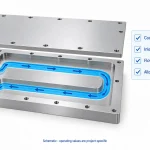
Inside the sealed chamber, a small amount of working fluid absorbs heat at the source, evaporates, and travels across the flat cavity. When the vapor reaches a cooler zone, it condenses and releases that heat, then the liquid returns by capillary action. This cycle can spread heat much more evenly than a standard flat metal spreader, especially in high heat flux electronics such as power electronics cooling, LED thermal management, optical module cooling, and laser cooling.
Industry users often choose vapor chamber cooling because it supports sustained performance in thin devices where airflow is limited. For example, modern phones and gaming notebooks use it to reduce hotspot temperatures under heavy app loads, while industrial electronics cooling systems use it to protect sensitive boards from local thermal stress. A good thermal interface is critical; poor contact can block the benefit even when the chamber itself is well made.
Key Parts
| Part | Role |
|---|---|
| Sealed shell | Holds the working fluid and vacuum |
| Wick structure | Returns liquid to the heat source |
| Working fluid | Evaporates and condenses to move heat |
| Contact surface | Connects to the chip or chassis |
For compact electronics cooling, these parts must work as one system. A vapor chamber thermal solution does not remove heat by itself; it must pass heat to fins, a fan, or the device frame. That is why designers compare a vapor chamber cooling plate with a flat heat pipe or a traditional vapor chamber heat sink before choosing the final layout.
Heat Spreading vs Heat Moving
The main value of a vapor chamber is heat spreading, not long-distance heat moving. A flat heat pipe can send heat along one direction, but a vapor chamber spreads it across a wider area, which is better for large chips, AI server cooling, and GPU cooling boards. This wider spread helps lower peak temperature and gives the rest of the cooling system more time to reject heat.
- Use heat spreading when one chip creates a tight hotspot.
- Use heat moving when the source and sink are far apart.
- Choose a vapor chamber when both thickness and surface area are limited.
In practice, the best design depends on the device layout, airflow, and contact quality. For 5G thermal management and telecom equipment cooling, a properly tuned vapor chamber often gives more even temperatures than a simple metal plate. But for best results, engineers should verify flatness, mounting pressure, and downstream heat rejection before final production.
Why Compact Electronics Need Better Cooling
Compact electronics now pack more power into less space, so heat builds faster than many designs can remove it. In thin laptops, phones, and edge devices, that challenge is even sharper because there is little room for large fans or thick metal heat sinks. This is why vapor chamber cooling has become a common choice in compact electronics cooling: it spreads heat sideways instead of letting one small chip area overheat.
Industry testing and product design trends show the same pattern in many high heat flux electronics. Flagship smartphones with gaming and AI features, thin-and-light notebooks, and small servers all need better heat spreading to avoid thermal throttling. Ecothermgroup and other thermal solution makers often combine a vapor chamber heat spreader with chassis metal or a flat heat pipe to support steadier temperatures under load.
Rising Power Density
Power density keeps climbing because more compute is moving into smaller products. AI server cooling, GPU cooling, and ASIC cooling all face this issue, but the same trend also affects telecom equipment cooling, 5G thermal management, and optical module cooling. When a device has more watts per square centimeter, a normal heat sink may not spread the heat fast enough. A vapor chamber thermal solution helps because it uses two-phase cooling and phase change cooling to move energy across a wider area.
Compared with a flat heat pipe, a vapor chamber heat sink works in two dimensions, so it can feed heat to more of the cooling surface. That is useful in laser cooling, industrial electronics cooling, and power electronics cooling, where space is tight and heat loads rise quickly. In practice, engineers often choose a custom vapor chamber or custom vapor chamber heat sink when they need a better fit for a narrow board or a thin housing.
| Design challenge | Why it matters | Vapor chamber benefit |
|---|---|---|
| High power in a small area | Heat builds up faster than it can escape | Spreads heat laterally to reduce peak temperature |
| Limited airflow space | Fans and vents may be too small | Improves downstream cooling efficiency |
| Thin product design | Less room for large thermal parts | Fits as a slim vapor chamber heat spreader |
Hotspots in Small Devices
Hotspots are one of the biggest thermal risks in compact electronics. A single processor, RF section, or power stage can create a local hot zone that raises surface temperature and stresses nearby parts. In smartphones, the same issue can affect gaming, camera use, and AI tasks; in laptops, it can change CPU and GPU boost behavior. Vapor chamber cooling helps by moving heat away from the hotspot before it concentrates in one place.
Common best practice is to pair the vapor chamber with other conductors, such as a metal frame or a flat heat pipe, so the whole device shares the load more evenly. This is especially helpful in LED thermal management and compact electronics cooling, where small temperature differences can reduce life and performance. Thermal design should always match the device’s real power profile, because an undersized cooling part can still allow overheating.
Effects on Performance
When heat is not spread well, devices often lower speed to protect themselves. That is why users of high-end phones and thin laptops often notice slower sustained performance after a few minutes of heavy work. Better heat spreading through vapor chamber cooling reduces thermal throttling and helps devices hold boost levels for longer periods.
Common user feedback across consumer devices is simple: lower surface temperature, less fan noise, and more stable performance matter most. For engineers, the main benefit is predictable thermal behavior, which supports reliability in 5G thermal management, AI server cooling, and optical module cooling. Compact electronics need better cooling not just to stay safe, but to keep real-world performance stable.
- Lower hotspot temperature
- Less throttling under sustained load
- Better use of limited space
- More even heat spread across the chassis
How Vapor Chamber Cooling Spreads Heat
Vapor chamber cooling works by turning a small hot spot into a much larger heat source that the rest of the cooling stack can handle. In compact electronics, that matters because phones, thin laptops, AI server cooling modules, and GPU cooling packages often deal with high heat flux electronics in a very small space. Compared with a solid plate or even a flat heat pipe, a vapor chamber heat spreader moves energy sideways first, then passes it to fins, frames, or other cooling parts. This is why Ecothermgroup and other thermal designers often use a vapor chamber thermal solution when simple conduction is no longer enough.
Lateral Heat Flow
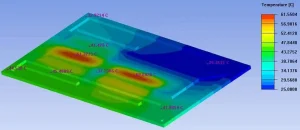
The main advantage of vapor chamber cooling is lateral heat flow. Heat at the chipset causes the working fluid to evaporate, the vapor moves across the chamber, and then it condenses in cooler areas. This two-phase cooling path spreads heat over a wider area than a planar heat pipe, which is usually better suited to one-direction transfer. In modern smartphones, gaming laptops, ASIC cooling, and telecom equipment cooling, that wider spread helps reduce local overload at the chip edge and improves compact electronics cooling.
| Design choice | Typical effect on heat spreading |
|---|---|
| Flat heat pipe | Good for moving heat along one path |
| Vapor chamber heat sink | Better for spreading heat in two dimensions |
| Custom vapor chamber | Useful when layout, thickness, or mounting space is tight |
In practice, wick structure is critical because it returns liquid to the hot zone. Thin devices usually require a careful balance between chamber thickness, capillary strength, and reliability. That is why custom vapor chamber heat sink designs are common in 5G thermal management, LED thermal management, optical module cooling, laser cooling, and industrial electronics cooling, where the layout is fixed and heat must be spread quickly.
Faster Surface Distribution
Once the heat is spread laterally, the surface temperature becomes more even. This faster surface distribution helps the next stage, such as a fin stack or chassis wall, remove energy with less stress. For GPU cooling and power electronics cooling, that can support more stable boost behavior and reduce thermal throttling during heavy workloads. User feedback across laptops and mobile devices often points to the same result: better sustained performance, less abrupt fan ramping, and fewer hot corners.
- Best results come when the chamber covers the full hotspot area.
- Integration space should be checked early, especially in slim enclosures.
- Orientation and wick return performance should be reviewed for real use cases.
Lower Peak Temperatures
Lower peak temperatures are often the most visible benefit of vapor chamber cooling. By moving heat away from one small point, the chamber reduces the chance of a damaging hotspot on the die or package. In high-power devices such as AI server cooling boards, ASIC cooling platforms, and telecom equipment cooling systems, that can improve stability and protect nearby parts. Industry practice also shows that phase change cooling works best when paired with a well-matched sink and airflow path, not used as a stand-alone fix.
For teams choosing a vapor chamber thermal solution, the main rule is simple: match the chamber size, wick design, and stack height to the actual heat map. That is the most reliable way to improve heat spreading without overpromising performance.
Vapor Chambers vs Heat Pipes
In compact electronics, vapor chamber cooling is often the better choice when the main challenge is not only moving heat, but spreading it evenly across a small chassis. A vapor chamber works like a flat, two-dimensional heat pipe, so it can pull heat away from a small hot spot and distribute it across a wider area. This is why it is common in slim smartphones, thin laptops, and tablets that face rising power density from faster chipsets, AI workloads, and gaming loads.
Traditional heat pipes are still useful, but they usually move heat in one primary direction. That makes them strong in point-to-point transfer, while a vapor chamber heat sink is better when a processor, memory package, or power stage needs broader in-plane spreading. In practice, this difference matters in AI server cooling, GPU cooling, ASIC cooling, and power electronics cooling, where local hot spots can quickly reduce performance if the heat is not spread effectively.
Design Differences
The core difference is geometry. A flat heat pipe or planar heat pipe is designed to carry heat along a preferred path. A vapor chamber uses a larger sealed cavity, internal wick structure, and phase change cooling to move vapor and liquid in multiple directions. For custom vapor chamber projects, Ecothermgroup often treats wick design, fill ratio, and vapor flow limit as the key engineering points, because poor design can lead to dry-out under high heat flux electronics.
| Feature | Vapor Chamber | Heat Pipe |
|---|---|---|
| Heat flow | Two-dimensional spreading | Mostly linear transfer |
| Best strength | Lower spreading resistance | Fast transport over distance |
| Fit in compact electronics | Excellent for wide hot spots | Good for narrow layouts |
| Design complexity | Higher | Lower |
This is why vapor chamber cooling usually costs more and requires tighter manufacturing control, but it also provides a stronger thermal solution when a board has little space for solid copper to do the job alone. For 5G thermal management, optical module cooling, and LED thermal management, the ability to flatten temperature peaks is often more valuable than simple one-way heat travel.
Performance in Thin Devices
In thin devices, the main benefit is a lower hotspot temperature. Reviews of modern flagships and thin-and-light laptops commonly note better sustained performance, less thermal throttling, and more stable boost behavior when a vapor chamber is used instead of small heat pipes alone. That matches the general engineering view: when thickness is limited, a vapor chamber heat spreader can cover more of the available footprint and reduce temperature variation across the surface.
There is still a trade-off. A vapor chamber needs enough internal area to work well, and the package must stay within its vapor and liquid transport limits. In very tight spaces, a heat pipe may be simpler and cheaper, especially if the heat source is narrow. The common rule is straightforward: if you need spreading, choose a chamber; if you need transport along a route, choose a pipe.
- Use a vapor chamber for broad chip packages and mixed heat sources.
- Use a heat pipe for long, narrow thermal paths.
- Check thickness, cost, and assembly limits before final design.
Best Use Cases
Vapor chamber cooling is often the better choice for compact electronics with large local heat loads, such as AI server cooling, GPU cooling, ASIC cooling, telecom equipment cooling, and industrial electronics cooling. It is also strong in custom vapor chamber heat sink designs for tablets, gaming phones, and slim notebooks where the goal is to spread heat before it reaches the case surface.
Heat pipes remain a strong option for simpler layouts, especially in laser cooling subsystems, some power electronics cooling modules, and smaller devices with one main hot spot. For system designers, the best approach is to match the thermal path to the problem: choose vapor chamber cooling for broad spreading, and choose a heat pipe for directional transport. That balance gives compact electronics better temperature control without overdesigning the cooling stack.
Device Applications and Benefits
Vapor chamber cooling is used most often where compact electronics must handle high heat flux without adding bulky cooling parts. In premium smartphones and tablets, the chamber spreads heat laterally across a wider area, which helps keep the display side, frame, and battery zone more uniform during gaming or AI use. This matters because modern mobile chipsets, camera processors, and radios can create short heat spikes that a simple metal plate cannot move away fast enough.
The same logic applies in laptops and gaming hardware. Thin-and-light notebooks and slim gaming systems use a vapor chamber heat sink or vapor chamber heat spreader to reduce hotspot temperatures around the CPU and GPU, so boost clocks stay steadier for longer. Industry testing and user feedback on performance devices often point to the same result: lower surface heat near the chip and less thermal throttling during long sessions, especially when the chassis also has a clear path to release heat through vents or fins.
| Device Type | Main Benefit | Why It Fits |
|---|---|---|
| Smartphones and tablets | Better thermal balance | Small boards need wide heat spreading near dense chipsets |
| Laptops and gaming hardware | Higher sustained performance | CPU and GPU heat can be spread across more chassis area |
| AI server cooling and telecom equipment cooling | Stable operation under load | Dense electronics need fast lateral transfer from hot spots |
Designers also use vapor chamber cooling in ASIC cooling, 5G thermal management, laser cooling, industrial electronics cooling, power electronics cooling, LED thermal management, and optical module cooling when heat sources sit close together. A custom vapor chamber or custom vapor chamber heat sink is often chosen when a standard flat heat pipe or planar heat pipe cannot match the footprint, thickness, or mounting points. In these cases, a two-phase cooling or phase change cooling design gives better spreading than a single narrow heat path.
- Use it when heat comes from one dense area.
- Pair it with good chassis contact and airflow.
- Choose custom parts when space and mounting limits are tight.
Future compact electronics will likely use vapor chamber thermal solution designs more often as power density rises. The main gain is not just lower peak temperature, but more even temperature across the device, which supports longer component life and a smoother user experience. Ecothermgroup and similar suppliers focus on this balance because compact electronics cooling must solve heat flow without adding too much thickness, cost, or assembly complexity. For best results, the chamber should be treated as part of the full thermal path, not as a standalone fix.
Safety note: the chamber only helps when the whole system is designed correctly. Poor contact, weak external heat removal, or unrealistic thickness limits can reduce performance, so thermal validation remains necessary before mass production.
People Also Ask
What does a vapor chamber do in compact electronics?
A vapor chamber spreads heat laterally across a larger area, helping a device move heat away from a hotspot more quickly. In thin phones, laptops, and tablets, that wider heat distribution helps components run more consistently without excessive local temperature buildup.
Why are smartphones and laptops increasingly using vapor chambers?
As chip performance and power density rise, compact devices need better ways to manage heat without adding bulk. Vapor chamber cooling helps reduce thermal throttling, support sustained performance, and keep slim devices within tighter thermal limits.
How is vapor chamber cooling different from a heat pipe?
A heat pipe moves heat along a more linear path, while a vapor chamber spreads heat in two dimensions across a broad surface. That makes vapor chambers especially useful when a device needs to distribute heat evenly across a cramped internal layout.
What are the main benefits of vapor chambers in modern devices?
They lower hotspot temperatures, improve heat spreading, and help processors maintain boost behavior for longer periods. That is why they are common in flagship smartphones, thin-and-light laptops, gaming notebooks, and other slim electronics with high thermal loads.
How does vapor chamber cooling work?
Inside the chamber, a working fluid evaporates at the hot spot, moves through the sealed cavity as vapor, then condenses in cooler areas and returns by capillary action. This cycle transfers heat efficiently across the chamber surface and smooths out temperature differences.
Does vapor chamber cooling completely eliminate overheating?
No. It improves heat spreading and reduces local hotspots, but a device still depends on the rest of its thermal design, including the chassis, airflow, and overall power management. It is a major part of cooling, not a complete substitute for system-level thermal engineering.
Are vapor chambers better for thin devices than traditional cooling solutions?
They are often a strong fit for thin devices because they can move heat across a wider area without requiring a tall cooling stack. That makes them useful when the design needs low-profile hardware but still has to handle dense, sustained heat from modern chips.
What kinds of compact electronics benefit most from vapor chamber cooling?
Smartphones, tablets, thin laptops, gaming notebooks, and other tightly packed consumer electronics benefit most when heat sources sit close together. These devices see the biggest gains when vapor chamber cooling helps spread heat away from concentrated chip and component hotspots.