Custom Liquid Cold Plates: CNC Deep-Hole Drilling Guide
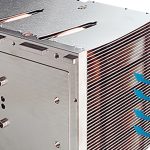
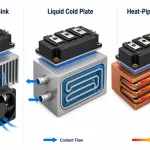
Managing Thermal Design Power (TDP) in excess of 3000W for industrial power electronics requires a highly robust thermal management infrastructure. While air-cooled solutions, such as large-scale skived fin heat sinks (manufactured up to 3 meters in length), provide excellent convection cooling, extreme localized heat fluxes necessitate the integration of custom liquid cold plates. The thermodynamic efficiency of these liquid-cooled modules depends entirely on the precision of their internal fluid channels.

Structural Integrity in Monolithic Cold Plates
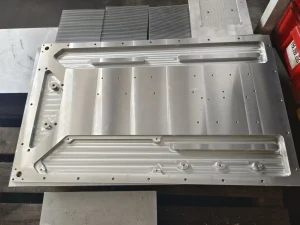
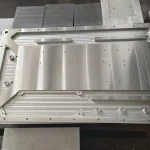
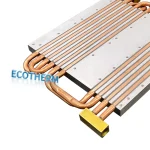
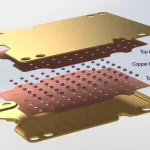
Industrial applications prioritizing long-term reliability often utilize monolithic liquid cold plates. This design involves machining continuous coolant paths directly into solid aluminum or copper substrates, effectively avoiding the leak risks associated with brazed two-piece assemblies. (Note: These heavy-duty applications utilize internal macro-channel routing rather than immersion liquid cooling configurations).
The primary manufacturing challenge in monolithic designs lies in boring long, straight channels without compromising the internal wall structure. Standard drilling operations introduce severe radial drift when pushed to extended depths. This deflection leads to uneven wall thicknesses, elevated internal surface roughness, and localized fluid pressure drops. These machining defects directly degrade the overall Thermal Resistance (Rth) of the heat sink.
Achieving Precision through Specialized Machining
To maintain strict CNC Machining Tolerances across extended tool paths, the fabrication process requires specialized techniques. To manufacture deep, seamless continuous fluid channels, thermal engineers specify CNC deep-hole drilling. This specific machining process utilizes high-pressure coolant delivered directly through the cutting tool to evacuate metal chips instantaneously, preventing internal galling and minimizing radial run-out.
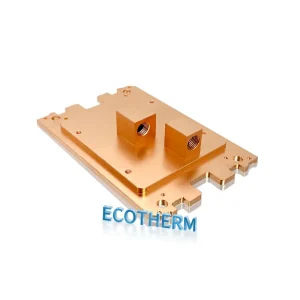
Comparative Machining Metrics for Fluid Channels
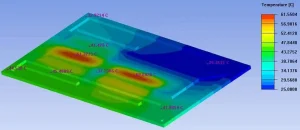
The implementation of specific deep-hole tooling guarantees that internal fluid dynamics match theoretical thermal simulations, ensuring safe operation for high-power components.
| Machining Metric | Standard CNC Drilling | Deep-Hole Drilling Application | Impact on Thermal Performance |
| Depth-to-Diameter (D:d) Ratio | < 15:1 | Up to 100:1 | Enables continuous cooling paths for large-footprint IGBT modules. |
| CNC Machining Tolerance | ± 0.15 mm | ± 0.02 mm | Ensures uniform thermal transfer across the entire contact base. |
| Surface Finish (Ra) | Ra 3.2 – 6.3 | Ra 0.4 – 1.6 | Lowers fluid friction, significantly reducing system pressure |
Conclusion
High-performance custom liquid cold plates demand exact engineering at the manufacturing level. By utilizing advanced CNC machining capabilities to control internal fluid channel geometry, industrial thermal management systems can achieve lower Thermal Resistance and support higher TDP requirements with absolute reliability.