Double-Sided Cooled IGBT Modules for Higher Power Density
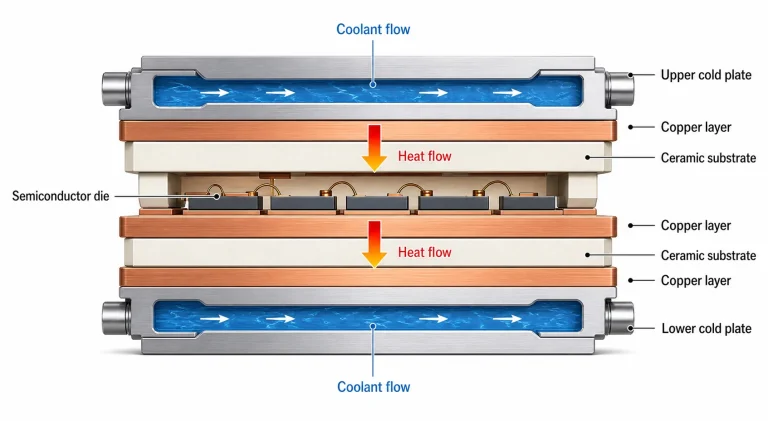
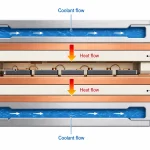
As inverter power density increases, removing heat through only one side of an IGBT module can become a serious limitation. Double-sided cooling provides an additional thermal path, allowing heat to move away from the semiconductor through both the upper and lower surfaces of the package.
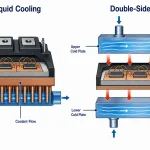
In a traditional module, the die is usually connected to a substrate and baseplate on one side. Heat then travels through the package, thermal interface and external cooling component in a single dominant direction. A double-sided cooled structure distributes the thermal load between two cooling surfaces, reducing the effective thermal resistance between the junction and the cooling system.
How Double-Sided Cooling Works
The upper and lower sides of the semiconductor are connected to electrically and mechanically suitable heat-spreading structures. Depending on the package design, the connections may use soldering, sintering, pressure contact or other interconnection technologies. The cooling components must maintain the required electrical insulation while providing low thermal resistance.
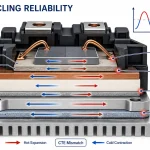
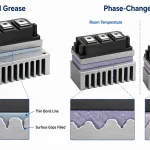
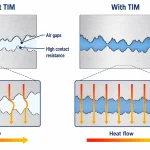
The benefit is greatest when the two cooling paths are reasonably balanced. If one side has much higher contact resistance or poorer coolant access, the package will not achieve the expected improvement. Mechanical flatness, pressure distribution and thermal expansion must therefore be controlled carefully.
Thermal Benefits
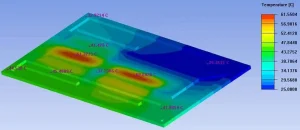
Double-sided cooling can reduce junction-to-coolant thermal resistance and improve temperature uniformity across the semiconductor area. Lower junction temperature can increase the available current margin, reduce thermal stress and support a more compact inverter design.
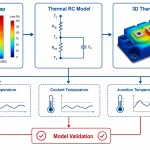
The actual improvement depends on package structure, interface materials, cooling method and assembly pressure. It should be confirmed through thermal simulation and measurement rather than assumed from the package name alone.
Application in Electric Vehicles
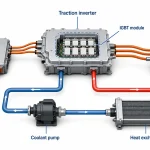
Electric vehicle traction inverters operate under rapidly changing load conditions. Acceleration, regenerative braking and repeated power cycling create demanding thermal transients. A double-sided cooled module can shorten the thermal path and help control the temperature swing experienced by the semiconductor and interconnections.
However, vehicle applications also require strong resistance to vibration, coolant leakage, thermal cycling and manufacturing variation. The thermal design must be integrated with electrical insulation, mechanical packaging and production quality control.
Design Considerations
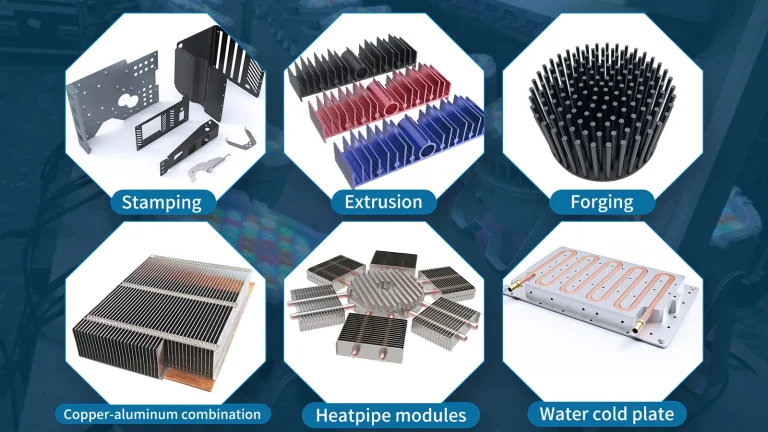
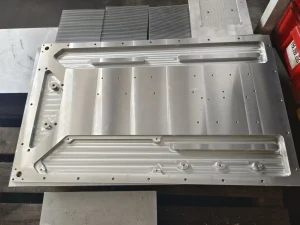
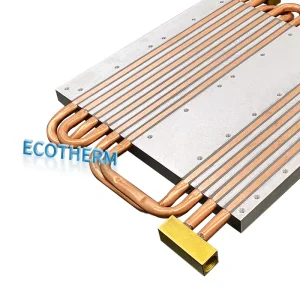
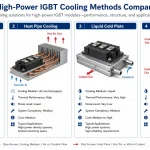
The cooling structure must be designed around the module’s electrical layout, heat distribution and available installation space. Direct liquid cooling, external cold plates and pressure-contact cooling each provide different trade-offs in thermal resistance, manufacturability and serviceability.
Ecothermgroup can support custom cooling components for inverter and power semiconductor applications. The Ecothermgroup thermal management website can be used as the starting point for a project discussion.
FAQ
What is the main advantage of double-sided cooling?
It provides two parallel heat-removal paths, which can reduce effective thermal resistance and improve temperature uniformity.
Is double-sided cooling suitable for every IGBT module?
No. The module package, electrical insulation, mechanical interfaces and cooling architecture must all support the arrangement.
Does double-sided cooling remove the need for a cold plate?
No. It changes the thermal path inside and around the module, but the heat must still be transferred to an appropriately designed air or liquid cooling system.